Gujarat Green Cover Expansion Through Mangrove and Grassland Rest
Source:indianmasterminds ↗
Why It Matters
Important for understanding state-level environmental initiatives, mangrove conservation, and grassland management in Gujarat, which frequently appear in state civil services examinations.
Summary
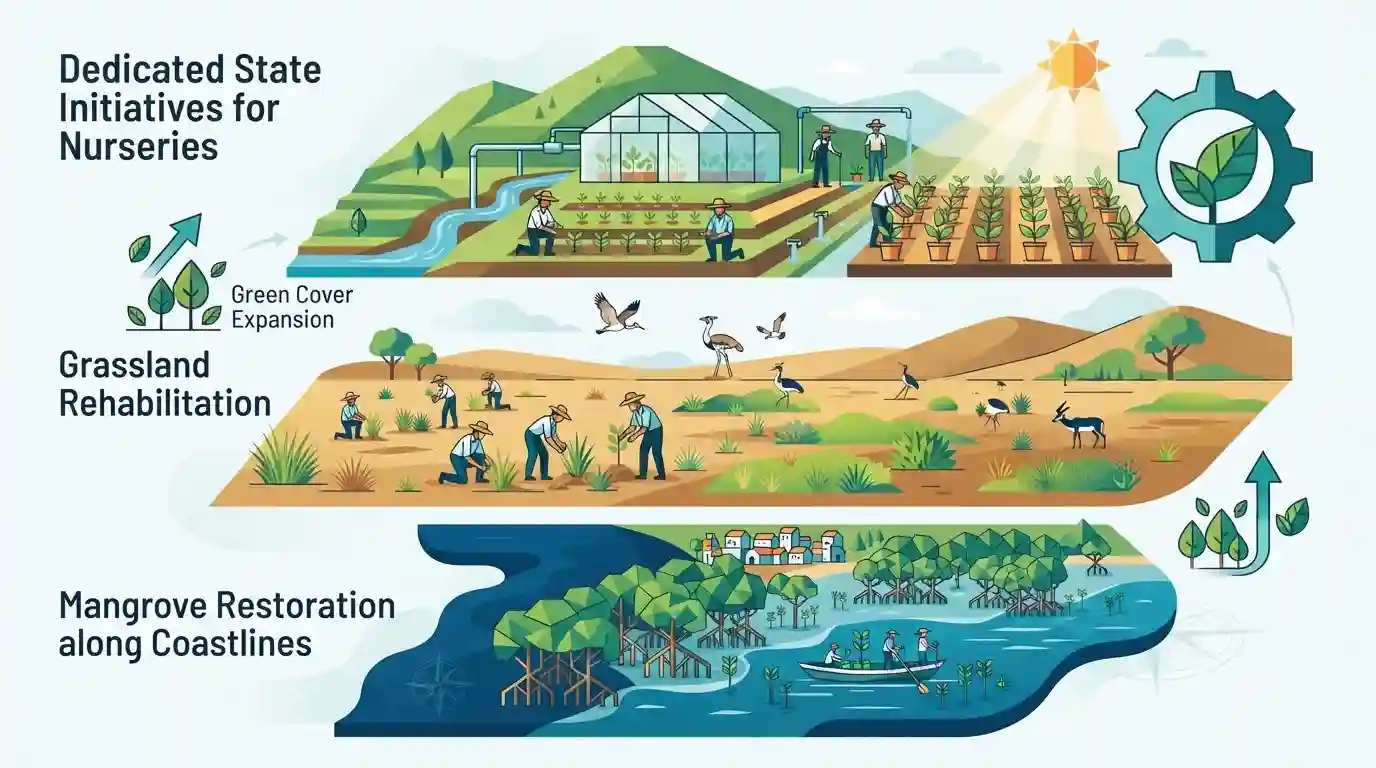
Gujarat is aggressively expanding its green cover through dedicated state initiatives focusing on nurseries, mangrove restoration along coastlines, and grassland rehabilitation to enhance biodiversity and combat environmental challenges.
Key Points
- Gujarat is expanding its green cover significantly through initiatives like nursery development, mangrove restoration, and grassland ecosystem rehabilitation.
- The state aims to boost ecological balance, protect coastal regions via mangrove expansion, and improve biodiversity in arid and semi-arid grasslands.
- Focus is laid on community involvement and scientific afforestation methods to counter climate change and land degradation.
Important Terms
MISHTI Scheme

A central government scheme launched to promote and restore mangrove ecosystems along India's coastline through convergence of funds, where Gujarat has accounted for the vast majority of national implementation.
UPSC context
GPSC Paper 3 / Environment and Ecology: Important government schemes for coastal biodiversity conservation and climate resilience.
Banni Grassland
Asia's largest natural grassland, located in Kutch, Gujarat, facing ecological threats from invasive species like Prosopis juliflora and undergoing community-led restoration and herbivore rewilding.
UPSC context
GPSC Geography & Environment: Biodiversity hotspots, invasive species management, and regional ecosystems of Gujarat.
Gujarat Forest Department
The nodal state agency responsible for implementing afforestation, wildlife protection, riverine landscape management, and green cover expansion initiatives across Gujarat.
UPSC context
GPSC Paper 3 / Polity and Governance: State administrative machinery and environmental policy execution in Gujarat.
Prelims Trap
Gujarat holds the largest mangrove cover in India, second only to the Andaman and Nicobar Islands.
Aspirants often confuse West Bengal as having the second-largest mangrove cover (it has the largest in the Sundarbans), whereas Gujarat holds the second-largest mangrove cover in India.
Static Concepts Connected
What are the key ecological characteristics and distribution of mangroves in India?
- Geographic Share: India accounts for about 3% of the world's mangrove cover, with West Bengal having the largest share followed by Gujarat.
- Ecological Role: Mangroves act as natural bio-shields against cyclones, storm surges, and coastal erosion while supporting high marine biodiversity.
- Adaptations: Pneumatophores (breathing roots) and viviparous germination (seeds germinating on the tree) are key adaptations of mangrove species.
Cross-Topic Patterns
Mangroves + MISHTI Scheme + NDC Targets
Gujarat's 2nd-largest mangrove cover and MISHTI scheme implementation connect coastal ecology with national climate adaptation commitments under India's NDC targets.
Grassland Rehabilitation + Endangered Fauna Conservation
Restoration of arid/semi-arid grasslands in Gujarat directly impacts the natural habitat and migratory corridors of the endangered Greater Florican.

Gujarat's mangrove leadership (MISHTI 85% share) and high-tech nursery afforestation models are high-yield for prelims statements.
Linked PYQs · 2
Linked PYQs · 2
- 2026GPSC_PRELIMSGS1
The 'Great Indian Bustard (GIB)' (Ghorad) is frequently seen in the news in the context of wildlife conservation efforts in western India. Consider the following statements regarding this species: 1. Currently, the highest surviving wild population of the Great Indian Bustard in India is located in the semi-arid grasslands of Gujarat. 2. It is a long-distance migratory bird that travels from Central Asia to the Indian subcontinent to escape harsh winters. Which of the above statement(s) is/are correct?
- 2025GPSC_PRELIMSGS1
In which state was the 'Mahabharata Vatika' featuring 37 plant species mentioned in the 'Mahabharata', set up for plant conservation?
