School Entry Regulations Tightened for Campus Safety in Gujarat
Source:theprint ↗
Why It Matters
This policy initiative by the Gujarat government directly relates to state-level governance, child safety regulations, and institutional security measures in educational frameworks.
Summary
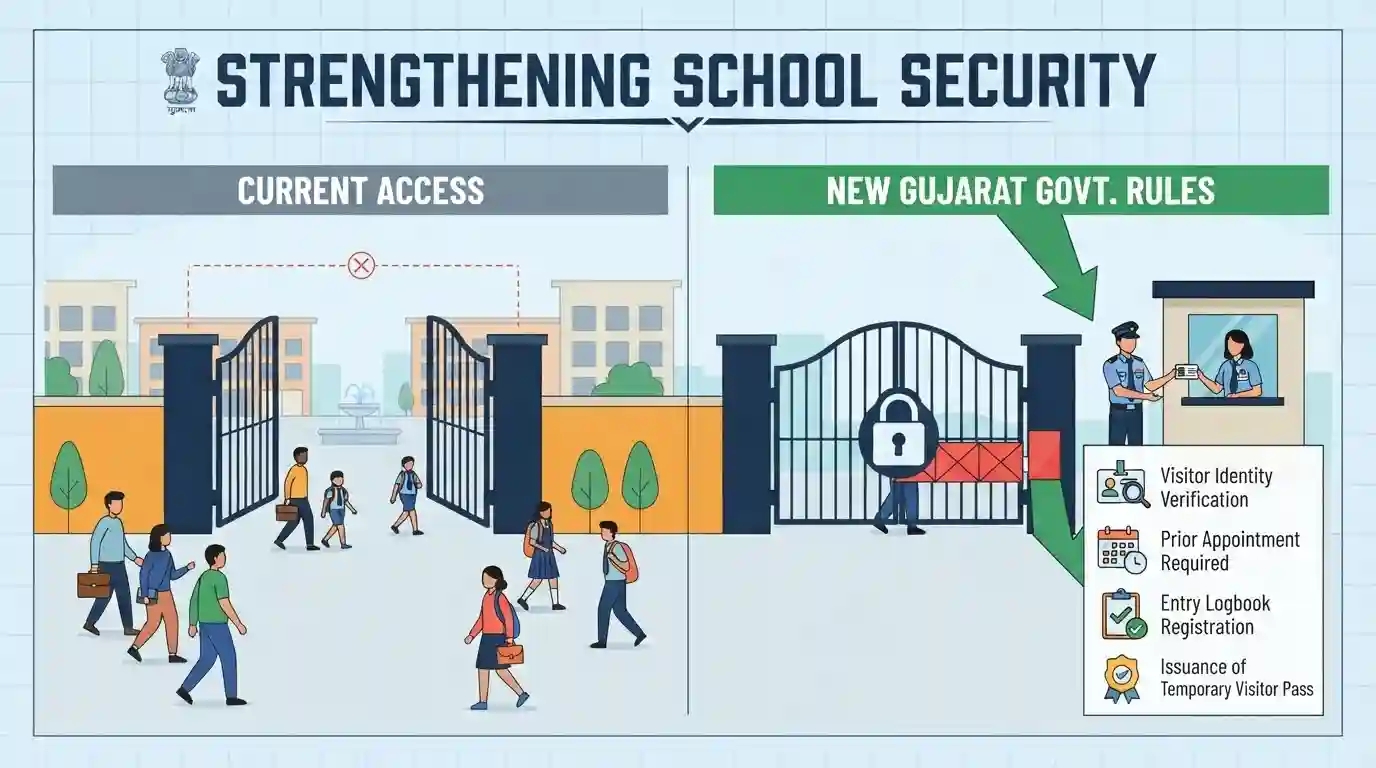
The Gujarat government has introduced stringent school entry rules, restricting outsiders from entering educational institutions without explicit prior permission, aimed at bolstering child safety and campus security.
Key Points
- The Gujarat government has tightened school entry regulations to enhance student safety and security.
- Outsiders, including visitors and unauthorized individuals, are barred from entering school premises without prior formal permission.
- The guidelines aim to prevent untoward incidents and regulate visitor movement during school hours.
Important Terms
Gujarat Government

The executive authority responsible for formulating state-level policies, administering public welfare, and implementing security, governance, and child safety directives across educational institutions in Gujarat.
UPSC context
Important for GPSC Paper II (Governance and State Administration), testing policies on child safety, educational reforms, and administrative governance.
Education Department Gujarat
The state administrative body under the Gujarat government tasked with overseeing school education, establishing academic standards, and implementing safety policies and campus regulations in schools.
UPSC context
Important for GPSC Paper II / State Administration, focusing on educational administration, student welfare policies, and regulatory enforcement.
Prelims Trap
guidelines stem from recommendations of the National Commission for Protection of Child Rights (NCPCR)
Aspirants often assume NCPCR guidelines are legally non-binding advisory opinions, but state-level enforcement through penal and administrative actions gives them mandatory legal standing.
Static Concepts Connected
What are the statutory powers and composition of the National Commission for Protection of Child Rights (NCPCR)?
- Establishment Act: Statutory Body under the Commission for Protection of Child Rights (CPCR) Act, 2005, operationalized in March 2007.
- Nodal Ministry: Functions under the administrative control of the Ministry of Women and Child Development, Government of India.
- Core Mandate: Mandated to examine and review safeguards for child rights, inquire into child rights violations, and recommend remedial measures.
Cross-Topic Patterns
In Loco Parentis & Article 21A Linkage
The legal concept of 'In Loco Parentis' bridges state accountability in public education with fundamental rights under Article 21A, linking child safety mandates directly to constitutional obligations.
NCPCR Mandates & State Administrative Compliance
NCPCR guidelines feed directly into state-level executive governance, showcasing how central statutory bodies mandate operational directives for state administrative machinery.

Expect statements on NCPCR guidelines and 'In Loco Parentis' state liabilities in child safety school entry norms.
Linked PYQs · 3
Linked PYQs · 3
- 2025GPSC_PRELIMSGS1
Which of the following statements is/are correct regarding the G-SAFAL scheme?
- 2024GPSC_PRELIMSGS1
Consider the following statements. 1. The Constitution of India states that Parliament can bring no law that violates the fundamental rights of citizens. 2. Article 20(3) of the Constitution is a fundamental right that guarantees the right against self-incrimination. 3. In the Puttaswamy case, the Supreme Court held that the State can collect fingerprints and iris scan for welfare schemes. Which of the above statements is/are correct?
- 2026GPSC_PRELIMSGS1
With reference to the Uniform Civil Code Bill recently passed by the Gujarat Legislative Assembly, consider the following statements: 1. The Bill provides for compulsory registration of live-in relationships and excludes Scheduled Tribes from its applicability. 2. The Bill grants legal recognition to same-sex marriages and civil unions on par with heterosexual marriages. Which of the above statement(s) is/are correct?
