Gujarat Withdraws Cases Against NEET Protesters
Source:theprint ↗
આ શા માટે મહત્વનું છે
Highlights the executive power of state governments to withdraw criminal prosecutions and reflects on the judicial protection of the fundamental right to peaceful protest (Article 19). Relevant for Polity and Governance sections on fundamental rights and executive-judiciary relations.
સારાંશ
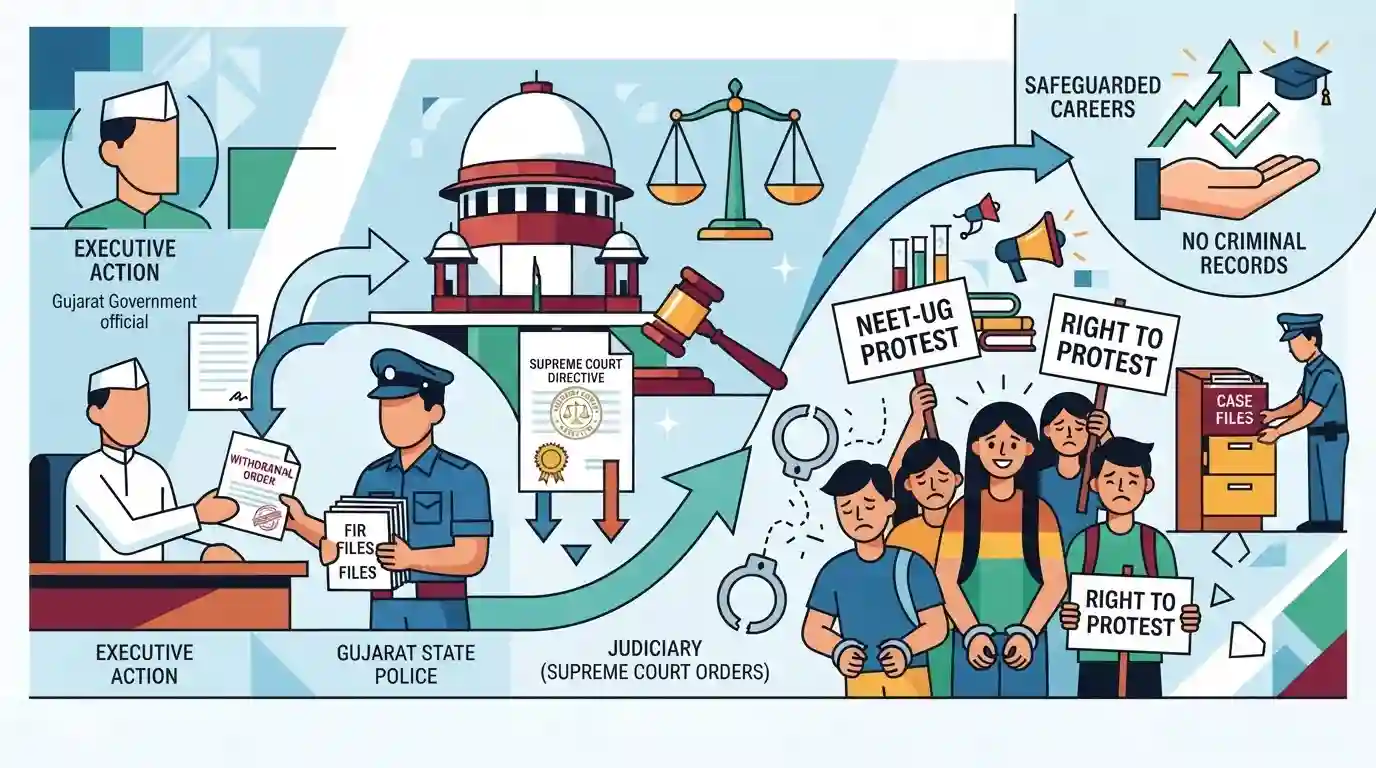
The Gujarat government has instructed state police to withdraw criminal cases filed against students and youths who participated in protests against the NEET-UG paper leak. The move is in compliance with a Supreme Court directive to avoid coercive actions against student protesters. Consequently, the Home Department ordered the closure of FIRs for youths with no prior criminal records, safeguarding their future careers and acknowledging their right to protest.
મુખ્ય મુદ્દા
- The Gujarat government directed state police to withdraw criminal cases against students who participated in protests over the NEET-UG paper leak.
- This decision follows a Supreme Court order restraining the police from taking coercive steps against the student protesters.
- The government clarified that students who had FIRs registered against them without prior criminal antecedents should be relieved from the cases.
- The withdrawal falls within the scope of state government powers regarding criminal prosecutions and upholds the rights of youths participating in democratic protests.
મહત્વપૂર્ણ શબ્દો
Supreme Court of India

The apex judicial body in India, established under Article 124 of the Constitution. It acts as the final interpreter of the Constitution, guardian of fundamental rights, and the highest court of appeal.
UPSC context
GS Paper II (Polity - Judiciary). Tests understanding of judicial review, judicial activism, and separation of powers.
NEET-UG
A standardized national-level competitive entrance examination in India conducted by the National Testing Agency (NTA) for students seeking admission to undergraduate medical, dental, and allied courses.
UPSC context
GS Paper II (Governance - Education). Tests issues concerning public examinations, regulatory frameworks, federal challenges, and institutional accountability.
Section 360 of BNSS (formerly Section 321 CrPC)
A statutory provision enabling a public prosecutor, with the court's consent, to withdraw from the prosecution of any person before the judgment is pronounced, resulting in discharge or acquittal.
UPSC context
GS Paper II (Polity - Criminal Justice). Tests separation of powers, executive discretionary powers, and recent criminal law reforms.
Gujarat Government
The subnational executive authority of Gujarat state, headed constitutionally by the Governor and politically by the Chief Minister, responsible for executing laws and maintaining law and order.
UPSC context
GS Paper II (State Legislature/Executive). Tests the functioning of federalism, public order (State List), and the executive-judicial interface.
NSUI
The National Students' Union of India, established in 1971, is the student wing of the Indian National Congress party, engaging in campus representation and student welfare activism.
UPSC context
GS Paper II (Polity - Pressure Groups). Tests understanding of student unions as pressure groups influencing public policy and democratic participation.
ABVP
The Akhil Bharatiya Vidyarthi Parishad, founded in 1949, is a prominent student organization in India ideologically aligned with the RSS, focusing on campus activism and national reconstruction.
UPSC context
GS Paper II (Polity - Pressure Groups). Tests the role of youth-led political mobilization and non-governmental actors in democratic structures.
પ્રિલિમ્સ ટ્રેપ
State governments possess the absolute executive power to unilaterally withdraw criminal cases against protesters.
Under Section 360 BNSS (formerly 321 CrPC), the Public Prosecutor applies for withdrawal, which mandatorily requires the prior consent of the Court. Executive orders alone cannot close cases.
સંલગ્ન સ્થિર ખ્યાલો
What is the constitutional basis and limitation of the Right to Protest?
- Implicit Right: Implicitly derived from Article 19(1)(a) (speech and expression) and Article 19(1)(b) (peaceful assembly without arms).
- Reasonable Restrictions: Not absolute; subject to Article 19(2) and (3) for sovereignty and integrity of India, or public order.
- Public Spaces Limits: The Supreme Court (Amit Sahni case) ruled that the constitutional right to protest does not permit the indefinite occupation of public ways or spaces.
How is the withdrawal of criminal prosecution executed in India?
- Legal Provision: Governed by Section 360 of the Bharatiya Nagarik Suraksha Sanhita (BNSS), which replaces Section 321 of the CrPC.
- Prosecutor's Role: Only the Public Prosecutor or Assistant Public Prosecutor in charge of the case can formally apply for withdrawal from prosecution.
- Judicial Consent: The withdrawal is not an automatic executive fiat; it strictly requires the prior consent of the presiding Court.
આંતર-વિષય પેટર્ન
Protest Rights vs Statutory Prosecution
The withdrawal highlights the interplay between Article 19 constitutional protections and statutory mechanisms under BNSS requiring judicial oversight for case closure.
Exam leaks & Public Trust Deficit
Frequent paper leaks (NEET/state exams) link to the Public Examinations (Prevention of Unfair Means) Act, 2024, raising governance ethics and systemic accountability issues for Mains GS-2 and GS-4.

Expect a 2026 Prelims multi-statement question combining Article 19's reasonable restrictions with BNSS rules on withdrawal of prosecution.
સંલગ્ન PYQ · 1
સંલગ્ન PYQ · 1
- 2024GPSC_PRELIMSGS1
The fundamental right of "Freedom of speech and expression" has been interpreted by the law courts to include which of the following rights? 1. Right to know about government activities. 2. Freedom of silence. 3. Right to strike 4. Right against imposition of pre-censorship on a newspaper. Select the correct answer code:
