Gujarat Taluka Classification: Decentralized Industrial Investment
Source:business-standard ↗
Why It Matters
Crucial for understanding state-level industrial policy instruments, regional development strategies, and investment promotion frameworks in Gujarat relevant to civil services aspirants.
Summary
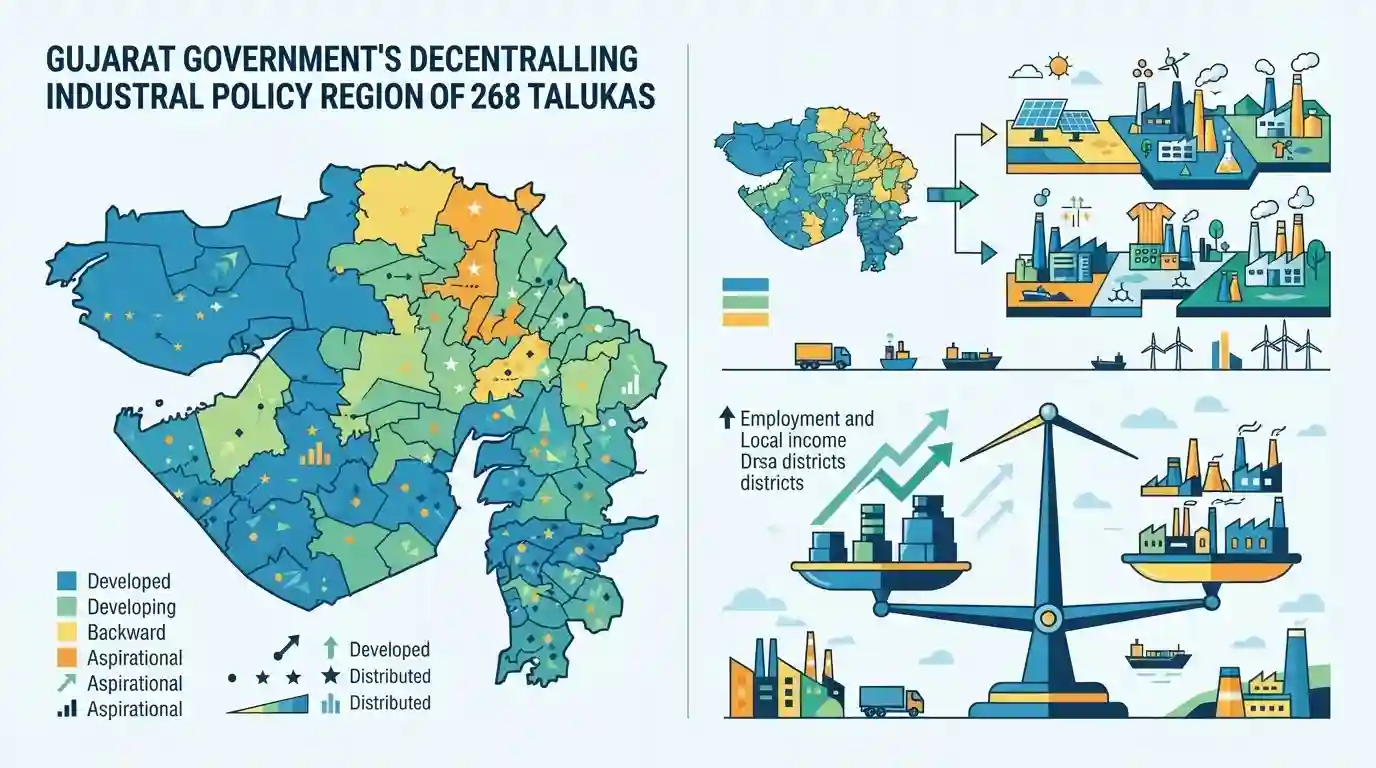
The Gujarat government has classified 268 talukas into distinct categories to incentivize and promote industrial investment evenly across different regions, addressing regional economic imbalances and boosting decentralized manufacturing growth in the state.
Key Points
- The Gujarat government has reclassified 268 talukas across the state into different categories to promote balanced industrial investment and regional growth.
- The classification framework provides customized incentives and benefits to attract industries to developing or backward talukas, reducing regional disparities in industrialization.
- This policy move aligns with Gujarat's broader strategic goals of fostering decentralized economic development, MSME expansion, and manufacturing leadership.
Important Terms
Viksit Gujarat Industrial Policy 2026

A five-year framework launched by the Gujarat government effective June 1, 2026, aimed at fostering decentralized manufacturing, sustainability, and balanced regional industrial development.
UPSC context
Relevant for GPSC General Studies (Economy of Gujarat and Industrial Policy), testing knowledge of state-led economic decentralization and investment frameworks.
Taluka Classification for Industrial Investment
The division of Gujarat's talukas into Category A (less developed) and Category B (established/developing) to provide tiered financial incentives and curb regional economic imbalances.
UPSC context
Crucial for GPSC Paper III (Economic Development of Gujarat), testing candidates' understanding of regional disparities and policy measures for backward areas.
Static Concepts Connected
What are the key instruments of regional industrial policy in India and Gujarat?
- Taluka Classification: Gujarat classifies talukas based on socio-economic backwardness indices to channel higher subsidies to Category A regions.
- Fiscal Incentives: Instruments include capital investment subsidies, interest subsidies, electricity duty exemptions, and stamp duty concessions.
- Objective: Backward area development aims to curb urban migration and balance regional gross state domestic product (GSDP).
Cross-Topic Patterns
Decentralized Industrial Growth & Cooperative Federalism
Gujarat's taluka-level incentives connect regional economic policy with cooperative federalism and the 73rd/74th Constitutional Amendments promoting decentralized rural-urban planning.
Fiscal Federalism & Regional Disparity Correction
Industrial classification policies link directly to the 14th Finance Commission horizontal devolution criteria that reward fiscal effort and backwardness correction.

Gujarat's taluka classification (Category A vs B) for industrial incentives is prime for matching-type prelims questions.
Linked PYQs · 3
Linked PYQs · 3
- 2025GPSC_PRELIMSGS1
Which of the following statements are correct regarding the economy of Gujarat according to the Socio-Economic Review, 2024-2025 of Gujarat? 1. Gujarat has consistently contributed over 8% to India's GST collections, highlighting its economic vitality and strength. 2. During the year 2022-23, Gujarat stood first in handling total cargo among the states of India. 3. According to the results of Annual Survey of Industries (ASI) 2022-23, Gujarat is first in the country in Industrial Production and Fixed Capital.
- 2025GPSC_PRELIMSGS1
According to the Socio-Economic Review, 2024-2025 of Gujarat, Gujarat comes in ______ category in Logistic Ease Across Different States (LEADS), 2024.
- 2025GPSC_PRELIMSGS1
______ is one of the cities chosen by the NITI Aayog for its Growth Hub (G-HUB) programme to boost their economic growth.
