Gujarat Bans Non Standard Analogue Dairy Products
Source:ians ↗
Why It Matters
Illustrates state-level enforcement of food safety regulations to combat adulteration and substitution, emphasizing the intersection of public health governance and the protection of the agricultural (dairy) economy.
Summary
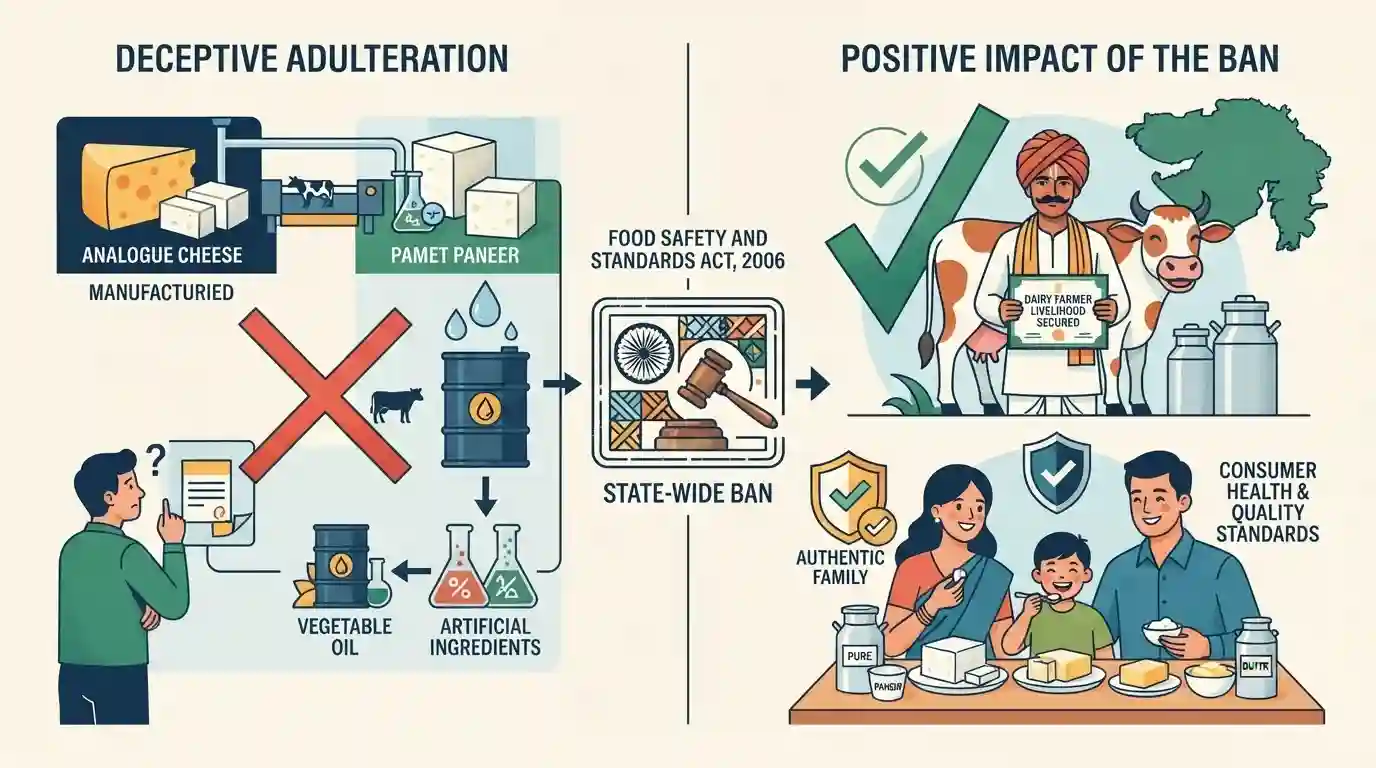
The Gujarat government has imposed a state-wide ban on non-standard analogue paneer, cheese, and butter under the Food Safety and Standards Act, 2006. This measure targets products that deceptively substitute milk fat with vegetable oils and artificial ingredients. The ban is intended to safeguard consumer health from substandard food items, prevent market deception, and protect the livelihoods and economic interests of the farmers in Gujarat's extensive dairy sector.
Key Points
- The Gujarat government has banned the manufacture, storage, distribution, and sale of non-standard analogue paneer, cheese, and butter state-wide.
- Analogue dairy products substitute authentic milk fat with cheaper vegetable oils, hydrogenated fats, or artificial ingredients, which can pose health risks and mislead consumers.
- The ban is enforced under the provisions of the Food Safety and Standards Act (FSSA), 2006.
- This regulatory action aims to protect public health as well as the economic interests of Gujarat's robust dairy industry and its cooperative farmers from unfair competition.
Important Terms
Food Safety and Standards Act, 2006

A comprehensive law enacted to consolidate multiple food-related regulations in India. It provides a science-based framework for regulating the manufacture, storage, distribution, and import of food to ensure safe human consumption.
UPSC context
Relevant to GS Paper 2 (Governance) and GS Paper 3 (Food Security). Tests understanding of statutory frameworks governing consumer health.
Food Safety and Standards Authority of India (FSSAI)
A statutory body under the Ministry of Health and Family Welfare, established under the FSS Act, 2006. It formulates food standards, regulates food businesses, and monitors compliance to ensure public health.
UPSC context
Important for GS Paper 2 (Statutory Bodies) and GS Paper 3 (Food Processing). It tests knowledge of India's apex food regulator.
Analogue Dairy Products
Synthetic substitutes mimicking dairy items like paneer or cheese, created by replacing milk fat and proteins with plant-based ingredients such as vegetable oils and starches. They must be explicitly labelled under FSSAI rules to avoid misleading consumers.
UPSC context
Relevant to GS Paper 3 (Agriculture/Food Processing). Tests awareness of food adulteration, consumer protection, and challenges within the dairy economy.
Prelims Trap
Dairy analogues are entirely prohibited under FSSAI regulations across all states in India.
Dairy analogues are legally permitted in India if explicitly labelled as such. Gujarat banned non-standard/deceptive analogues using state-level powers under FSSA to protect public health.
Static Concepts Connected
What is the mandate and structure of FSSAI under FSSA 2006?
- Statutory Body: Established under the Ministry of Health and Family Welfare (not Consumer Affairs), serving as the apex food regulator.
- Consolidation: Consolidated older laws, including the Prevention of Food Adulteration Act, 1954, to create a single reference point for food standards.
- State Enforcement: State Food Safety Commissioners enforce the act and have the power to issue localized prohibitions on harmful or deceptive products.
Why are partially hydrogenated oils (PHOs) used in analogues harmful?
- Cholesterol Imbalance: Industrial trans fats in PHOs raise LDL (bad cholesterol) and simultaneously lower HDL (good cholesterol), increasing cardiovascular disease risk.
- WHO Elimination Target: WHO's REPLACE initiative targets the global elimination of industrially produced trans-fatty acids.
- FSSAI Limits: To combat these risks, FSSAI capped trans fats in oils and fats to 2% by mass from 2022 onwards.
Cross-Topic Patterns
White Revolution to Analogue Bans
The Anand model (three-tier cooperative) empowered small farmers. State bans on cheap synthetic analogues act as regulatory protections for this cooperative economy against synthetic industrial substitutes.
Food Labelling & Market Deception
Connects to FSSAI’s broader push for explicit food labelling to prevent 'economic fraud', where cheap plant-based fats masquerade as premium dairy products.

Expect a mixed-statement Prelims question testing FSSAI's statutory powers alongside the physiological effects of trans fats (LDL/HDL).
Linked PYQs · 2
Linked PYQs · 2
- 2026GPSC_PRELIMSGS1
Consider the following statements about commercial dairy farming. 1. It is a high labour intensive activity. 2. It is highly commercial, wherein, efficient transport, refrigeration and pasteurization processes are its major facilitators. Which of the above statement(s) is/are correct?
- 2022GPSC_PRELIMSGS1
One of the following is not a correct statement in relation to the "One District One Focus Product (ODOFP)" Scheme:
