Minor mineral rule amendments for legal heir lease transfers
Source:deshgujarat ↗
Why It Matters
It highlights state-level administrative reforms in governance and minor mineral regulation, emphasizing procedural clarity, property rights, and the ease of doing business, which are crucial for public policy implementation.
Summary
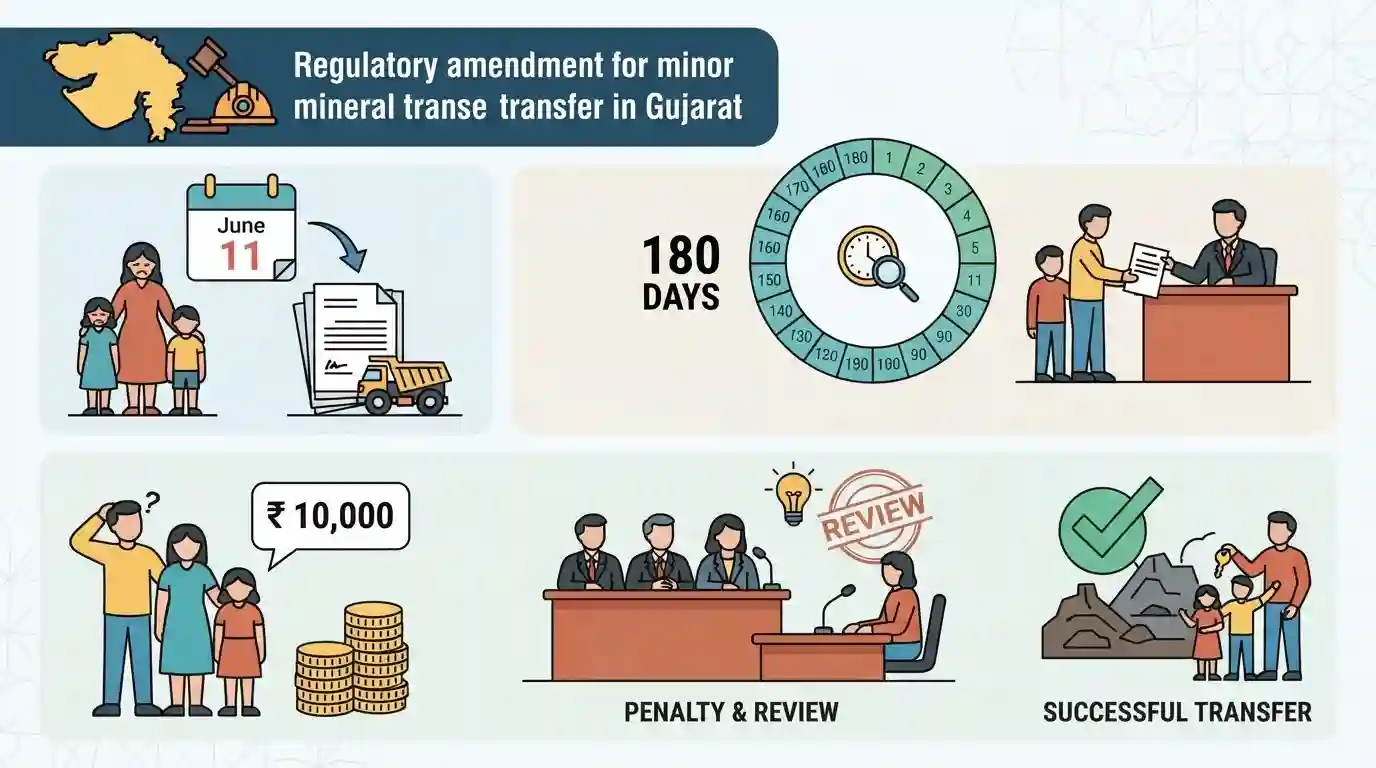
The Gujarat government has amended the Gujarat Minor Mineral Concession Rules, 2017, effective June 11, to streamline the transfer of minor mineral mining leases, letters of intent, and quarrying rights to legal heirs following a leaseholder's death. The amendment mandates legal heirs to inform the government within 180 days and imposes a Rs 10,000 penalty for subsequent delays. If unnotified for two years, the State government may terminate the rights, but only after affording the heirs a fair hearing, thereby preventing arbitrary lapsing of rights and promoting ease of doing business.
Key Points
- The Gujarat government amended the Gujarat Minor Mineral Concession Rules, 2017 to ease the transfer of mining leases to legal heirs after a leaseholder's death.
- Legal heirs must notify the government within 180 days with appropriate documentation, including a mutual agreement designating the new leaseholder.
- A penalty of Rs 10,000 is levied for every 180-day delay in notification.
- If not informed within two years, the matter goes to the State government, which can terminate the lease only after providing an opportunity for a hearing.
Important Terms
Gujarat Minor Mineral Concession Rules, 2017

State-level regulations governing the extraction, leasing, and transfer of minor minerals in Gujarat. Recent amendments streamline the transfer of leases to legal heirs to prevent arbitrary lapsing of rights.
UPSC context
GS Paper 2 (State Policies). Tests knowledge of state-level mineral administration and governance reforms.
Minor Minerals
Minerals like building stones, gravel, and sand. Under the MMDR Act, 1957, the Central Government notifies them, but State Governments possess the rule-making power for their regulation and leasing.
UPSC context
GS Paper 1 (Geography) & GS 2 (Polity). Tests the Centre-State division of powers regarding mineral resources.
Mines and Minerals (Development and Regulation) Act, 1957
The primary legislation governing India's mining sector. It distinguishes between major and minor minerals, establishing the legal framework for resource allocation and empowering states to regulate minor minerals.
UPSC context
GS Paper 2 (Polity) & GS 3 (Economy). Tests the statutory framework governing natural resource management.
Letter of Intent (LoI)
A formal preliminary document issued by the government expressing its intention to grant a mining lease, contingent upon the applicant fulfilling specific regulatory, financial, and environmental conditions.
UPSC context
GS Paper 2 (Governance). Tests understanding of administrative procedures and transparency in resource allocation.
Ease of Doing Business
Regulatory reforms aimed at simplifying government procedures, reducing compliance burdens, and ensuring policy certainty—such as predictable lease transfers—to attract private investment and promote economic growth.
UPSC context
GS Paper 3 (Indian Economy). Tests awareness of administrative reforms enhancing industry competitiveness and investment.
Prelims Trap
State Governments have the statutory power to notify or declare a mineral as a minor mineral under the MMDR Act.
The power to declare or notify a mineral as 'minor' rests solely with the Central Government; State Governments only possess rule-making powers once declared.
Static Concepts Connected
Who regulates minor minerals in India under the MMDR Act, 1957?
- State authority: State Governments hold complete legislative and administrative power to frame rules for minor mineral concessions.
- Minor minerals list: Includes ordinary sand, gravel, building stones, bentonite, and ordinary clay, as defined under Section 3(e).
- Revenue ownership: All royalties, dead rents, and auction revenues from minor minerals accrue entirely to the respective State Government.
Cross-Topic Patterns
Resource federalism in mineral governance
While States fully regulate minor minerals, the Centre controls major and critical minerals. This dual control highlights the federal division of economic resources under Schedule VII.
Natural justice in economic governance
Mandating a fair hearing before lease termination demonstrates how administrative law and principles of natural justice safeguard private enterprise against arbitrary state action.

Expect statement-based questions testing the division of powers under the MMDR Act, specifically Central classification vs State rule-making.
Linked PYQs · 1
Linked PYQs · 1
- 2024GPSC_PRELIMSGS1
Public Administration is the study of
