Gujarat transfers 144 Class 1 officers across state
Source:gujarat-samachar ↗
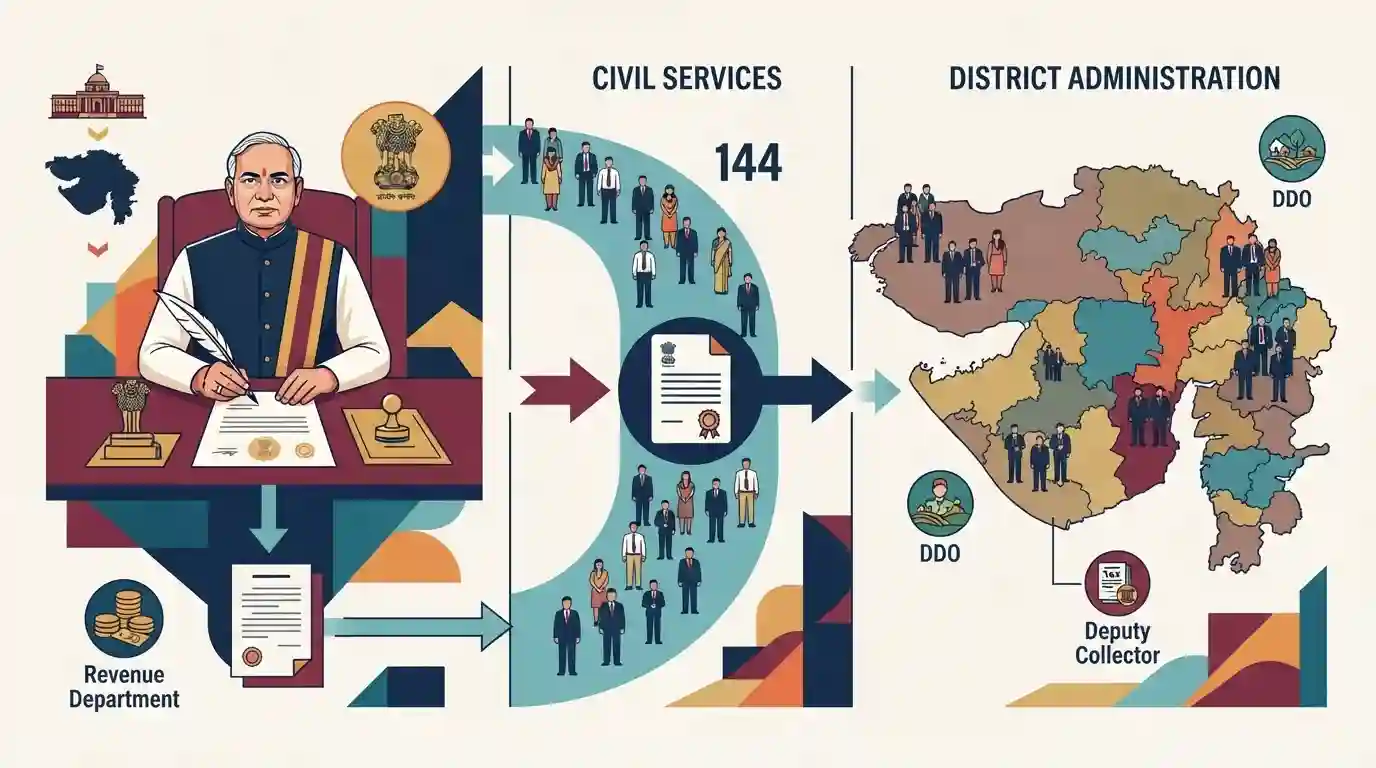
Why It Matters
Routine administrative transfers highlight the practical functioning of the State Civil Services, the structure of district administration (Deputy Collectors/DDOs), and the formal executive powers of the Governor under the Constitution (Articles 166 and 309-311).
Summary
The Gujarat government, through its Revenue Department, has issued transfer orders for 144 Class-1 officers of the Gujarat Administrative Service, including Deputy Collectors and DDOs, with the directives formally executed in the name of the Governor.
Key Points
- The Gujarat Revenue Department executed a massive administrative reshuffle, transferring 144 Gujarat Administrative Service (Junior Scale), Class-1 officers.
- The transfers primarily involved Deputy Collectors, Sub-Divisional Magistrates (SDMs), District Supply Officers, and District Development Officers (DDOs) across the state.
- The official notification and transfer orders were formally issued in the name of the Governor of Gujarat, adhering to constitutional protocols for state civil servants.
- The restructuring aims to streamline district-level administration and revenue operations across key districts like Ahmedabad, Surat, and Bhavnagar.
Important Terms
Gujarat Administrative Service

The premier Group A administrative civil service of the Government of Gujarat. Recruited partly through the GPSC exam and partly by promotion, it serves as the state\'s core administrative apparatus and a feeder for the Indian Administrative Service.
UPSC context
Relevant for GPSC General Studies (State Administration). Tests knowledge of Gujarat's civil service structure, recruitment, and the state's administrative hierarchy.
Deputy Collector
A senior administrative officer in the state revenue department handling land administration, disaster management, and executive magistrate functions. It is the entry-level post for directly recruited Gujarat Administrative Service officers.
UPSC context
Key to GPSC Public Administration and Governance. Covers district administration, revenue roles, and implementation of government programs at the sub-divisional level.
Article 166
The constitutional provision requiring all executive action of a state government to be expressed in the name of the Governor. It mandates the Governor to make rules for conducting state government business.
UPSC context
Crucial for GPSC Indian Polity. Tests understanding of the state executive branch, the Governor's nominal authority, and the formal conduct of government business.
District Development Officer
An executive officer in Gujarat vested with powers to manage the administrative and executive functions of the District Panchayat. They act as the ex-officio Secretary of the District Panchayat.
UPSC context
Important for GPSC Governance and Panchayati Raj. Highlights local self-government structures and the bureaucratic execution of rural development policies in Gujarat.
Prelims Trap
The Governor directly orders the transfer of state civil servants under their discretionary powers.
Under Article 166, state executive actions are merely *expressed* in the Governor's name. The actual decisions are made by the Council of Ministers or the delegated department.
Static Concepts Connected
How are executive actions of a State Government constitutionally formalized under Article 166?
- Governor's Name: All executive actions of the Government of a State must be explicitly expressed as being taken in the name of the Governor.
- Authentication Rules: Orders and instruments executed in the Governor's name are authenticated according to rules made by the Governor.
- Business Allocation: The Governor makes rules for the convenient transaction of state business and its allocation among Ministers.
What constitutional protections does Article 311 offer to state civil servants?
- Subordinate Authority Ban: A civil servant cannot be dismissed or removed by an authority subordinate to the one by which they were appointed.
- Right to Inquiry: They cannot be penalized with dismissal, removal, or rank reduction without a formal inquiry and opportunity to be heard.
- Transfer Exemption: Routine administrative transfers do not constitute a "reduction in rank" and thus fall entirely outside Article 311 penal safeguards.
Cross-Topic Patterns
Executive vs. Judicial Magistrates
Deputy Collectors acting as SDMs exercise executive magistrate powers (preventive law & order) under CrPC, distinct from judicial magistrates under the constitutional separation of powers.
Article 309 vs Article 312 dynamics
Gujarat Administrative Service officers are governed by state legislature laws (Article 309), whereas IAS officers holding parallel district administrative roles are regulated under All India Services (Article 312).

Expect multi-statement Polity questions testing the technical difference between Art 166 (Governor's name) and actual discretionary powers.
Linked PYQs · 3
Linked PYQs · 3
- 2026GPSC_PRELIMSGS1
Examine the following statements regarding 'Article 311' of the Constitution and protection granted to Civil Servants: 1. No civil servant shall be dismissed by an authority subordinate to the one by which they were appointed. 2. No officer shall be removed without informing them of the charges and giving them an opportunity for inquiry. 3. In the interest of national security, the President or Governor can remove an officer without an inquiry. 4. This protection is available only to All India Services officers and not to state service officers. Which of the above statements are correct?
- 2022GPSC_PRELIMSGS1
As per the 73rd Constitutional Amendment Act of Panchayati Raj, who specifies a "Village"?
- 2017GPSC_PRELIMSGS1
According to the Balwantrai Mehata Committee, the district collector should be :
