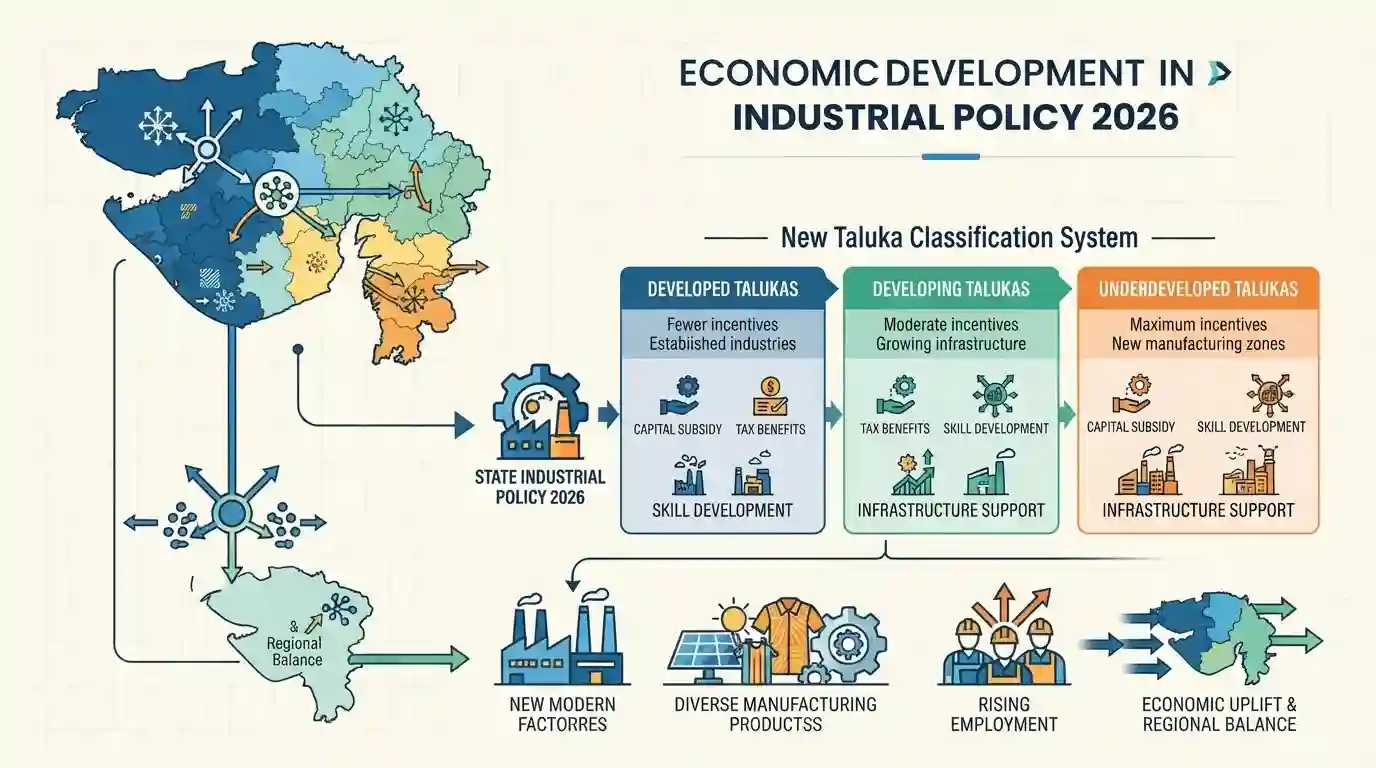
Gujarat Industrial Policy Introduces New Taluka Classification System
Source:english-gujaratsamachar ↗
Why It Matters
Important for GPSC aspirants tracking Gujarat's economic policies, industrial development strategies, and regional growth incentives.
Summary
The Gujarat government has introduced a new taluka classification system under the Industrial Policy 2026 to foster decentralized and balanced industrial growth across different regions of the state, providing structured incentives to boost manufacturing and employment in underdeveloped areas.
Key Points
- The Gujarat government announced a new taluka classification framework under its Industrial Policy 2026.
- The policy aims to promote balanced regional industrial growth across various talukas of the state by offering tailored incentives based on classification.
- Backward or underdeveloped talukas are incentivized to attract investments and generate localized employment opportunities.
Important Terms
Industrial Policy 2026

A comprehensive framework introduced by the Gujarat government to foster decentralized regional growth, incentivize green manufacturing, and support MSMEs, startups, and women entrepreneurs across 268 talukas.
UPSC context
Important for GPSC General Studies Paper on Gujarat's economy, industrial development, investment policies, and regional growth strategies.
Gujarat Government
The executive administration of the state of Gujarat, responsible for policy formulation, administrative governance, and implementing economic and industrial development initiatives.
UPSC context
Essential for understanding state-level governance, administrative frameworks, and policy implementation under GPSC syllabus topics.
Prelims Trap
Category B talukas receive higher maximum incentive ceilings of up to 45% of eligible fixed capital investment compared to Category A.
Aspirants often assume more developed regions get higher incentives to maximize returns, whereas backward areas receive higher fiscal support (up to 45%).
Static Concepts Connected
How does Gujarat classify its talukas for industrial incentives under state policy frameworks?
- Dual Classification: Two Categories: Gujarat's industrial policy classifies talukas into Category A (less developed/backward) and Category B (more developed) to balance regional growth.
- Higher Subsidies: Capital Subsidies: Less developed Category A talukas receive higher incentive ceilings on fixed capital investments to attract investments away from urban hubs.
- Spatial Equity: Decentralization: The framework aims to distribute manufacturing units evenly, reducing congestion in major industrial belts like Ahmedabad-Vadodara.
Cross-Topic Patterns
Decentralized Industrial Growth & Regional Parity
Gujarat's taluka-wise incentives mirror central backward district initiatives like the Aspirational Districts Programme, testing decentralized economic equity models in exam questions.
Subsidational Industrial Policy & WTO Norms
Differential capital subsidies link sub-national fiscal policies to WTO Subsidies and Countervailing Measures (SCM) agreement debates on regional development grants.

Expect a match-the-following or statement-based question pairing Category A/B taluka classifications with their respective incentive ceilings.
Linked PYQs · 2
Linked PYQs · 2
- 2025GPSC_PRELIMSGS1
According to the Socio-Economic Review, 2024-2025 of Gujarat, Gujarat comes in ______ category in Logistic Ease Across Different States (LEADS), 2024.
- 2025GPSC_PRELIMSGS1
______ is one of the cities chosen by the NITI Aayog for its Growth Hub (G-HUB) programme to boost their economic growth.
