Gujarat Appoints Class I Officers for Tribal Development
Source:socialnews-xyz ↗
Why It Matters
Important for understanding administrative reforms, decentralization, and welfare implementation strategies for dispersed tribal populations in Gujarat.
Summary
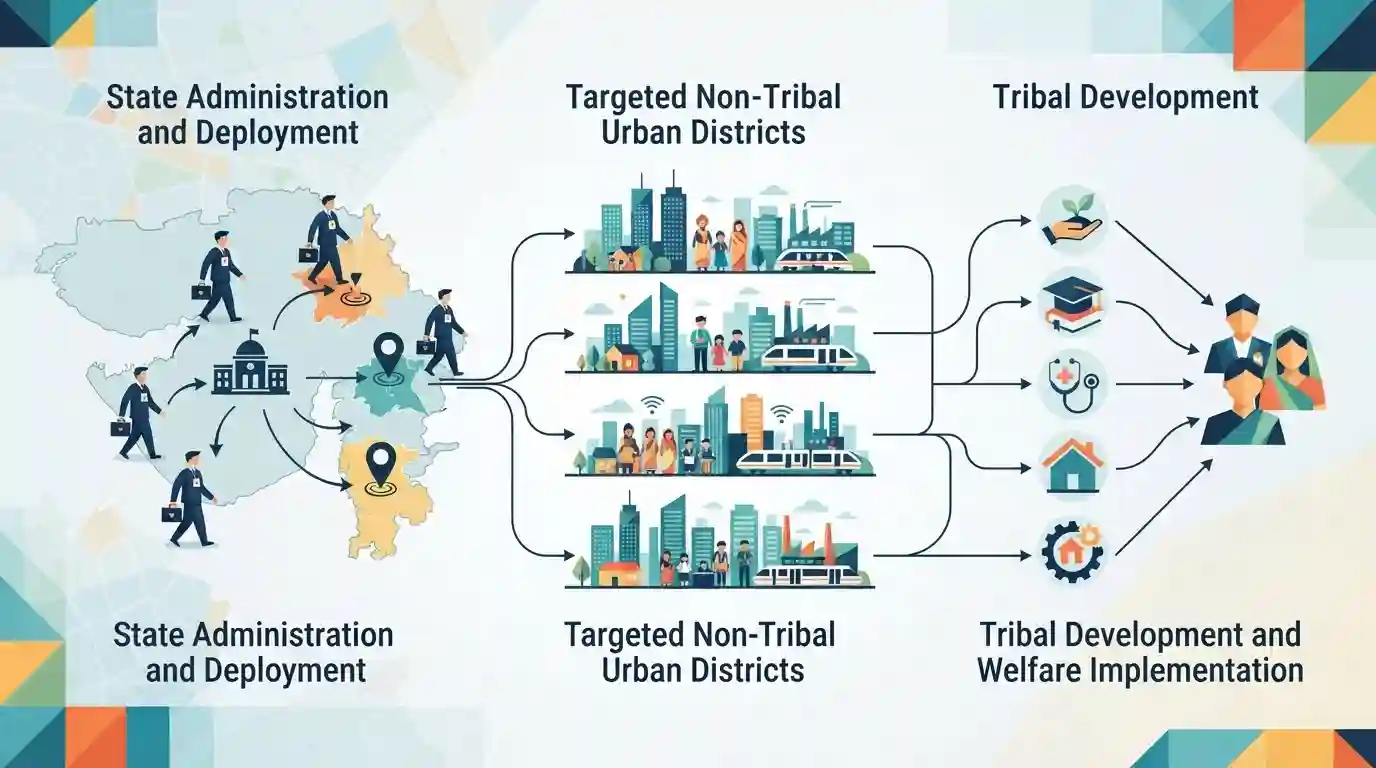
The Gujarat government has deployed Class-I officers to assume direct charge of tribal development and welfare implementation in four non-tribal urbanized districts—Ahmedabad, Surat, Vadodara, and Rajkot—to better target dispersed tribal communities.
Key Points
- The Gujarat government has appointed Class-I officers to take direct charge of tribal development initiatives in four non-tribal districts: Ahmedabad, Surat, Vadodara, and Rajkot.
- This administrative step aims to bridge developmental gaps, ensure targeted implementation of welfare schemes, and monitor tribal populations living outside traditional scheduled tribal areas.
- Reflects a decentralized governance approach to address the socio-economic needs of dispersed tribal communities in urban and semi-urban hubs.
Important Terms
Government of Gujarat

The apex executive body of Gujarat, responsible for state administration, policy formulation, and the implementation of social welfare initiatives across districts.
UPSC context
Important for GS Paper II (State Administration and Governance) and policy execution affecting vulnerable groups.
Prelims Trap
tribal development initiatives in four non-tribal districts: Ahmedabad, Surat, Vadodara, and Rajkot
Aspirants may assume these four districts are declared Fifth Schedule Scheduled Areas, whereas they are specifically non-tribal urbanized districts lacking traditional scheduled tribal frameworks.
Static Concepts Connected
What are the constitutional provisions and administrative mechanisms for the welfare of Scheduled Tribes in Gujarat?
- Constitutional Basis: Fifth Schedule provides special governance and protection mechanisms for Scheduled Areas through Tribal Advisory Councils in states with scheduled populations.
- Geographic Spread: Gujarat has significant tribal populations concentrated in eastern districts like Dahod, Tapi, Narmada, and Valsad, governed via dedicated Tribal Sub-Plans.
- Non-Scheduled Areas: Dispersed tribal populations living in non-scheduled urban districts often miss out on Fifth Schedule protections, requiring special administrative interventions like dedicated state-level welfare schemes.
Cross-Topic Patterns
Urban Migration vs. Tribal Welfare Governance
Urban local governance intersects with scheduled tribe welfare when large industrial hubs attract migrant tribal populations needing targeted welfare allocations outside Fifth Schedule areas.
Bureaucratic Restructuring and Mission-Mode Execution
Shifting from concurrent additional charges to dedicated Class-I administrative control mirrors civil service reforms seen in mission-mode project execution.

Expect statement-based questions on the administrative machinery for non-scheduled areas and specific welfare schemes like Mukhyamantri Adimjuth Yojana.
Linked PYQs · 2
Linked PYQs · 2
- 2025GPSC_PRELIMSGS1
Which of the following statements is/are correct regarding the G-SAFAL scheme?
- 2021GPSC_PRELIMSGS1
Which of the following statements are correct? 1. Siddi or Sheedi is one of the major tribal communities of some districts of Gujarat. 2. Siddi are also living in parts of state of Jharkhand and Madhya Pradesh. 3. Dhamal dance is performed by the Siddi, it reflects the Siddi's passion for hunting.
