Gujarat Flood Aftermath and Disaster Response Measures
Source:rediff ↗
Why It Matters
The repeated occurrence of severe flooding in Gujarat highlights critical aspects of disaster management, institutional response (NDRF/SDRF), and climatic vulnerabilities. For GPSC aspirants, understanding the geographical susceptibility of Gujarat districts, the functional roles of disaster response agencies, and meteorological alert systems is crucial for both objective and subjective assessments on disaster resilience.
Summary
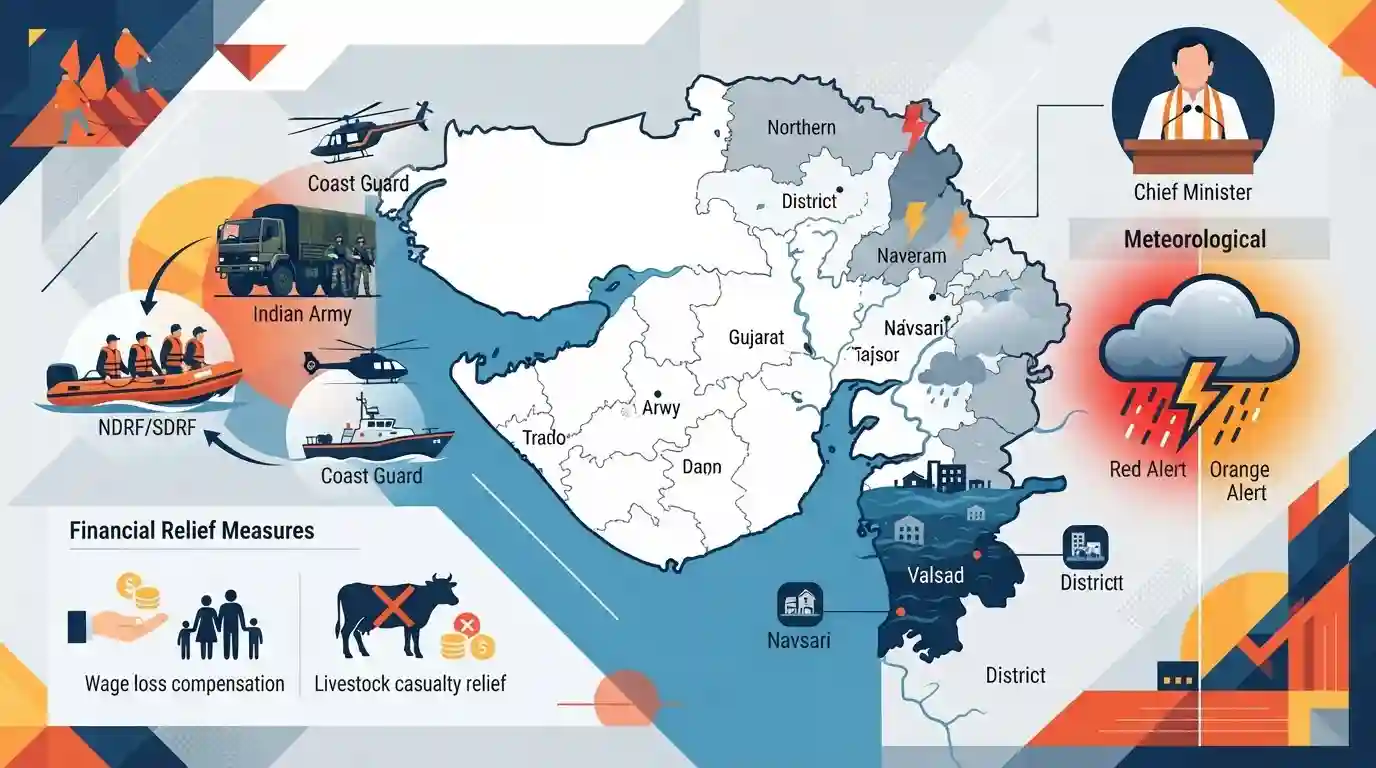
Devastating floods in Gujarat have led to 35 reported deaths, with Navsari and Valsad districts being the most severely impacted by heavy downpours. The crisis has triggered a massive multi-agency response, including deployments from the NDRF, SDRF, Indian Army, and Coast Guard. To support the affected populace, the state government, led by CM Bhupendra Patel, has initiated financial relief measures covering wage losses and livestock casualties. Furthermore, the IMD has issued critical red and orange alerts for northern districts, highlighting the persistent threat of severe climatic conditions and testing the state's disaster management framework.
Key Points
- Severe floods triggered by heavy monsoon rains in Gujarat have claimed 35 lives, predominantly affecting Navsari and Valsad districts.
- Extensive rescue and relief operations are underway, heavily involving the NDRF, SDRF, Indian Army, and the Coast Guard.
- The state government has announced cash doles, compensation for livestock loss, and ex-gratia for families of the deceased to mitigate the economic impact.
- The India Meteorological Department (IMD) issued red and orange alerts for northern districts like Patan and Banaskantha due to anticipated extreme weather events.
Important Terms
National Disaster Response Force (NDRF)

The NDRF is India's specialized, multi-skilled force established under the Disaster Management Act, 2005. Operating under the Ministry of Home Affairs, it acts as the primary operational backbone for emergency search, rescue, and relief during natural and man-made disasters.
UPSC context
Highly relevant to GS-3 (Disaster Management). It tests candidates on India's institutional framework, emergency response protocols, and multi-agency crisis coordination.
State Disaster Response Force (SDRF)
The SDRF is a state-level specialized emergency response team constituted under the Disaster Management Act, 2005. It serves as the first line of defense during calamities, conducting immediate rescue and relief operations tailored to regional vulnerabilities.
UPSC context
Important for GS-3 (Disaster Management), highlighting the decentralized nature of India's disaster response, state-level preparedness, and Centre-State administrative cooperation.
India Meteorological Department (IMD)
Founded in 1875 under the Ministry of Earth Sciences, the IMD is India's principal agency for meteorological observations and weather forecasting. It issues critical early warnings, including red and orange alerts, for extreme weather events like cyclones and floods.
UPSC context
Crucial for GS-1 (Geography) and GS-3 (Disaster Management), testing knowledge on climate early warning systems, forecasting frameworks, and mitigation strategies.
Indian Coast Guard
Established in 1978 under the Ministry of Defence, the Indian Coast Guard is a maritime law enforcement and security organization. Beyond coastal security, its mandate includes conducting search, rescue, and humanitarian assistance during coastal and riverine natural disasters.
UPSC context
Relevant to GS-3 (Security and Disaster Management). Evaluates understanding of maritime security architecture, disaster relief roles of armed forces, and inter-agency coordination.
Prelims Trap
"The State Disaster Response Fund (SDRF) is solely funded by the respective State Governments."
SDRF is funded in a 75:25 ratio between the Centre and general category states (90:10 for special category states), under the Disaster Management Act, 2005.
Static Concepts Connected
How is the State Disaster Response Fund (SDRF) constituted and funded?
- Statutory Basis: It is constituted under Section 48(1)(a) of the Disaster Management Act, 2005 for state-level emergency response.
- Funding Ratio: The Centre contributes 75% for general category states and 90% for special category states, with states providing the remainder.
- Allocation Mechanism: The Finance Commission recommends the annual central contribution, released in two equal installments based on state utilization.
What are the key west-flowing rivers of South Gujarat prone to flooding?
- Valsad Drainage: Valsad district's flooding is primarily driven by the Auranga, Par, and Damanganga rivers, which empty into the Arabian Sea.
- Navsari Drainage: Navsari district's vulnerability is linked to the Purna, Ambika, and Kaveri river systems.
- Interlinking Potential: The Par-Tapi-Narmada link proposes transferring surplus water from these basins to drought-prone Saurashtra/Kutch.
Cross-Topic Patterns
River Interlinking as Flood Mitigation
The Par-Tapi-Narmada river linking project serves a dual purpose: mitigating recurrent floods in South Gujarat while transferring surplus monsoon water to the arid, water-deficit regions of Saurashtra and Kutch.
Climate Change & Extreme Weather Shifts
The shift towards fewer rainy days with intense downpours tests existing drainage capacities, linking global climate change directly to increased frequency of localized flooding emergencies.

Expect a 2026 Prelims question combining South Gujarat's west-flowing rivers, the Par-Tapi-Narmada link, and SDRF funding mechanisms.
Linked PYQs · 3
Linked PYQs · 3
- 2021GPSC_PRELIMSGS1
The 15ᵗʰ Finance Commission recommended Grants-in-Aid falls into five broad categories. Which of the following is NOT in the said categories?
- 2026GPSC_PRELIMSGS1
Consider the following statements regarding climate change: 1. Floods and droughts are increasing in India. 2. There has been a sharp increase in the number of tropical cyclones in India. 3. Humidity levels are gradually increasing in the regions of central India. Which of the above statement/s is/are correct?
- 2026GPSC_PRELIMSGS1
Consider the following statements regarding the drainage system of Kutch: 1. Most rivers in the Kutch region are ephemeral and non-perennial, carrying water only during the brief monsoon season. 2. The rivers originating from the central hilly tracts of Kutch invariably drain into the Arabian Sea directly. 3. The Luni River, after traversing through Rajasthan, dissipates into the marshy lands of the Rann of Kutch. Which of the above statements are correct?
