Ahmedabad Opens Gujarat First Tree Integrated Green Bus Shelter
Source:ommcomnews ↗
આ શા માટે મહત્વનું છે
This pilot project represents a shifts from destructive urban construction to nature-positive, climate-resilient infrastructure. For civil service aspirants, it provides a practical case study on integrating circular economy principles (using construction and demolition waste) and eco-friendly design in public transport facilities to tackle the Urban Heat Island (UHI) effect.
સારાંશ
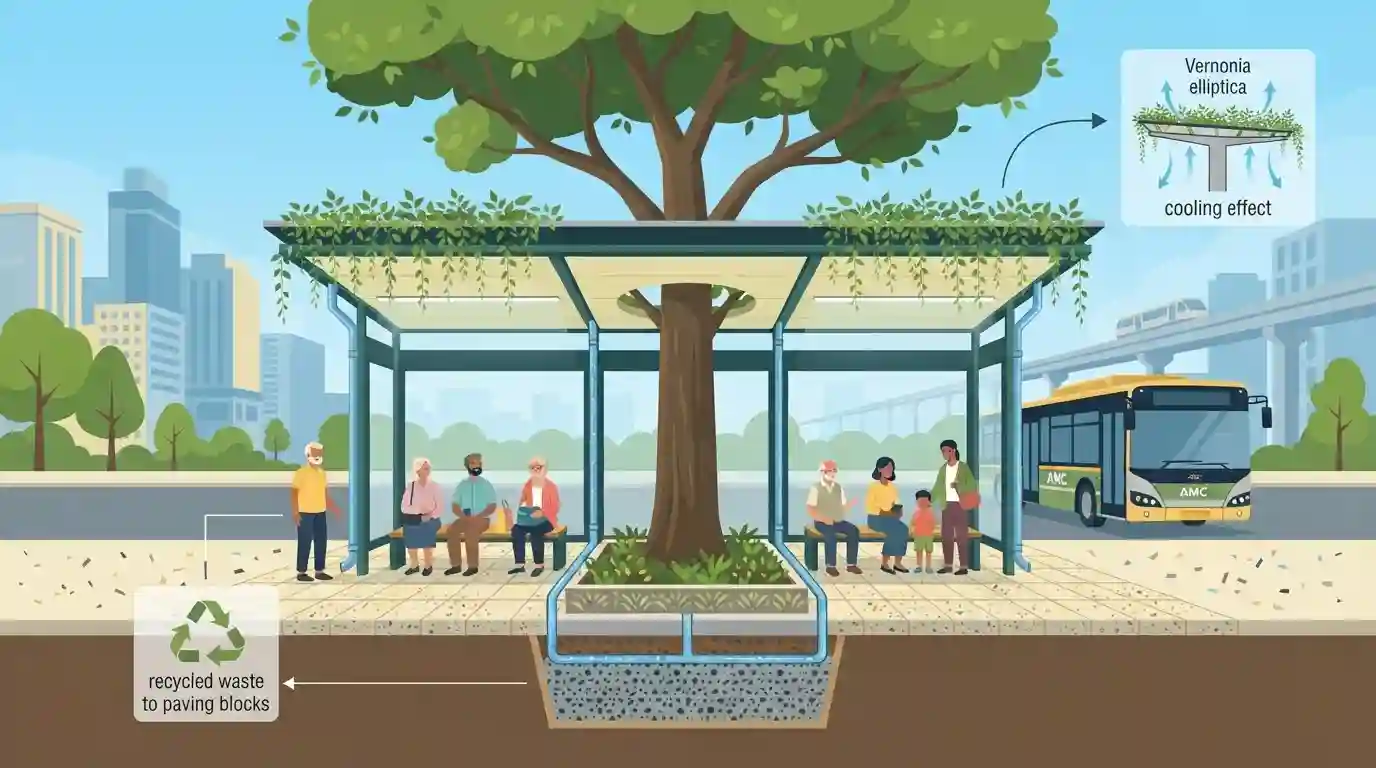
Ahmedabad Municipal Corporation (AMC) has launched Gujarat's first tree-integrated green bus shelter at Acher AMTS Station in Sabarmati. The pilot project demonstrates a sustainable, co-existence-based urban planning model by preserving a decades-old tree within the structure. To enhance cooling, the shelter features a dual-layer roof, 'Vernonia elliptica climber' vegetation, and an intelligent rainwater system, while incorporating recycled construction and demolition waste for paving blocks to support circular economy goals.
મુખ્ય મુદ્દા
- Gujarat's first tree-integrated green bus shelter has been opened as a pilot project at the Acher AMTS Station in the Sabarmati area of Ahmedabad.
- Developed by the Ahmedabad Municipal Corporation (AMC), the shelter preserves and integrates a decades-old mature tree into its design rather than cutting it down.
- To naturally lower temperatures, the shelter features a dual-layer roof (combining fiber-reinforced plastic sheets and cement boards) and will be covered by 'Vernonia elliptica climber' plants over time.
- Promoting a circular economy, recycled Construction and Demolition (C&D) waste was used to manufacture the shelter's curb stones and anti-skid paving blocks.
- The shelter is equipped with modern passenger amenities, including ergonomic high-pressure laminate (HPL) benches, energy-efficient LED lighting, an intelligent rainwater system, and digital commuter information boards.
મહત્વપૂર્ણ શબ્દો
Ahmedabad Municipal Corporation (AMC)

The urban local body responsible for the civic administration, infrastructure development, and municipal services of Ahmedabad, Gujarat, operating under state municipal laws.
UPSC context
GS Paper II: Urban Local Bodies (ULBs) and the implementation of the 74th Constitutional Amendment Act.
Ahmedabad Municipal Transport Service (AMTS)
The public transport arm of the Ahmedabad Municipal Corporation, responsible for operating city bus services and promoting sustainable public transit in Ahmedabad.
UPSC context
GS Paper III: Infrastructure and sustainable urban transport models under municipal governance.
Circular Economy
An economic model focused on minimizing waste and maximizing resources by keeping products, materials, and resources in use through recycling, reuse, and regeneration.
UPSC context
GS Paper III: Environment, waste management, and sustainable economic development models.
Green Infrastructure
An urban planning and design approach that utilizes natural systems, vegetation, and ecological processes to manage water, reduce temperatures, and enhance urban resilience.
UPSC context
GS Paper I: Urbanization challenges; GS Paper III: Environmental conservation and climate change adaptation.
Vernonia elliptica
Commonly known as the curtain creeper, this hardy evergreen climbing plant is widely used in urban landscaping to form green canopies, reduce heat, and improve air quality.
UPSC context
GS Paper III: Environmental pollution degradation and biodiversity conservation in sustainable cities.
પ્રિલિમ્સ ટ્રેપ
Construction and Demolition Waste Rules, 2016, apply exclusively to public sector projects and municipal authorities, exempting private individual waste generators.
The rules actually apply to EVERY generator of construction and demolition waste, including private individuals, households, and private developers, who must segregate and store waste.
સંલગ્ન સ્થિર ખ્યાલો
What are Nature-Based Solutions (NbS) in urban planning?
- Definition: IUCN defines NbS as actions to protect, sustainably manage, and restore natural or modified ecosystems to address societal challenges effectively.
- Urban Applications: Includes urban forestry, green roofs, vertical gardens, and integrating mature trees into transit design to combat the Urban Heat Island (UHI) effect.
- Key Benefits: Provides natural cooling, stormwater retention, air purification, and local biodiversity habitats within concrete-heavy zones.
What are the salient features of the Construction and Demolition (C&D) Waste Management Rules, 2016?
- Universal Scope: Applies to every waste generator resulting from construction, remodeling, repair, and demolition of any civil structure.
- Segregation Mandate: Generators must segregate waste into concrete, soil, steel/wood/plastics, and bricks/mortar before deposition.
- Procurement Mandate: Local bodies must facilitate collection and mandate 10% to 20% use of recycled C&D materials in municipal contracts and civic works.
આંતર-વિષય પેટર્ન
NbS as urban climate adaptation
Shifting from resource-heavy 'gray' infrastructure to hybrid 'green-gray' designs to mitigate extreme heat domes and urban flooding under India's National Action Plan on Climate Change.
Circular economy in municipal finance
Leveraging C&D waste recycling to lower civic procurement costs while fulfilling the Swachh Bharat Mission (Urban) 2.0 mandates for 100% resource recovery.

C&D Waste Rules 2016 mandates combined with Urban Heat Island mitigation technologies like NbS likely to be tested in GS3/Prelims 2026.
સંલગ્ન PYQ · 3
સંલગ્ન PYQ · 3
- 2025GPSC_PRELIMSGS1
Under the Green Open Access Rules, 2022, the minimum size of the renewable energy project eligible for open access is
- 2022GPSC_PRELIMSGS1
What is "A Step Towards a Sustainable Future (STAT)" Scheme?
- 2025GPSC_PRELIMSGS1
Which of the following statement(s) is / are true? (i) National Clean Air Programme (NCAP) has a mandate to achieve up to a 40% reduction in PM₁₀ levels or to meet national standards (60 μg/m³) in the 131 non-attainment and million plus cities/urban agglomerations by 2025-26 (ii) PRANA is the special purpose vehicle which essentially funds the various mitigation strategies across the non-attainment cities
