Gujarat digital progress card aligned with education policy
Source:pioneer ↗
આ શા માટે મહત્વનું છે
Highlights the practical, state-level implementation of the National Education Policy (NEP) 2020's vision for competency-based and multi-dimensional student assessment, demonstrating the integration of digital infrastructure in modernizing India's education system.
સારાંશ
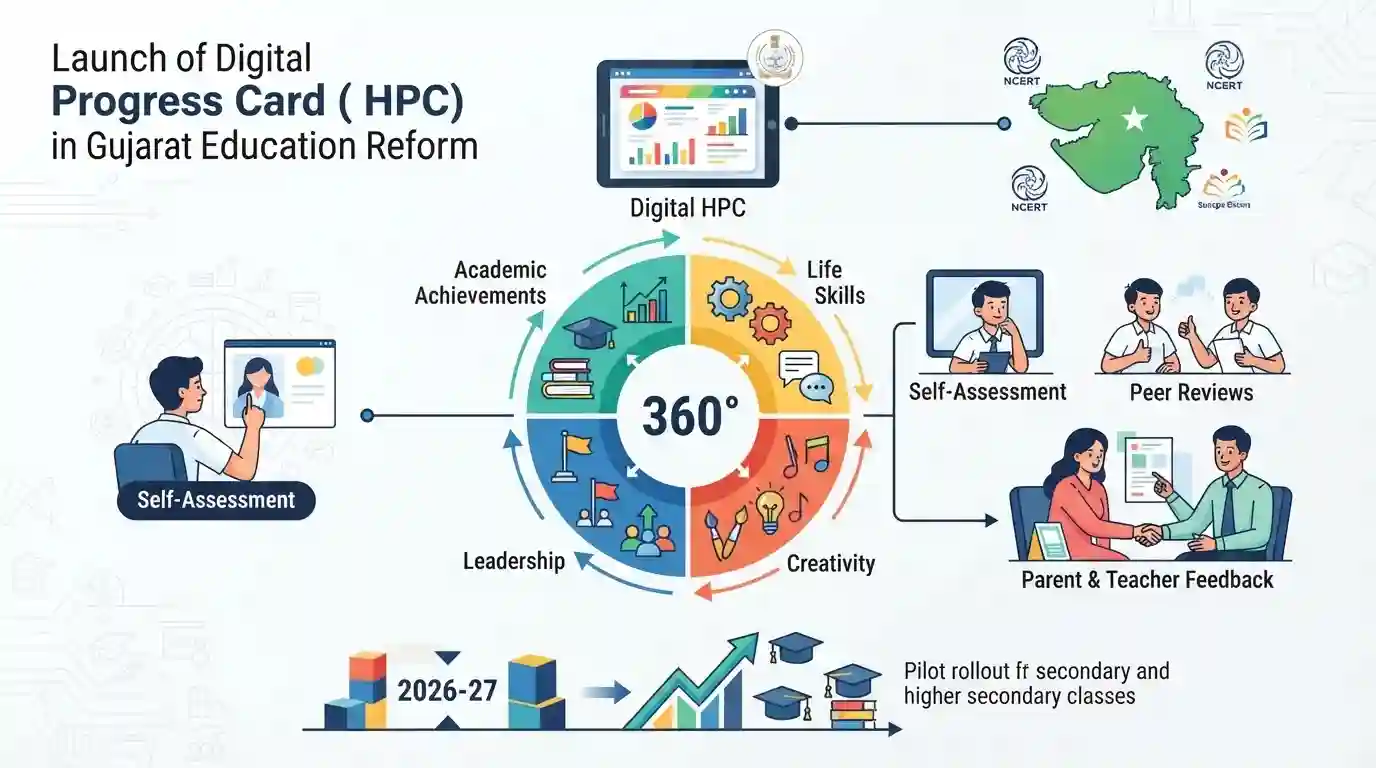
Gujarat has pioneered the launch of a digital Holistic Progress Card (HPC) for students, marking a significant step in implementing the National Education Policy (NEP) 2020. Developed in collaboration with NCERT's PARAKH and Samagra Shiksha, the HPC introduces a 360-degree assessment model. It evaluates not only academic achievements but also life skills, creativity, and leadership by incorporating self-assessment, peer reviews, and feedback from parents and teachers. The initiative aims to replace rote learning with comprehensive skill evaluation and will be piloted for secondary and higher secondary classes starting in 2026-27.
મુખ્ય મુદ્દા
- Gujarat has become the first Indian state to introduce a digital Holistic Progress Card (HPC) aligned with the National Education Policy (NEP) 2020.
- The HPC offers a 360-degree assessment framework that evaluates cognitive, affective, and psychomotor skills, moving away from traditional rote-learning evaluation.
- The assessment model incorporates self-evaluation, peer reviews, and feedback from parents and teachers alongside academic performance.
- The initiative was developed collaboratively by the state education board, NCERT's PARAKH division, and Samagra Shiksha.
- The digital cards will be introduced on a pilot basis from the 2026-27 academic year for students in classes 9 to 12.
પ્રિલિમ્સ ટ્રેપ
"The Holistic Progress Card under NEP 2020 is evaluated exclusively by teachers and standardized testing agencies."
HPC is a 360-degree multidimensional report. It shifts away from teacher-only assessments by explicitly mandating the inclusion of self-assessment, peer reviews, and parent feedback.
સંલગ્ન સ્થિર ખ્યાલો
What is the mandate of PARAKH under the National Education Policy 2020?
- Standard Setting: Functions as a standard-setting body under NCERT to establish norms, standards, and guidelines for student assessment across all recognized school boards.
- Board Equivalence: Aims to eliminate disparities by bringing equivalence in the evaluation patterns among various state and central educational boards.
- Assessment Shift: Guides school boards to shift assessment patterns away from rote memorization toward 21st-century skills and holistic development.
What are the key structural features of the Samagra Shiksha Scheme?
- Integrated Scheme: It is an overarching programme that subsumed three erstwhile schemes: Sarva Shiksha Abhiyan (SSA), Rashtriya Madhyamik Shiksha Abhiyan (RMSA), and Teacher Education (TE).
- Education Continuum: Treats school education holistically as a continuum from pre-school, primary, upper primary, and secondary to senior secondary levels (Classes pre-Nursery to 12).
- NEP Alignment: Revamped to align with NEP 2020, emphasizing foundational literacy and numeracy (FLN), digital initiatives, and vocational education.
આંતર-વિષય પેટર્ન
E-Governance: APAAR and NDEAR Integration
The digital HPC aligns with broader e-governance architectures like the APAAR (One Nation, One Student ID) registry and the National Digital Education Architecture (NDEAR) for seamless student mobility.
Concurrent List and Cooperative Federalism
Since education falls under the Concurrent List, Gujarat piloting the HPC demonstrates cooperative federalism, wherein states lead the operationalization of national frameworks like NEP 2020.

Expect a multi-statement Prelims question testing the constituents of the 360-degree HPC alongside the institutional mandate of PARAKH.
