Gujarat Farmers Left Vulnerable Without Central Crop Insurance Scheme
Source:Indian Express ↗
Why It Matters
This issue illustrates the implementation challenges of centrally sponsored agricultural safety nets like the PMFBY. It underscores the vulnerabilities farmers face when state and central schemes face discontinuity, especially amidst increasing climate risks like El Niño and unseasonal rainfall.
Summary
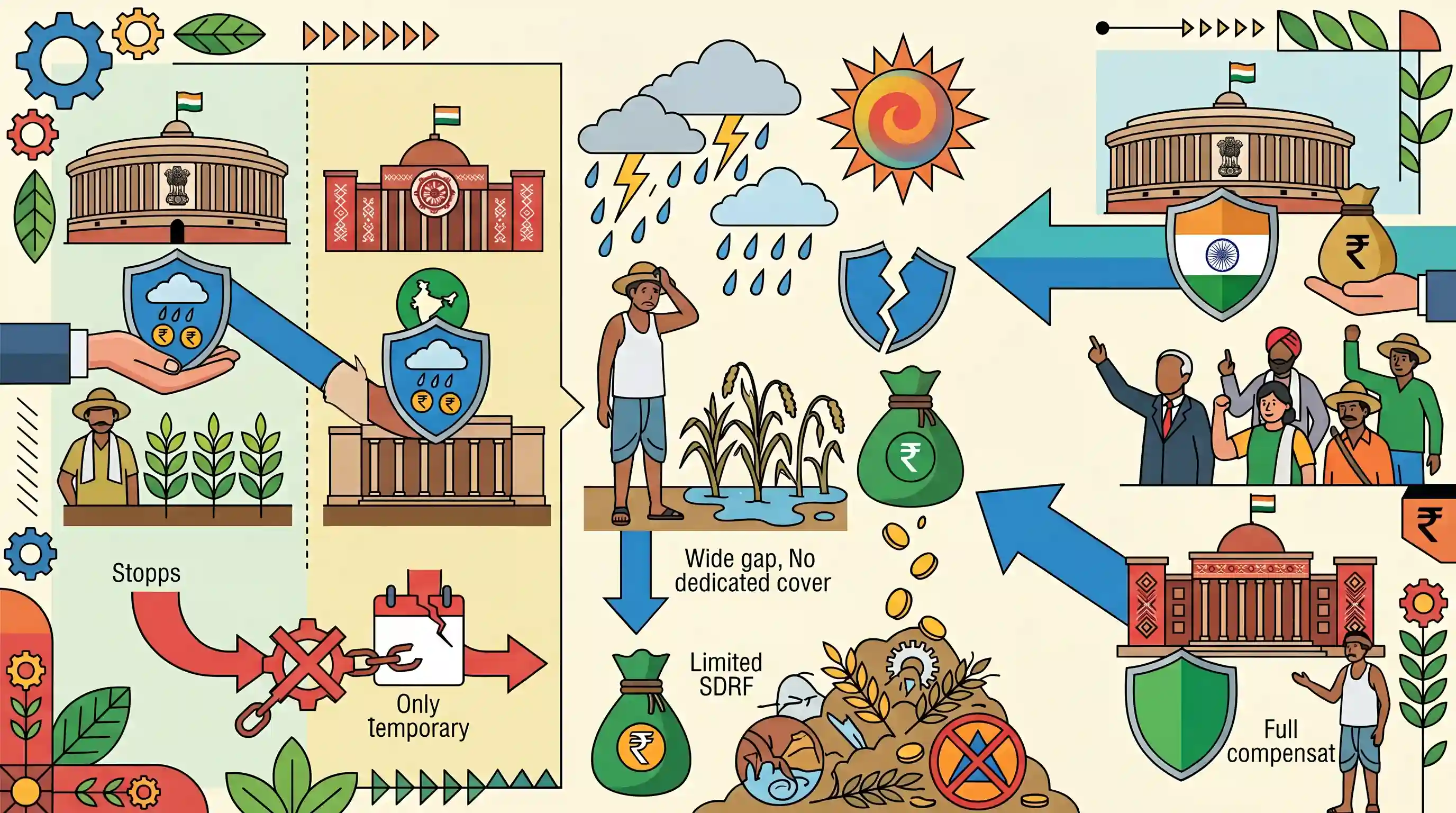
Congress leaders in Gujarat have raised concerns that farmers in the state have been deprived of the benefits of the Pradhan Mantri Fasal Bima Yojana (PMFBY) since the state government opted out of the scheme in 2020. Although the state introduced the Mukhyamantri Kisan Sahay Yojana (MKSY) as an alternative, it was only functional for a year. Consequently, farmers currently lack a dedicated crop insurance safety net and rely on inadequate compensation from the State Disaster Response Fund (SDRF) during losses. With the looming threats of unseasonal rains and the El Niño effect, there are growing demands for Gujarat to rejoin the central PMFBY or effectively implement its own crop insurance scheme.
Key Points
- Gujarat farmers have reportedly been excluded from the central crop insurance scheme, PMFBY, for the past 3-4 years.
- The state government launched the Mukhyamantri Kisan Sahay Yojana (MKSY) in 2020, citing high premiums for PMFBY, but MKSY was only implemented for one year.
- Farmers in Gujarat currently lack formal crop insurance coverage and must rely on limited compensation from the State Disaster Response Fund (SDRF) during crop losses.
- Political leaders are urging the state government to rejoin PMFBY or reinstate MKSY to protect farmers from climate risks, including unseasonal rains and the El Niño effect.
Important Terms
Pradhan Mantri Fasal Bima Yojana (PMFBY)

A central government crop insurance scheme providing financial support to farmers for crop failure due to natural calamities. It features uniform low premiums (1.5%–5%) and comprehensive risk coverage from pre-sowing to post-harvest.
UPSC context
GS Paper II/III: Government welfare schemes and agricultural risk management. Tests knowledge of social security frameworks and rural credit flow.
Mukhyamantri Kisan Sahay Yojana (MKSY)
A Gujarat state-funded, no-premium scheme launched in 2020 to compensate farmers for Kharif crop losses (33% or more) due to disasters like drought or unseasonal rain, introduced as an alternative to PMFBY.
UPSC context
GS Paper II/III: State-specific welfare initiatives. Relevant for discussing fiscal federalism and the challenges of implementing state-led agricultural insurance.
State Disaster Response Fund (SDRF)
The primary state-level fund for disaster relief constituted under the Disaster Management Act, 2005. Funding is shared between the Centre and States (75:25 for general states) to provide immediate relief for notified calamities.
UPSC context
GS Paper III: Disaster Management. Focuses on institutional funding patterns and the distinction between immediate disaster relief and structured crop insurance.
El Niño
A climate phenomenon involving the abnormal warming of surface waters in the eastern Pacific Ocean. In India, it is strongly associated with weakened monsoons, rainfall deficits, and increased drought risk for agriculture.
UPSC context
GS Paper I/III: Geography and Agriculture. Vital for understanding monsoon variability, climate-induced crop failures, and the need for climate-resilient farming.
Crop Insurance
A risk management mechanism where farmers pay a premium to protect against financial losses from crop failure. It aims to stabilize farm income, ensure creditworthiness, and encourage modern agricultural practices.
UPSC context
GS Paper III: Agricultural economics and farm subsidies. Tests understanding of rural safety nets and the economic stability of the primary sector.
Prelims Trap
"PMFBY is mandatory for loanee farmers and all states."
Following the 2020 revamp, PMFBY became completely voluntary for all farmers (including loanee farmers). States are also not mandated to participate.
Static Concepts Connected
What are the core premium and cost-sharing rules of PMFBY?
- Farmer Premiums: Max 2% for Kharif, 1.5% for Rabi, and 5% for annual commercial and horticultural crops.
- Subsidy Sharing: The Centre and State split the remaining premium subsidy equally (50:50), except in North-Eastern and Himalayan states where the ratio is 90:10.
How does SDRF relief differ from crop insurance compensation?
- SDRF Purpose: Provides baseline ex-gratia relief for immediate sustenance when notified disaster crop loss is >=33%. It is not full restitution.
- PMFBY Purpose: Operates on actuarial principles, providing comprehensive compensation based on actual crop yield shortfalls against historical averages.
Cross-Topic Patterns
Fiscal Federalism & Scheme Opt-outs
States opting out of Centrally Sponsored Schemes (CSS) like PMFBY due to matching-cost burdens highlights recurring friction in cooperative federalism and decentralized welfare delivery.
El Niño & Rural Vulnerability
The threat of El Niño-induced unseasonal rains intersecting with the absence of formal crop insurance directly links global climate anomalies to domestic agrarian distress and SDRF strains.

Expect a multi-statement question on PMFBY's post-2020 voluntary provisions combined with SDRF's criteria for crop loss compensation.
Linked PYQs · 4
Linked PYQs · 4
- 2016MainsGS3
Given the vulnerability of Indian agriculture to vagaries of nature, discuss the need for crop insurance and bring out the salient features of the Pradhan Mantri Fasal Bima Yojana (PMFBY).
- 2017MainsGS3
How do subsidies affect the cropping pattern, crop diversity and economy of farmers? What is the significance of crop insurance, minimum support price and food processing for small and marginal farmers?
- 2014MainsGS3
Drought has been recognized as a disaster in view of its spatial expanse, temporal duration, slow onset and lasting effects on vulnerable sections. With a focus on the September 2010 guidelines from the National Disaster Management Authority (NDMA), discuss the mechanisms for preparedness to deal with likely El Niño and La Niña fallouts in India.
- 2016PrelimsGS1
With reference to 'Pradhan Mantri Fasal Bima Yojana', consider the following statements: 1. Under this scheme, farmers will have to pay a uniform premium of two percent for any crop they cultivate in any season of the year. 2. This scheme covers post-harvest losses arising out of cyclones and unseasonal rains. Which of the statements given above is/are correct?
