Industrial Safety Lapses Cause Fatal Blast in Gujarat Firecracker Unit
Source:The Hindu ↗
Why It Matters
This incident acts as a potent case study for UPSC aspirants regarding the enforcement of industrial safety regulations, pre-disaster risk assessment, and the systemic exploitation of vulnerable migrant laborers in India's unorganized and hazardous sectors.
Summary
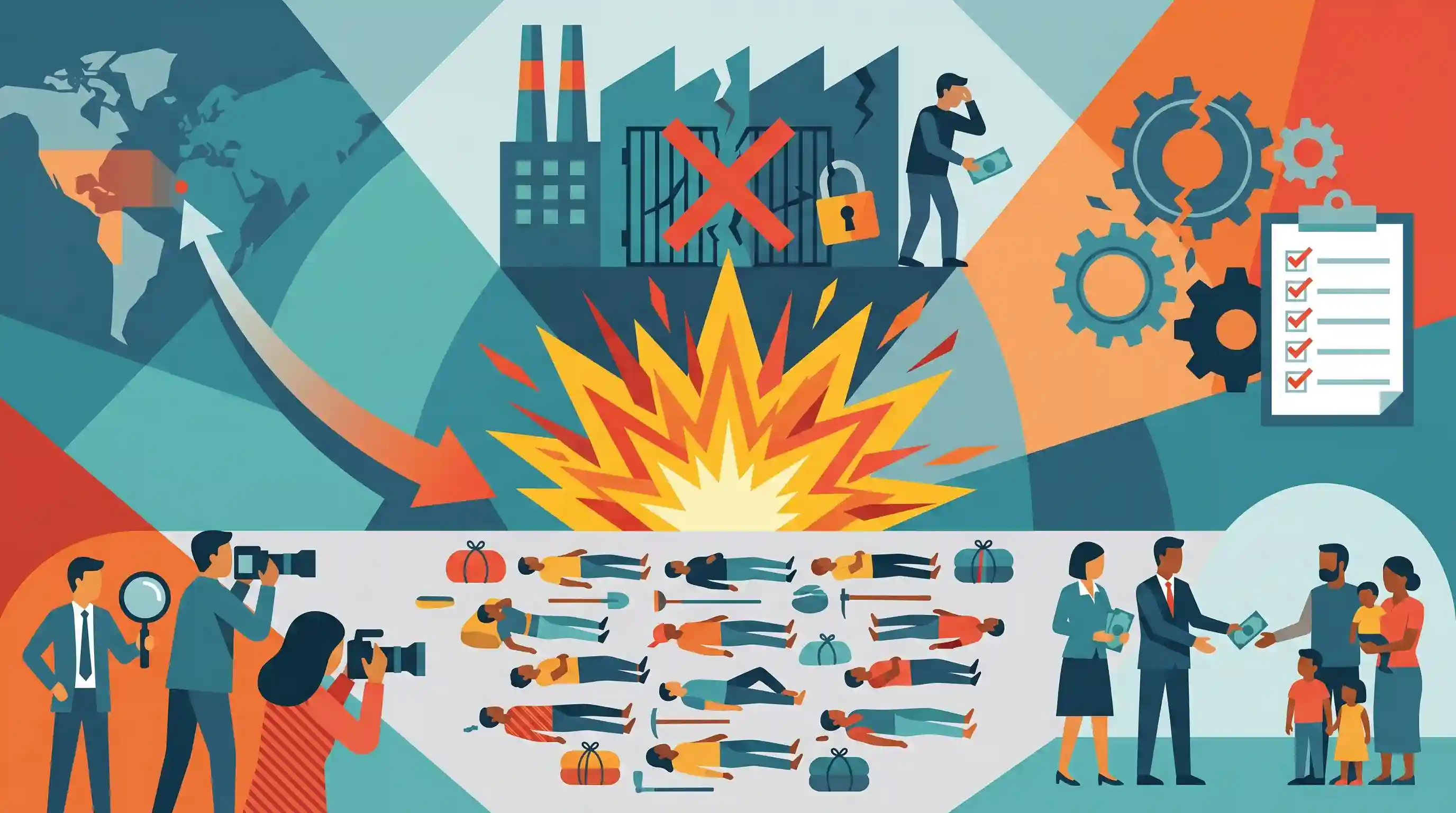
A powerful blast at an illegal firecracker godown in Banaskantha district, Gujarat, claimed the lives of at least 21 people, most of whom were inter-state migrant workers from Madhya Pradesh. The disaster underscores severe administrative negligence, as the facility was operating without a valid license and was illegally manufacturing explosives despite prior safety lapses that prevented its license renewal. The incident brings to the forefront critical issues such as industrial safety enforcement, disaster preparedness, and the severe occupational hazards faced by vulnerable migrant laborers in the unorganized sector. The government has initiated an SIT probe and announced ex gratia compensation for the victims' families.
Key Points
- A massive explosion at an illegal firecracker manufacturing unit in Banaskantha, Gujarat, killed at least 21 people and injured several others.
- The victims were predominantly migrant workers from the Harda and Dewas districts of Madhya Pradesh, highlighting the vulnerability of inter-state laborers.
- The facility's license to store firecrackers had expired in December 2024 and was deliberately not renewed due to safety lapses, yet illegal manufacturing continued.
- The explosion led to the collapse of a three-story structure, prompting a massive rescue operation and the formation of a Special Investigation Team (SIT) by the Gujarat government.
Important Terms
Special Investigation Team (SIT)

A temporary investigative unit formed by the government or judiciary to probe high-profile or complex crimes where regular law enforcement might lack resources, expertise, or perceived impartiality.
UPSC context
GS Paper 2 & 3; tests understanding of ad-hoc administrative mechanisms for accountability in high-profile criminal cases.
Ex Gratia
A voluntary payment made by a government or organization as a gesture of goodwill, rather than a legal liability, typically following accidents or disasters to provide immediate relief.
UPSC context
GS Paper 2 (Governance); relevant for administrative responses to tragedies and the distinction between voluntary relief and statutory compensation.
Unorganized Sector
The segment of the economy consisting of informal employment without formal contracts, fixed wages, or social security, where workers are highly vulnerable to exploitation and hazards.
UPSC context
GS Paper 3 (Economy) and GS Paper 2 (Social Justice); critical for analyzing labor vulnerability and migrant worker issues.
Explosives Act, 1884
The primary Indian legislation regulating the manufacture, possession, sale, and transport of explosives (including fireworks) and establishing the safety standards for the industry.
UPSC context
GS Paper 3 (Disaster Management); tests knowledge of the legal framework governing hazardous materials and public safety.
Occupational Hazards
Physical or health risks arising from work environments, particularly severe in the informal sector due to inadequate safety gear, training, and regulatory oversight.
UPSC context
GS Paper 2 & 3 (Labor Welfare/Economy); focuses on the state's responsibility for safe working conditions and human rights.
Industrial Safety
The legal protocols and management practices aimed at protecting workers and the environment from workplace accidents and industrial disasters through enforcement of safety norms.
UPSC context
GS Paper 3 (Disaster Management); essential for discussing systemic failures in regulatory oversight and implementation of safety standards.
Prelims Trap
"The Petroleum and Explosives Safety Organisation (PESO) functions under the Ministry of Home Affairs."
PESO actually operates under the DPIIT within the Ministry of Commerce and Industry, not the Ministry of Home Affairs or Ministry of Labour.
Static Concepts Connected
What is the mandate of PESO (Petroleum and Explosives Safety Organisation)?
- Nodal Authority: Functions as the nodal agency under the DPIIT (Department for Promotion of Industry and Internal Trade), Ministry of Commerce and Industry.
- Legislative Mandate: Administers the colonial-era Explosives Act, 1884, and the Petroleum Act, 1934 to regulate hazardous substances.
- Core Function: Grants mandatory approvals and licenses for the manufacturing, testing, storage, and transport of explosives and petroleum products.
How does the OSHWC Code 2020 alter protections for inter-state migrant workers?
- Definition Expansion: Includes workers earning up to ₹18,000/month who migrate voluntarily on their own, extending beyond just those recruited via contractors.
- Portability of Benefits: Mandates a statutory framework for portability of PDS benefits (One Nation One Ration Card) and building cess benefits across states.
- Journey Allowance: Requires employers to provide an annual lump-sum allowance for migrant workers to travel to their native places.
Cross-Topic Patterns
PESO + CSIR-NEERI Green Crackers
Illegal units entirely bypass PESO-mandated green cracker formulations (SWAS, STAR, SAFAL) developed by CSIR-NEERI, directly linking industrial safety loopholes to environmental regulations and air pollution management.
Occupational Hazards + Labour Codes
Frequent industrial disasters in unregistered factories highlight critical enforcement gaps in the OSHWC Code 2020, testing the state's capacity to protect informal inter-state migrants.

PESO's nodal ministry, statutory backing under the Explosives Act, and its role in green cracker certification are highly probable for 2026.
Linked PYQs · 3
Linked PYQs · 3
- 2013MainsGS3
How important are vulnerability and risk assessment for pre-disaster management ? As an administrator, what are key areas that you would focus on in a Disaster Management System.
- 2015MainsGS1
Discuss the changes in the trends of labour migration within and outside India in the last four decades.
- 2024MainsGS1
Why do large cities tend to attract more migrants than smaller towns? Discuss in the light of conditions in developing countries.
