Gujarat Government Extends Ban on Gutka and Pan Masala
Source:times-of-india ↗
Why It Matters
Highlights the exercise of statutory powers by state governments under central food safety laws to combat public health hazards like tobacco consumption.
Summary
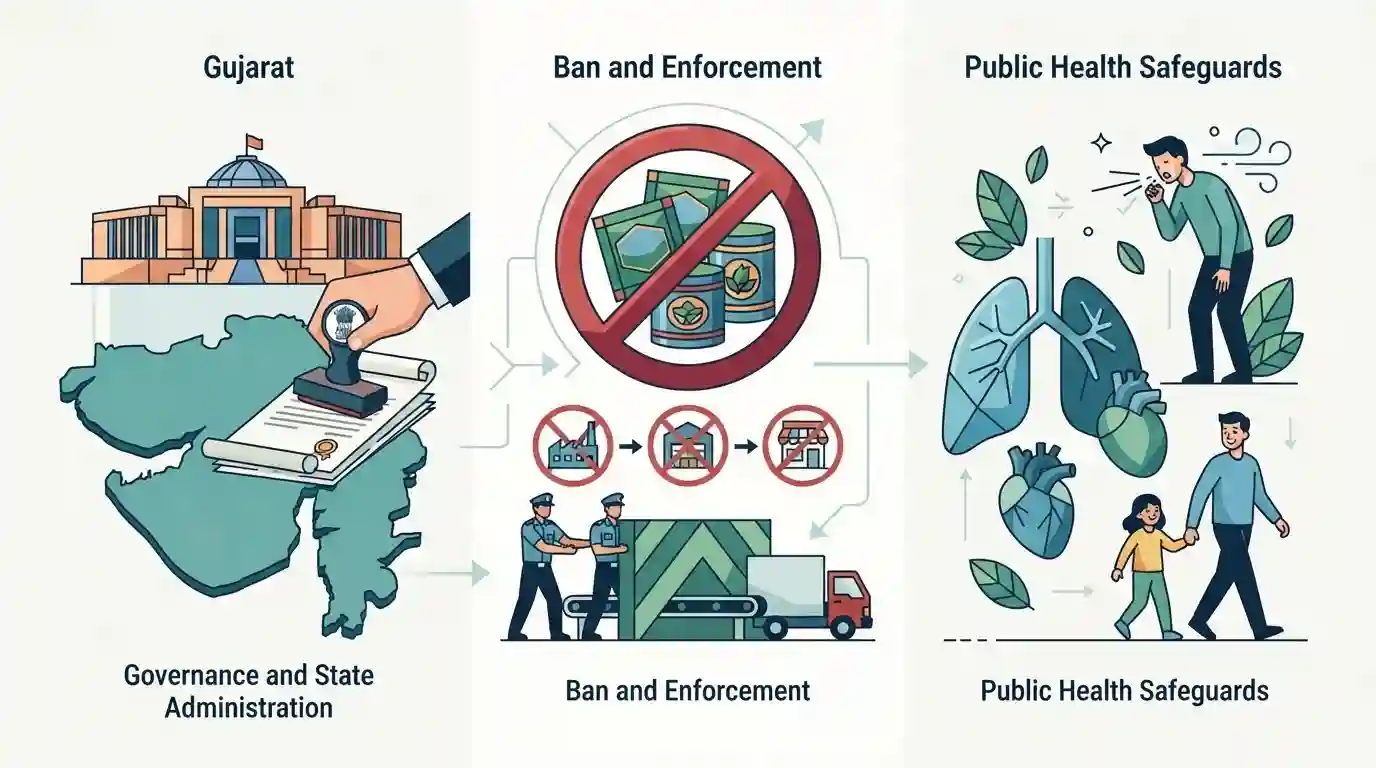
The Gujarat government has extended its annual ban on the production, storage, distribution, and retail sale of gutka and pan masala containing tobacco or nicotine for an additional year, maintaining public health safeguards under the Food Safety and Standards Act, 2006.
Key Points
- The Gujarat government has extended the ban on the manufacture, storage, distribution, and sale of gutka and pan masala containing tobacco or nicotine for another year in the interest of public health.
- The ban is enforced under the provisions of the Food Safety and Standards (Prohibition and Restrictions on Sales) Regulations made under the Food Safety and Standards Act, 2006.
- Tobacco consumption is a major contributor to oral cancer and cardiovascular diseases, making such public health restrictions crucial at the state level.
Important Terms
Food Safety and Standards Act, 2006

An umbrella legislation enacted in 2006 to consolidate food laws, establish scientific standards for food items, and regulate their manufacture, storage, distribution, sale, and import to ensure public safety in India.
UPSC context
Important for UPSC CSE Prelims/Mains (GS Paper II/III: Governance, Health Policies, and Food Safety Regulation).
COTPA 2003
The principal central legislation enacted in 2003 to control and regulate the production, supply, distribution, and advertisement of cigarettes and other tobacco products to protect public health.
UPSC context
Important for UPSC CSE Prelims/Mains (GS Paper II: Social Justice and Health, Public Health Legislation).
Food Safety and Standards Authority of India (FSSAI)
The apex statutory body under the Ministry of Health and Family Welfare responsible for laying down science-based standards for food articles and regulating their manufacture and sale in India.
UPSC context
Important for UPSC Prelims/Mains (GS Paper II/III: Statutory Bodies, Food Security, and Health Governance).
Prelims Trap
permanent nationwide statutory prohibition under the FSS Act without needing state-level annual renewal orders
Aspirants often confuse permanent central bans with state-level Commissioner orders which legally require periodic annual extensions under Section 30(2)(a) of the FSS Act.
Static Concepts Connected
What are the key enforcement provisions and limits under the Food Safety and Standards Act, 2006 for state-level public health bans?
- Section 30(2)(a):: Empowers State Food Safety Commissioners to issue prohibition orders for a maximum of one year at a time in the interest of public health.
- Regulation 2.3.4:: Bars tobacco and nicotine as ingredients in any food products, serving as the legal basis for gutka/pan masala bans.
- FSSAI Role:: Statutory body established under the Act to lay down science-based standards for articles of food and regulate manufacture/sale.
Cross-Topic Patterns
Public Health Federalism: FSS Act vs. State Powers
State food safety commissioners derive prohibition powers under central FSS Act, balancing federal standard-setting with decentralized public health execution.
Administrative Law: Statutory Limits on State Bans
Prohibition orders must be renewed annually under Section 30(2)(a), illustrating administrative checks on executive regulatory overreach in preventive health.

Expect a statement-based question combining FSS Act Section 30(2)(a) powers with Regulation 2.3.4 tobacco bans and COTPA 2003 mandates.
Linked PYQs · 2
Linked PYQs · 2
- 2025GPSC_PRELIMSGS1
The concept of Public Interest Litigation (PIL) in India was introduced to: 1. Allow the courts to take suo motu cognizance of matters affecting the public interest. 2. Ensure legal representation for the economically weaker sections of society. 3. Enable NGOs and activists to file petitions on behalf of affected communities. 4. Restrict the judiciary's power to interfere in government policy decisions. Select the correct answer using the codes given below:
- 2024GPSC_PRELIMSGS1
Consider the following statements regarding 'Public Order'. 1. Article 25 of the Constitution guarantees to all persons the right to profess, practise and propagate religion freely subject to public order. 2. According to Seventh Schedule of the Constitution of India, the power to legislate on aspects of public order rests with the States. 3. Public order is also one of the grounds to restrict fundamental rights. Which of the above statement/statements is/are correct?
