State fiscal discipline and industrial hubs behind top rank
Source:walianewsnetwork ↗
આ શા માટે મહત્વનું છે
Understanding state-level economic competitiveness and fiscal health is crucial for grasping India's cooperative and competitive federalism models. NITI Aayog indices and state financial metrics (like debt-to-GSDP) are frequent themes in state civil services examinations.
સારાંશ
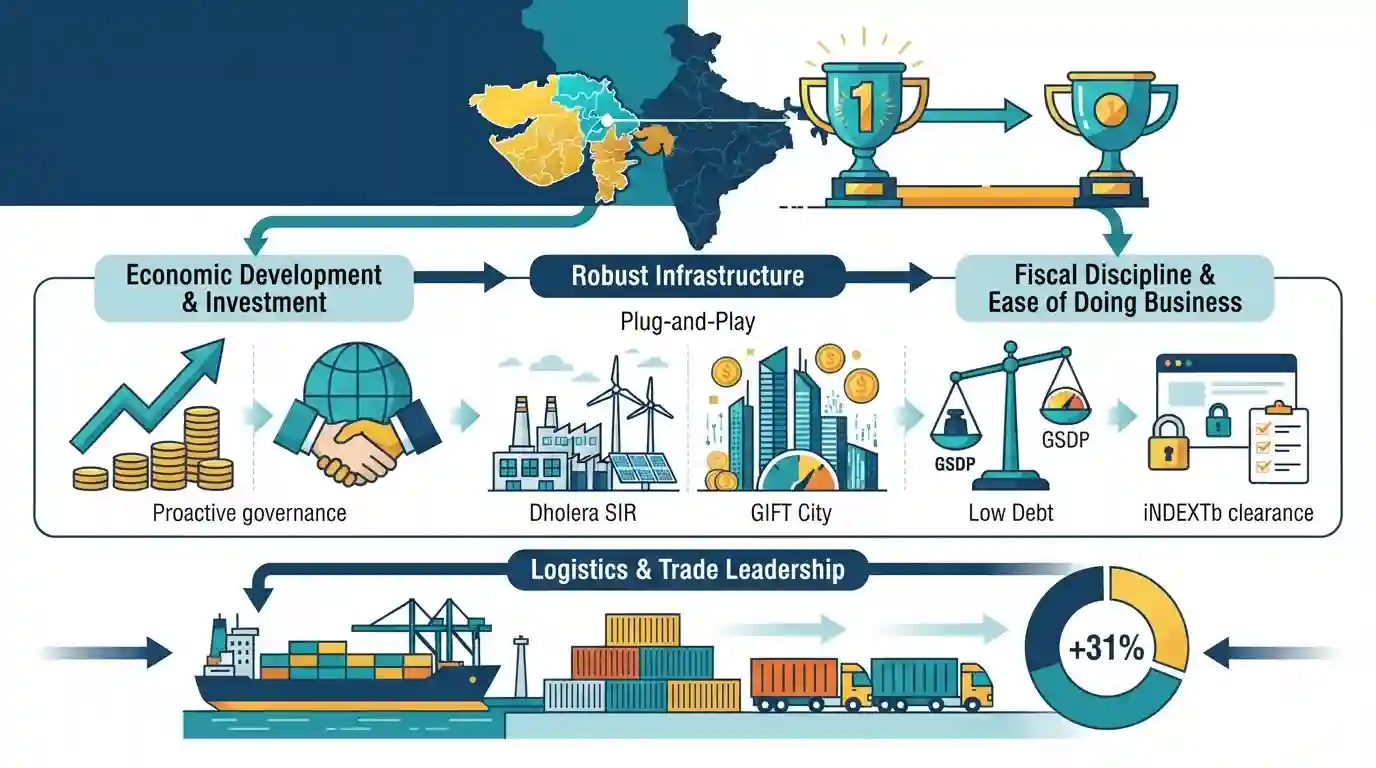
Gujarat has emerged as India's most investment-friendly state, securing the top rank in NITI Aayog's inaugural Investment Friendliness Index 2026. This success is driven by proactive governance, robust 'plug-and-play' industrial infrastructure such as Dholera SIR and GIFT City, and strong fiscal discipline with low debt-to-GSDP and fiscal deficit ratios. The state's single-window clearance system through iNDEXTb enhances the ease of doing business. Furthermore, Gujarat leads in logistics and trade, accounting for over 31% of India's merchandise exports.
મુખ્ય મુદ્દા
- Gujarat ranked first in NITI Aayog's first-ever Investment Friendliness Index 2026, ahead of Maharashtra and Tamil Nadu.
- The state's top position is attributed to efficient governance, robust industrial infrastructure (like Dholera SIR, GIFT City, and Dahej), and strong financial management.
- Gujarat maintains strict fiscal discipline with a fiscal deficit of 2.81% of GSDP and outstanding liabilities at 18% of GSDP for FY24.
- A dedicated single-window clearance mechanism via iNDEXTb significantly improves ease of doing business for investors.
- The state is a leading export hub, contributing over 31% to India's total merchandise exports, supported by strong MSME growth and port connectivity.
મહત્વપૂર્ણ શબ્દો
Investment Friendliness Index

A subnational assessment framework launched by NITI Aayog in 2026 to evaluate, score, and benchmark the investment readiness, business ecosystems, and regulatory ease of Indian states and Union Territories.
UPSC context
GS Paper III (Economy) - Mobilization of resources; tests state-level ease of doing business and competitive federalism dynamics.
NITI Aayog
The apex policy think tank of the Government of India, established in 2015 to replace the Planning Commission and promote cooperative federalism through bottom-up policy strategies.
UPSC context
GS Paper II (Governance) - Statutory and regulatory bodies; tests policymaking mechanisms and the transition to cooperative federalism.
iNDEXTb
The Industrial Extension Bureau, a government of Gujarat investment promotion and single-window facilitation agency designed to assist investors and accelerate industrial development.
UPSC context
GS Paper III (Economy) - Industrial growth; tests administrative facilitation structures and single-window clearance systems.
Vibrant Gujarat Global Summit
A biennial international business and investment summit organized by the Government of Gujarat to showcase the state's industrial potential, foster partnerships, and attract global private capital.
UPSC context
GS Paper III (Economy) - Mobilization of resources; tests subnational diplomacy and public-private investment frameworks.
FRBM Act
The Fiscal Responsibility and Budget Management Act, enacted in 2003, which establishes a legally mandated framework to ensure fiscal discipline, reduce deficits, and manage public debt.
UPSC context
GS Paper III (Economy) - Government budgeting; tests concepts of fiscal consolidation, debt sustainability, and macroeconomic stability.
પ્રિલિમ્સ ટ્રેપ
The Investment Friendliness Index is a state-ranking framework designed and released by the DPIIT under the Ministry of Commerce.
Aspirants often confuse NITI Aayog's inaugural Investment Friendliness Index with the Ease of Doing Business / Business Reforms Action Plan (BRAP) rankings, which are managed by DPIIT.
સંલગ્ન સ્થિર ખ્યાલો
What are the key state fiscal targets recommended by the N.K. Singh Committee on FRBM?
- Fiscal deficit limit: The committee recommended capping the fiscal deficit of state governments at 3% of their Gross State Domestic Product (GSDP).
- Debt-to-GSDP ceiling: It recommended limiting the outstanding debt of individual state governments to 20% of their respective GSDP by FY23.
- Combined public debt: The overall target for combined center-state debt was set at 60% of GDP, with 40% allocated to the center.
How is regulatory jurisdiction managed within India's International Financial Services Centres (IFSCs)?
- Unified regulator: The IFSCA acts as a unified authority, replacing individual sectoral regulators like RBI, SEBI, IRDAI, and PFRDA within the IFSC.
- Foreign currency transactions: Financial services within the IFSC are predominantly carried out in freely convertible foreign currencies rather than domestic INR.
- Deemed foreign territory: Under Indian exchange control laws, IFSC units are treated as persons resident outside India, enjoying distinct regulatory and tax concessions.
આંતર-વિષય પેટર્ન
Competitive federalism vs regional equity
Index-driven rankings drive administrative efficiency but can widen developmental gaps. Historically lagging inland states struggle to match the structural maritime advantages of coastal export hubs like Gujarat.
Infrastructure-led growth and fiscal health
Gujarat’s ability to finance megaprojects like Dholera while staying within FRBM limits showcases how capital expenditure can be scaled without triggering debt-sustainability crises.

State-level FRBM adherence combined with NITI's new competitiveness indices likely to form a core multi-statement Prelims question in 2026.
સંલગ્ન PYQ · 3
સંલગ્ન PYQ · 3
- 2025GPSC_PRELIMSGS1
Consider the following statements: 1. Gujarat has the second lowest debt-to-gross state domestic product (GSDP) ratio among all states 2. A low debt-to-GSDP ratio denotes an unhealthy financial position Which of the statement(s) given above is/are correct?
- 2025GPSC_PRELIMSGS1
______ is one of the cities chosen by the NITI Aayog for its Growth Hub (G-HUB) programme to boost their economic growth.
- 2026GPSC_PRELIMSGS1
Primary deficit is the difference between __________________.
