Doodh Sanjeevani Yojana expansion to tribal ICDS blocks
Source:ianslive ↗
આ શા માટે મહત્વનું છે
State-specific welfare schemes, especially those targeting tribal nutrition and maternal health, are frequently tested in GPSC Prelims. Understanding the integration of the cooperative dairy sector with government welfare programs is also crucial for State Policy questions.
સારાંશ
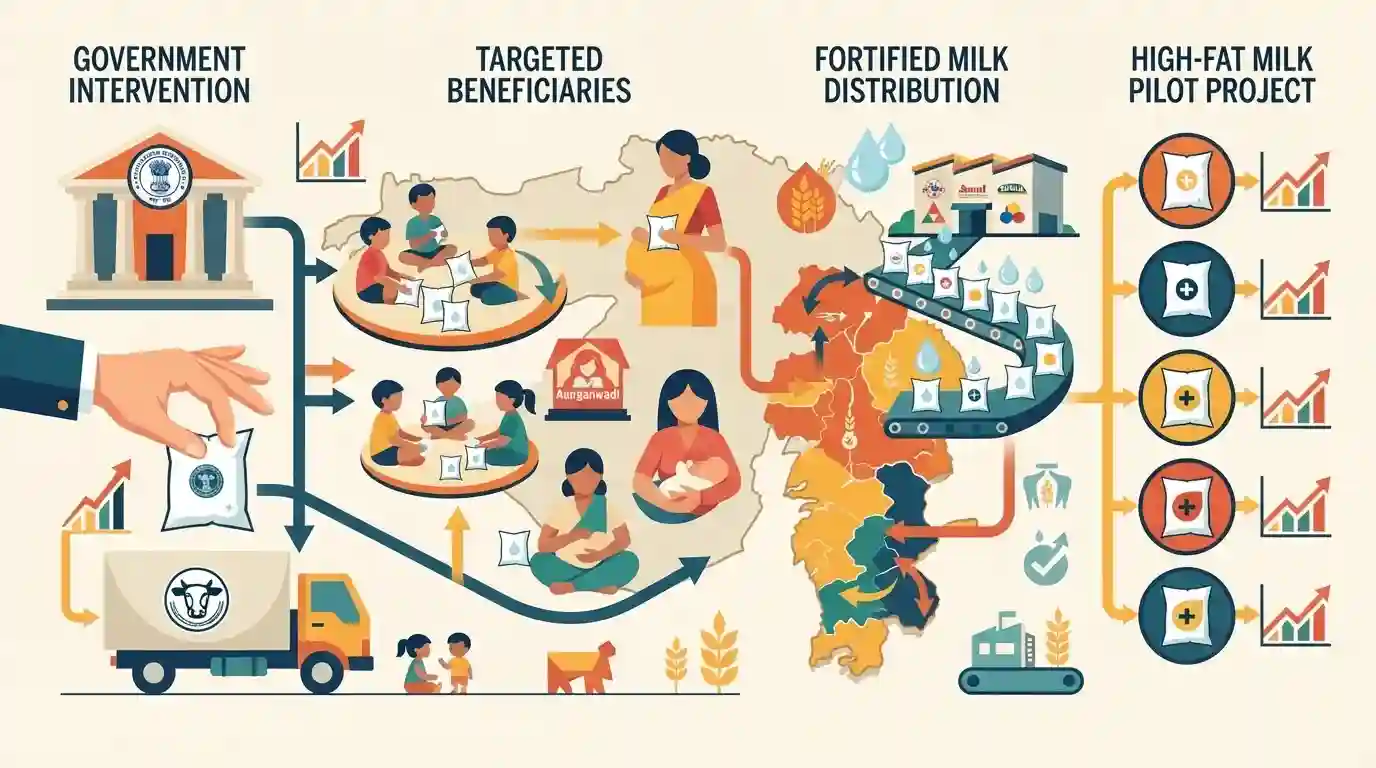
The Government of Gujarat has extended the 'Doodh Sanjeevani Yojana' to all Integrated Child Development Services (ICDS) blocks in the state's tribal areas. Originally launched in 2009 to tackle malnutrition among children, pregnant women, and lactating mothers, the scheme provides 200 ml of fortified milk through a network of cooperative dairies like Amul and Sumul. The latest expansion also features a high-fat milk pilot project in five specific districts, underlining a targeted approach to improving nutritional outcomes in vulnerable communities.
મુખ્ય મુદ્દા
- The Gujarat government has expanded the 'Doodh Sanjeevani Yojana' to cover all ICDS blocks across its tribal districts.
- Under this fully state-funded scheme, children, pregnant women, and lactating mothers receive 200 ml of fortified flavored milk.
- A pilot project distributes high-fat fortified milk (3% to 4.5% fat) in five specific tribal districts: Narmada, Dahod, Dang, Valsad, and Sabarkantha.
- The scheme integrates Gujarat's robust cooperative dairy network (including Amul, Banas, Sumul, and Mahi) for production and supply.
- The latest expansion involves a financial outlay of Rs 37.709 crore, further emphasizing the state's focus on combating malnutrition in marginalized communities.
મહત્વપૂર્ણ શબ્દો
Doodh Sanjeevani Yojana

A Gujarat state government initiative launched in 2009 to combat malnutrition by providing fortified flavored milk to school children, pregnant women, and lactating mothers in tribal areas.
UPSC context
GS Paper 2 (Welfare/Health). Showcases targeted state-level interventions addressing nutritional deficits in vulnerable tribal populations.
Integrated Child Development Services (ICDS)
A centrally sponsored scheme launched in 1975 providing supplementary nutrition, immunization, health check-ups, and pre-school education to children under six, pregnant women, and lactating mothers through Anganwadi centres.
UPSC context
GS Paper 2 (Social Justice). Vital for questions on early childhood development, maternal health, and grassroots service delivery.
Amul
An Indian dairy cooperative based in Anand, Gujarat, founded in 1946. Managed by the GCMMF, it spearheaded India's White Revolution, eliminating middlemen and empowering millions of rural milk producers.
UPSC context
GS Paper 3 (Cooperatives). A premier case study for rural economic empowerment, agricultural marketing, and decentralized socio-economic development.
Sumul
The Surat-Tapi District Co-operative Milk Producers' Union Ltd., established in 1951. It is a major district-level dairy cooperative in Gujarat that procures milk for GCMMF and executes state nutritional schemes.
UPSC context
GS Paper 3 (Agriculture/Cooperatives). Illustrates how district-level cooperative unions execute large-scale welfare schemes and promote financial inclusion among tribal farmers.
પ્રિલિમ્સ ટ્રેપ
"'Doodh Sanjeevani Yojana' is a sub-component of the Centrally Sponsored ICDS scheme funded by the Union Government."
While it utilizes the ICDS Anganwadi network for distribution, Doodh Sanjeevani is a fully state-funded scheme by the Gujarat government, not a central scheme.
સંલગ્ન સ્થિર ખ્યાલો
What are the core components of the ICDS Scheme?
- Target Group: Children (0-6 years), pregnant women, and lactating mothers.
- Six Core Services: Supplementary nutrition, pre-school education, health/nutrition education, immunization, health check-ups, and referral services.
- Funding Structure: A Centrally Sponsored Scheme (CSS) where implementation and supplementary nutrition costs are shared between the Centre and States.
What is food fortification and how is milk fortified in India?
- Combating Hidden Hunger: Deliberate addition of essential micronutrients to staple foods (milk, salt, rice) to combat 'hidden hunger' in vulnerable populations.
- Milk Standards: In India, milk is typically fortified with Vitamin A and Vitamin D, which are often lost during fat processing.
- Plus-F Logo: Regulated by FSSAI, compliant fortified foods are easily identified by the mandated square +F logo on the packaging.
આંતર-વિષય પેટર્ન
Cooperatives + Nutritional Security
Leveraging local dairy cooperatives (Amul, Banas) bypasses intermediaries, ensuring direct nutritional delivery to tribal blocks while simultaneously boosting rural economic security.
Targeted Tribal Interventions
Piloting high-fat milk exclusively in tribal districts mirrors national efforts like the Sickle Cell Anemia elimination mission, highlighting region-specific health policymaking.

Expect a 2026 Mains question linking local cooperative networks (GS3) with targeted nutritional interventions in tribal areas (GS2).
સંલગ્ન PYQ · 3
સંલગ્ન PYQ · 3
- 2025GPSC_PRELIMSGS1
Which of the following statements is/are correct regarding the G-SAFAL scheme?
- 2024GPSC_PRELIMSGS1
Which international organisation works for children?
- 2026GPSC_PRELIMSGS1
Food subsidy is the difference between
