Gujarat Data Centre Policy Promotes Green AI Investment
Source:indianexpress ↗
Why It Matters
The policy serves as a significant case study on how Indian states are incentivizing cutting-edge digital infrastructure while integrating climate goals and green energy mandates into heavy-power industries like AI and data centres.
Summary
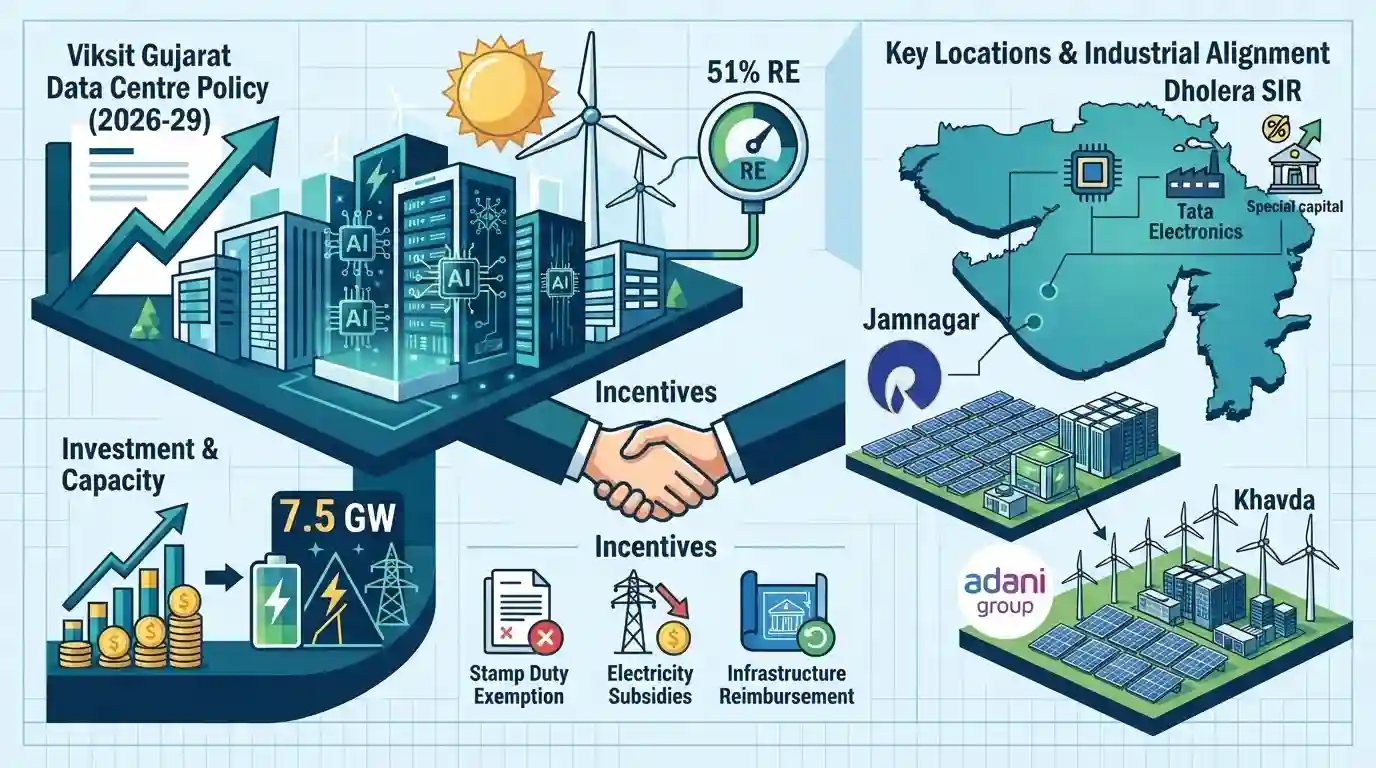
Gujarat has launched the Viksit Gujarat Data Centre Policy (2026-29), aiming to position the state as a leading destination for green, AI-ready data centres. The policy emphasizes sustainability, requiring at least 51% of core operational electricity to be sourced from renewable energy. It targets an ambitious Rs 6 lakh crore in investments and 7.5 GW of data centre capacity. To attract investors, Gujarat is offering sweeping incentives, such as 100% stamp duty exemption, long-term electricity subsidies, and reimbursements on infrastructure expenses. Notably, the policy provides special capital and interest subsidies for projects in the Dholera Special Investment Region (SIR), which is already slated to host Tata Electronics' semiconductor plant. The strategy also aligns with substantial ongoing projects like Reliance Industries' green-energy-powered data centre in Jamnagar and the Adani Group's renewable-backed infrastructure in Khavda.
Key Points
- The Viksit Gujarat Data Centre Policy (2026-29) mandates that at least 51% of electricity for core operations must come from green and renewable sources.
- The policy targets attracting Rs 6 lakh crore in investments and establishing 7.5 GW of data centre capacity.
- Incentives include a 100% exemption on stamp duty, Re 1/unit power tariff subsidy for 20 years, and 100% electricity duty reimbursement.
- Special incentives are focused on Dholera SIR, including capital subsidies of 2.5% on eligible fixed capital investment and interest subsidies up to 4%.
- Key industry alignments include Reliance Industries' green AI data centre in Jamnagar, Tata Electronics' semiconductor plant in Dholera, and Adani Group's renewable-powered facility at Khavda.
Important Terms
Viksit Gujarat Data Centre Policy (2026-29)

A state-level policy launched in July 2026 to attract ₹6 lakh crore in investments and build 7.5 GW of capacity by prioritizing green, AI-ready hyperscale data centers with mandatory 51% renewable energy usage.
UPSC context
GS Paper 3: Infrastructure and S&T. Tests knowledge of digital economy frameworks, green technology integration, and state-led industrial policies.
Tata Electronics
A Tata Group subsidiary establishing India's first commercial semiconductor fabrication facility (Fab) in Dholera, Gujarat, representing a ₹91,000 crore investment to manufacture chips for AI, automotive, and other sectors.
UPSC context
GS Paper 3: Indigenization of Technology and Manufacturing. Evaluates semiconductor self-reliance, the PLI scheme, and domestic high-tech manufacturing ecosystems.
Reliance Industries
A diversified Indian conglomerate developing a massive green-energy-powered data center campus in Jamnagar, Gujarat, and partnering with Meta for its first AI-enabled facility.
UPSC context
GS Paper 3: Infrastructure and Economic Growth. Relates to private sector investments in digital networks and green industrial ecosystems.
Meta
A global technology giant that signed an agreement with Reliance Industries in June 2026 to lease a 168 MW AI-enabled, green-powered, and seawater-cooled data center in Jamnagar, Gujarat.
UPSC context
GS Paper 3: Science & Technology. Assesses understanding of multinational tech infrastructure deployment and global-domestic digital ecosystem collaborations.
Adani Green Energy
India's largest renewable energy firm developing a massive 30 GW clean energy park in Khavda, Gujarat, featuring the world's largest single-location Battery Energy Storage System (BESS) outside China.
UPSC context
GS Paper 3: Energy and Environmental Infrastructure. Examines grid reliability, renewable energy integration, storage technology, and India’s decarbonization targets.
Prelims Trap
"Dholera SIR was recently established under the India Semiconductor Mission to host fabrication plants."
Dholera was conceptualized and developed as a greenfield smart city under the Delhi-Mumbai Industrial Corridor (DMIC), long before the Semiconductor Mission began.
Static Concepts Connected
What are the key features of the Delhi-Mumbai Industrial Corridor (DMIC)?
- Alignment: It runs across six states, largely aligned alongside the Western Dedicated Freight Corridor (WDFC).
- Objective: To develop greenfield industrial smart cities (like Dholera) and manufacturing hubs to boost economic growth and urbanization.
- Funding: It is being developed with financial and technical assistance from the Government of Japan.
How are Data Centres classified under India's economic framework?
- Infrastructure Status: The Union government granted 'Infrastructure' status to Data Centres with more than 5MW capacity in 2022.
- Benefits: This classification allows data centre companies to access long-term, cheaper institutional credit on easier terms and attracts foreign direct investment.
- Strategic Need: It boosts domestic capacity, which is essential for compliance with data localization norms under the DPDP Act.
Cross-Topic Patterns
Green AI & Carbon Footprints
The massive water and electricity requirements of AI data centres intersect directly with India's Net Zero 2070 targets, prompting state-level renewable energy mandates for digital infrastructure.
Industrial Corridors turning Tech Hubs
Legacy industrial corridors like DMIC (Dholera) are pivoting from traditional heavy manufacturing to high-tech clusters (semiconductors, data centres), synergizing PLI schemes with existing smart city infrastructure.

Expect a GS3 question linking the massive carbon footprint of AI to India’s Net Zero targets and data centre localization policies.
Linked PYQs · 1
Linked PYQs · 1
- 2025GPSC_PRELIMSGS1
Reliance industries has announced plans to build the world's largest data centre in ______
