Gujarat Launches Data Center Policy to Attract Investment
Source:india-briefing ↗
આ શા માટે મહત્વનું છે
Highlights Gujarat's strategic shift toward establishing a robust digital economy and accommodating the massive data requirements driven by AI and cloud computing, linking state-level industrial policies directly to digital infrastructure and green energy transitions.
સારાંશ
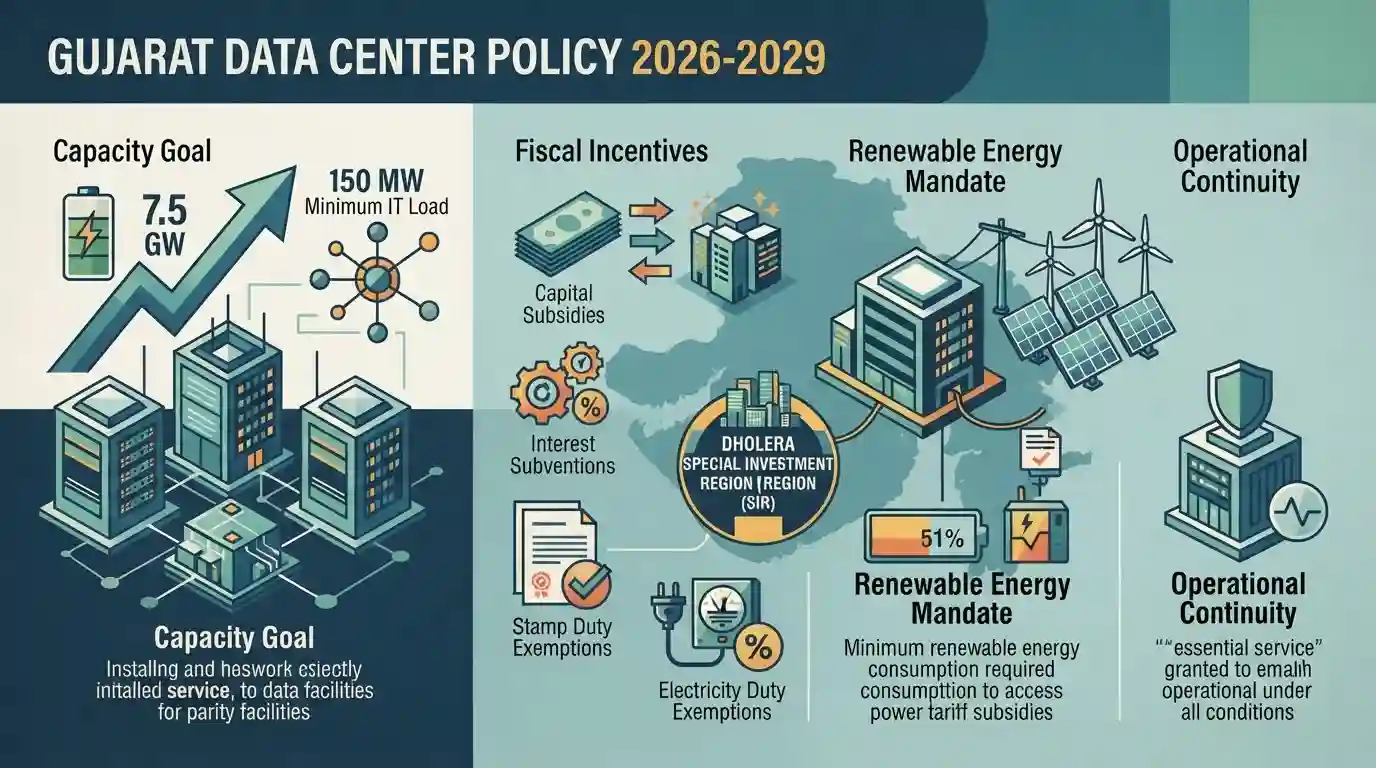
The Government of Gujarat has introduced the Data Center Policy 2026-2029 to establish the state as a prime destination for hyperscale and large colocation data centers. Aiming for an installed capacity of 7.5 GW, the policy outlines a comprehensive framework of fiscal, utility, and regulatory incentives for facilities with a minimum IT load of 150 MW. Key features include targeted capital subsidies for projects within the Dholera Special Investment Region (SIR), interest subventions, and substantial exemptions on stamp duty and electricity duty. The policy inherently promotes sustainability by mandating that at least 51% of power consumption be derived from renewable sources for operators to access the power tariff subsidies. Additionally, data centers will benefit from "essential service" status, ensuring operational continuity.
મુખ્ય મુદ્દા
- The Gujarat Data Center Policy 2026-2029 aims to attract large colocation and hyperscale data centers with a minimum IT load of 150 MW.
- The state has set a target of achieving 7.5 GW of installed data center capacity by the end of the policy period.
- Incentives include a 2.5% capital subsidy for projects in the Dholera Special Investment Region (SIR), up to 4% annual interest subsidy, and 100% exemption on stamp duty.
- To avail utility subsidies, such as the INR 1/unit power tariff subsidy and 100% electricity duty reimbursement, data centers must source at least 51% of their power from renewable energy.
- Data centers set up under this policy will be designated as essential services under the Gujarat Essential Services Maintenance Act, 1972.
મહત્વપૂર્ણ શબ્દો
Gujarat Data Center Policy 2026-2029

A regulatory framework aiming to establish Gujarat as a premier hyperscale data center hub. It targets 7.5 GW capacity, offers extensive fiscal incentives, and mandates that 51% of power consumption come from renewable energy.
UPSC context
GS Paper 3 (Digital Infrastructure). Tests knowledge of state-level tech policies, energy transition in computing, and digital economy growth.
Dholera Special Investment Region (SIR)
India's first planned greenfield smart city in Gujarat, developed under the Delhi-Mumbai Industrial Corridor. It is rapidly emerging as a central hub for renewable energy, semiconductor manufacturing, and large-scale green AI data centers.
UPSC context
GS Paper 3 (Infrastructure). Crucial for topics on industrial corridors, smart cities, and the spatial distribution of digital infrastructure.
Gujarat Essential Services Maintenance Act (ESMA), 1972
A state law ensuring the uninterrupted delivery of vital public services by prohibiting strikes. Under this Act, data centers are newly classified as essential services to guarantee continuous, dispute-free tech operations.
UPSC context
GS Paper 2 & 3 (Governance/Digital Security). Highlights the classification of digital data centers as critical, strike-protected national infrastructure.
IT/ITES Policy 2022-2027
Gujarat's overarching technology policy designed to boost IT exports and employment. Data centers were originally governed by this generalized framework until the state introduced a specialized, standalone infrastructure policy in 2026.
UPSC context
GS Paper 2 (Government Policies). Demonstrates the evolution of state frameworks from generalized IT support to niche, sector-specific digital regulations.
પ્રિલિમ્સ ટ્રેપ
"Data centers are universally classified as essential services pan-India under the Central ESMA."
Classification of specific sectors like data centers as 'essential' to prohibit strikes is typically done under State-specific ESMA laws, not a universal Central mandate.
સંલગ્ન સ્થિર ખ્યાલો
What is the legal framework governing Essential Services (ESMA) in India?
- Statutory Right: The right to strike is a statutory right under the Industrial Disputes Act, not a fundamental right. ESMA restricts this right.
- State Enactments: While a Central ESMA exists, States enact their own laws (e.g., Gujarat ESMA 1972) to notify specific state-level sectors as essential services.
What are the administrative features of the Dholera Special Investment Region?
- Greenfield Smart City: It is India's first greenfield industrial smart city and a major investment node on the Delhi-Mumbai Industrial Corridor (DMIC).
- Joint Venture: It is administered by a Special Purpose Vehicle jointly held by the Central Government (NICDC Trust) and the State Government.
આંતર-વિષય પેટર્ન
Green IT + Climate Commitments
The 51% RE mandate for subsidies connects GS3 digital infrastructure growth with GS3 carbon footprint reduction, highlighting an emerging "Green Data Center" theme.
Industrial Corridors + Digital Hubs
Locating hyperscale data centers in Dholera highlights the evolution of manufacturing corridors (DMIC) into integrated, data-driven smart industrial ecosystems.

Expect a Prelims question on the environmental cost of AI/Data Centers, linking hyperscale power demands to India's renewable energy goals.
સંલગ્ન PYQ · 2
સંલગ્ન PYQ · 2
- 2025GPSC_PRELIMSGS1
Reliance industries has announced plans to build the world's largest data centre in ______
- 2025GPSC_PRELIMSGS1
Under the Green Open Access Rules, 2022, the minimum size of the renewable energy project eligible for open access is
