Gujarat orders strict administrative probes via SWAGAT portal
Source:ians ↗
Why It Matters
The article is highly relevant for GPSC Class 1-2 Prelims as it showcases a prominent state-level e-governance initiative (SWAGAT), conceptually similar to the central PRAGATI portal, which is a key topic in GS2 Governance. It also touches upon grassroots governance challenges, such as protecting community resources (gauchar lands) and preventing leakages in public housing welfare schemes.
Summary
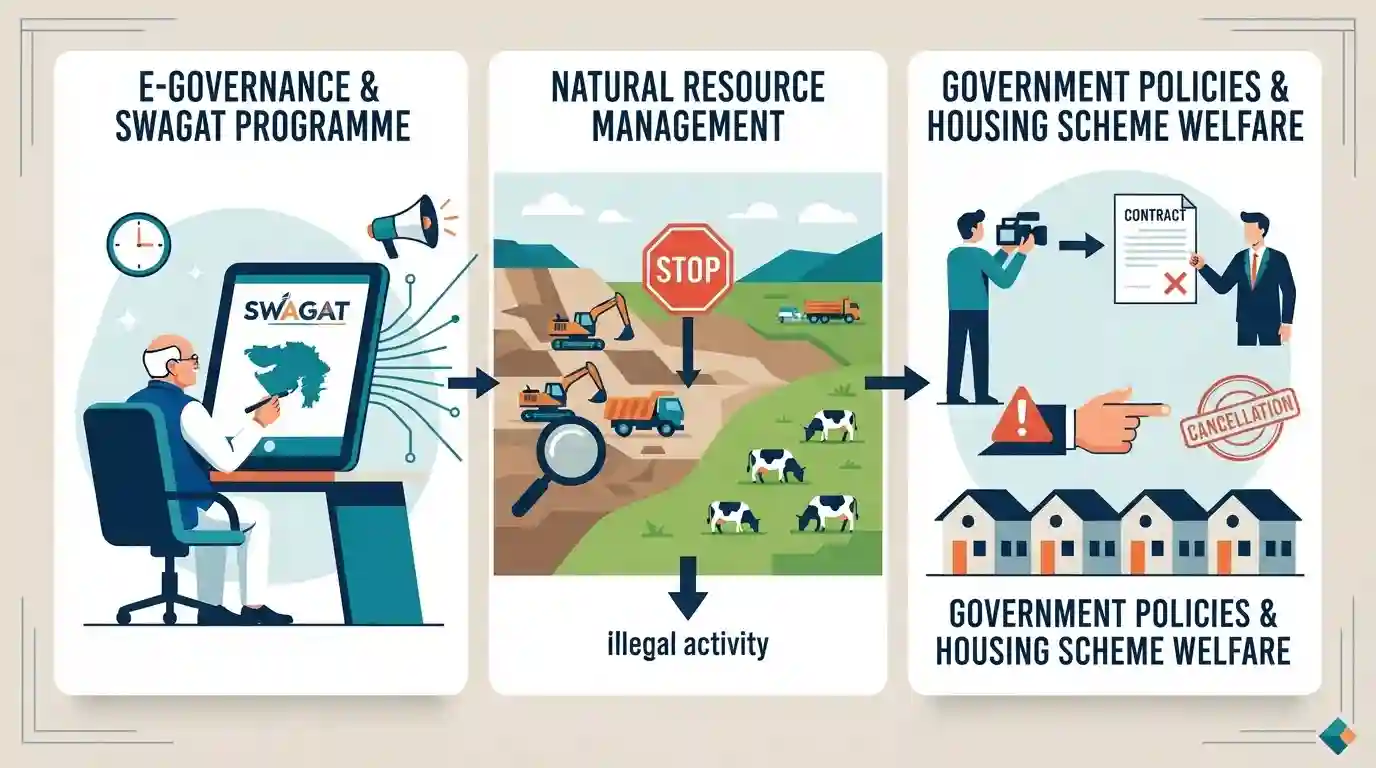
During the State SWAGAT online grievance redressal programme, Gujarat Chief Minister Bhupendra Patel ordered swift administrative action regarding two major citizen grievances. He directed the Geology and Mining Commissioner to probe and halt alleged illegal mining activities on gauchar (grazing) land in Mehsana district. Additionally, responding to complaints from Patan district, he ordered an inquiry, complete with video recording, into the illegal renting of houses allotted under a government housing scheme, warning that allotments would be cancelled if violations were found. The SWAGAT initiative exemplifies the state's use of e-governance for rapid and transparent public grievance resolution.
Key Points
- Gujarat CM utilized the State SWAGAT online grievance redressal programme to directly address citizen complaints.
- Directed the Geology and Mining Commissioner to take strict, immediate action against illegal mining on gauchar (grazing) lands in Mehsana district.
- Ordered an inquiry with video evidence into the illegal renting of government-allotted houses in Patan district, threatening cancellation of allotments.
- The intervention highlights the efficacy of tech-enabled e-governance platforms in ensuring administrative accountability and transparent grievance redressal.
Important Terms
SWAGAT Initiative

State-Wide Attention on Grievances by Application of Technology (SWAGAT) is a pioneering e-governance program in Gujarat enabling citizens to interact directly with the Chief Minister to resolve long-pending public grievances transparently.
UPSC context
Highly relevant for GPSC Public Administration and E-Governance sections, illustrating technology-driven administrative accountability and public grievance redressal.
Gauchar Land
Designated village pasture or grazing land owned by the government for community livestock. Protecting it from encroachments or illegal mining is a key duty governed by Gujarat's land revenue and panchayat laws.
UPSC context
Tested in GPSC Geography, Economy, and Panchayati Raj topics regarding natural resource management, land rights, and local self-government.
Government Housing Schemes
State and central welfare programs providing affordable housing to eligible beneficiaries. Strict allotment rules mandate personal use; illegally renting out such properties can result in administrative inquiries and allotment cancellation.
UPSC context
Important for GPSC Social Sector and Economy papers to test knowledge of public welfare policies, beneficiary compliance, and state interventions.
Commissionerate of Geology and Mining
The state administrative authority in Gujarat responsible for managing mineral exploration, administering mining leases, and investigating the illegal extraction of natural resources on government and private lands.
UPSC context
Relevant to GPSC State Administration and Geography, focusing on regulatory frameworks, environmental protection, and state resource management mechanisms.
Prelims Trap
Gauchar land is absolute property of the Gram Panchayat and the state administration has no authority to resume it.
Under Section 108 of the Gujarat Panchayats Act, while Gauchar land is vested in the Panchayat, the District Collector retains overriding legal authority to resume it for public purposes.
Static Concepts Connected
What is the structural framework of Gujarat's SWAGAT grievance redressal initiative?
- Four-Tier Architecture: The system is decentralized into Gram, Taluka, District, and State levels to ensure grievances are filtered and handled at the appropriate administrative tier.
- State SWAGAT: At the apex level, the Chief Minister personally addresses unresolved grievances directly from citizens on the fourth Thursday of every month.
- Launch & Objective: Launched in April 2003, it leverages e-governance to provide time-bound, transparent, and direct administrative accountability for the public.
How is minor mineral extraction regulated in India?
- State Jurisdiction: While major minerals are centrally regulated, minor minerals (like sand, stone, and gravel) fall under the regulatory jurisdiction of State Governments.
- MMDR Act 1957: State governments are empowered under the MMDR Act, 1957 to frame rules for minor mineral concessions and prevent illegal mining.
- Gujarat Rules 2017: Enforced via the Gujarat Minor Mineral Concession Rules, 2017, empowering the Geology and Mining Commissioner to levy fines and seize equipment.
Cross-Topic Patterns
E-governance intersecting local ecology
SWAGAT grievance data exposes grassroots mismanagement of ecological assets (Gauchar) governed by the Panchayati Raj Act, bridging state-level tech-policy with local land governance.
Welfare economics and asset tracking
The subletting of public housing highlights post-allotment asset leakage, a key challenge frequently evaluated in GS-2 welfare scheme audits and poverty alleviation frameworks.

Expect a multi-statement question combining SWAGAT's 4-tier structure with the statutory powers of the District Collector over Gauchar land.
Linked PYQs · 3
Linked PYQs · 3
- 2017GPSC_PRELIMSGS1
The Multi Purpose and Multi model platform PRAGATI (Pro Active Governance and Timely Implementation) launched in March 2015 aims to
- 2026GPSC_PRELIMSGS1
Consider the following pairs of mineral resources and their prominent mining districts/regions in Gujarat: Mineral - Associated Region 1. Bauxite - Devbhumi Dwarka 2. Lignite - Panandhro (Kutch) 3. Limestone - Porbandar 4. Chalk (Porbandar Stone) - Junagadh Which of the above pairs are correctly matched?
- 2025GPSC_PRELIMSGS1
Which of the following policies or programs are aimed at improving governance at the state and central level? 1. Digital India Mission 2. Smart Cities Mission 3. Direct Benefit Transfer (DBT) Scheme 4. Pradhan Mantri Awas Yojana (PMAY) Select the correct answer using the codes given below:
