Electric Bus Fleet Expansion and Green Mobility in Gujarat
Why It Matters
Highlights state-level initiatives in green mobility, electric vehicle adoption, and sustainable urban transport infrastructure, which are key themes in contemporary governance and environmental management questions.
Summary
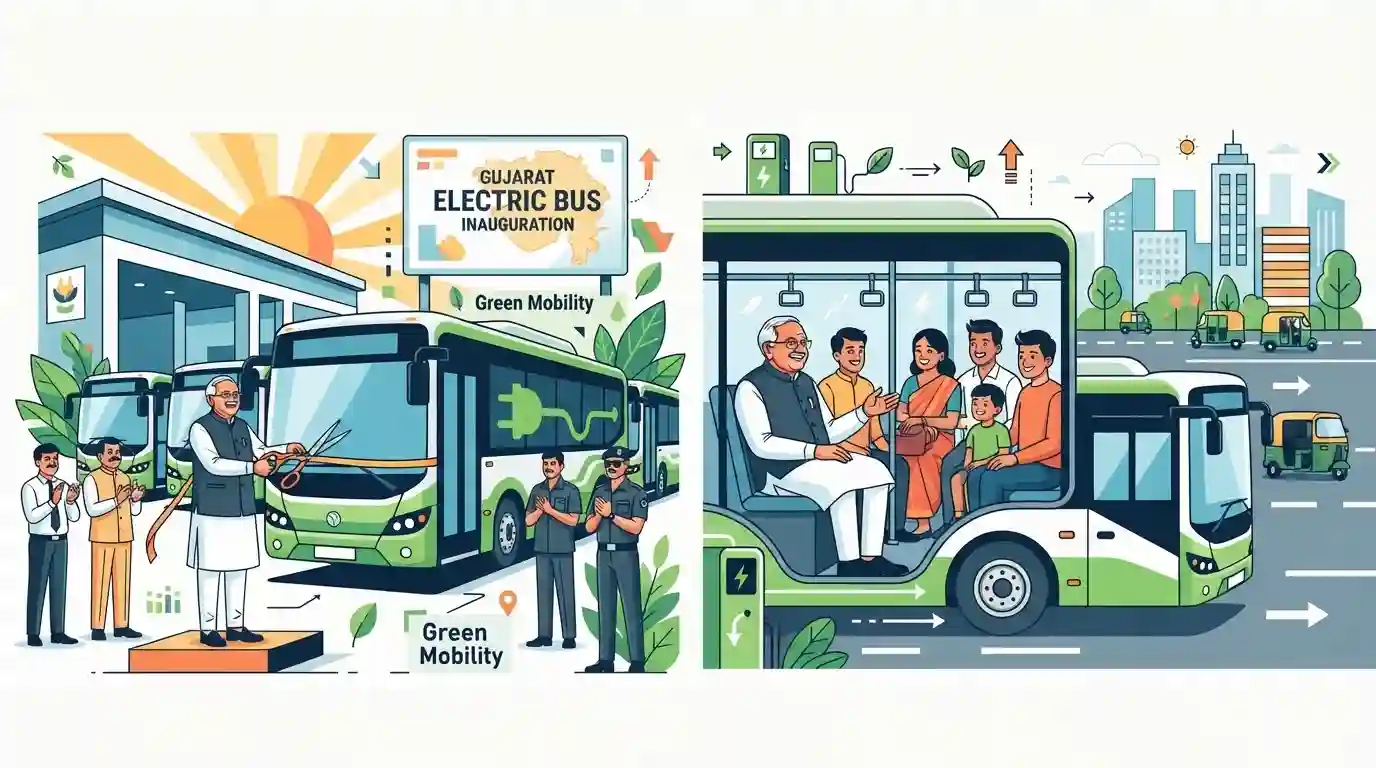
Gujarat Chief Minister Bhupendra Patel flagged off 30 new electric buses in the state, emphasizing green mobility and sustainable urban public transportation. He also personally traveled in one of the e-buses as a passenger to assess the service quality and interact with the public.
Key Points
- Gujarat Chief Minister Bhupendra Patel flagged off 30 new electric buses to boost sustainable public urban transportation in the state.
- The Chief Minister also took a ride as a regular passenger to experience the service and interact with citizens, promoting confidence in public mobility.
- The initiative aligns with broader national and state objectives to reduce carbon emissions, lower urban air pollution, and transition to green mobility infrastructure.
Important Terms
PM eBus Sewa

A central government scheme aimed at expanding city bus operations with 10,000 electric buses through a Public-Private Partnership model to promote green mobility.
UPSC context
Important for GPSC Paper 3 (Infrastructure, Urban Public Transport, and Environmental Sustainability).
Government of Gujarat
The executive branch of the state government of Gujarat, headed by the Chief Minister, responsible for implementing policies, infrastructure projects, and public welfare schemes in the state.
UPSC context
Important for GPSC Paper 2/3 (State Administration, Governance, and Policy Implementation).
Prelims Trap
PM-eBus Sewa scheme is fully funded by the central government without state or private participation.
Aspirants often confuse centrally sponsored schemes like PM-eBus Sewa as 100% centrally funded when they usually involve public-private partnerships (PPPs) and state co-funding.
Static Concepts Connected
What are the key funding and implementation mechanisms under the PM-eBus Sewa scheme?
- Funding Model: Assistance Model: Supports e-bus operations for 10 years through a Public-Private Partnership (PPP) model using Gross Cost Contract (GCC).
- Coverage Target: Target Cities: Focuses on cities with a population of 3 lakh and above, prioritizing state capitals and UT headquarters.
- Fleet Expansion: Green Objective: Aims to augment city bus services with 10,000 e-buses to curb urban carbon footprints.
Cross-Topic Patterns
E-Buses & Urban Fiscal Federalism
The PM-eBus Sewa scheme integrates green urban mobility with municipal fiscal federalism, linking central assistance to local public transport reforms across Indian cities.
Green Mobility & Climate Commitments
Expanding public e-mobility infrastructure directly supports India's Panchamrit commitments under the UNFCCC by cutting municipal transport emissions.

PM-eBus Sewa execution model + state-level green mobility targets frequently appear in multi-statement prelims questions.
Linked PYQs · 2
Linked PYQs · 2
- 2025GPSC_PRELIMSGS1
According to the Socio-Economic Review, 2024-2025 of Gujarat, Gujarat comes in ______ category in Logistic Ease Across Different States (LEADS), 2024.
- 2025GPSC_PRELIMSGS1
______ is one of the cities chosen by the NITI Aayog for its Growth Hub (G-HUB) programme to boost their economic growth.
