Gujarat grants special infrastructure funds for women legislators
Source:ani ↗
Why It Matters
Highlights executive discretionary funding mechanisms for localized infrastructure development and the political acknowledgment of women representatives, relevant to state polity, local governance, and empowerment themes in civil services.
Summary
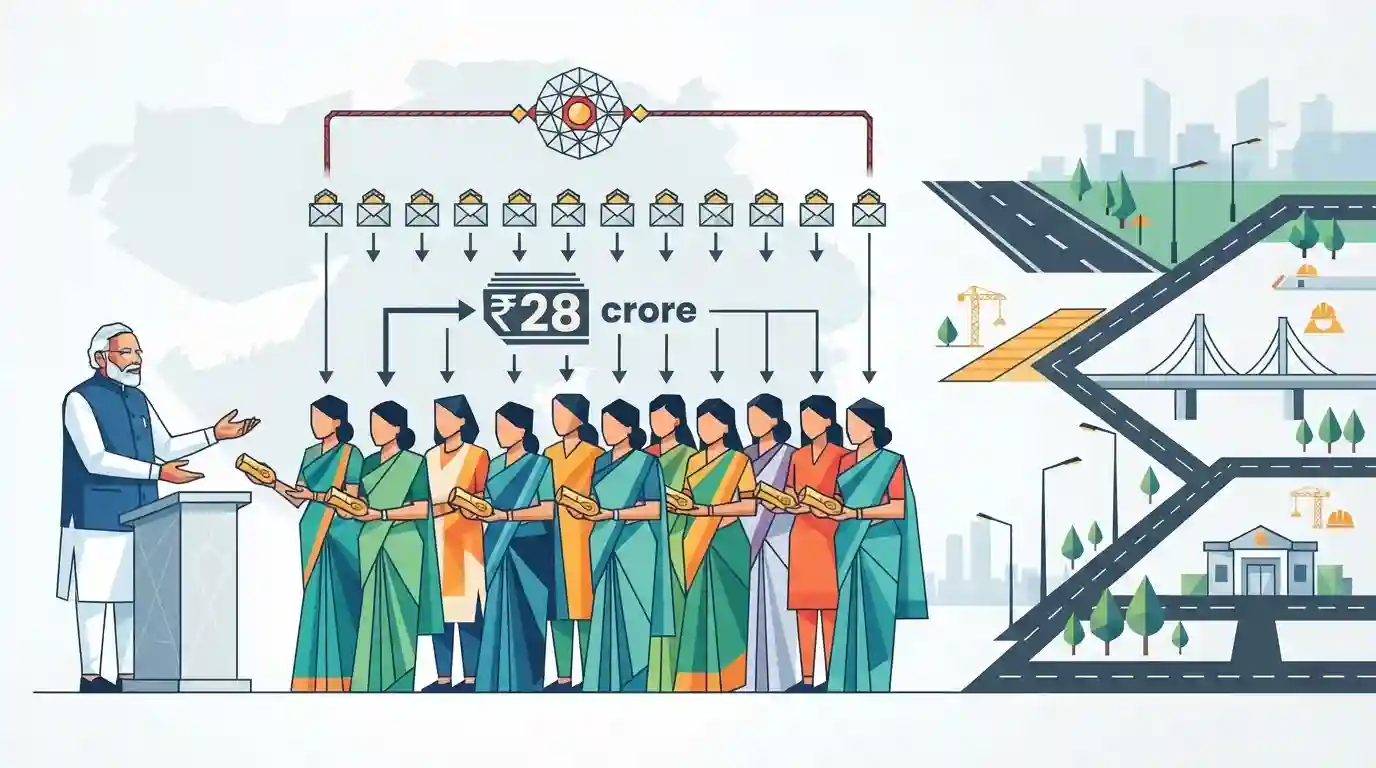
Gujarat Chief Minister Bhupendra Patel has allocated a special discretionary grant of Rs 28 crore to 14 women legislators as a Raksha Bandhan gift. Under this initiative, each female MLA will receive Rs 2 crore specifically for road and infrastructure development in their constituencies, underscoring the state's dual focus on women's political empowerment and localized infrastructure growth.
Key Points
- Gujarat CM Bhupendra Patel announced a Rs 28 crore special grant as a Raksha Bandhan gesture for women legislators.
- Each of the 14 female MLAs (9 from urban areas and 5 from rural areas) will receive Rs 2 crore.
- The funds are exclusively earmarked for road and infrastructure development within their respective constituencies.
- The initiative highlights the state government's commitment to 'Nari Shakti' (women empowerment) and localized development.
Important Terms
Government of Gujarat

The state-level governing authority of Gujarat, comprising the executive branch headed by the Chief Minister and a council of ministers responsible for administrative and policy decisions.
UPSC context
Relevant for GPSC Paper 2 (Polity); tests understanding of the state executive, its discretionary powers, and policy implementation frameworks.
Gujarat Legislative Assembly
The unicameral state legislature of Gujarat, consisting of elected Members of Legislative Assembly (MLAs) who enact state laws and represent their respective constituency interests.
UPSC context
Crucial for GPSC Paper 2 (Polity); covers state legislative structure, the role of MLAs, and representative democracy.
Discretionary Grant
Funds allocated by an executive authority, such as a Chief Minister, at their discretion for specific public welfare or infrastructure projects without strict pre-determined statutory allocation formulas.
UPSC context
Important for GPSC Paper 2 (Governance) and Paper 3 (Public Finance); tests knowledge of state financial management and executive powers.
Local Area Development
A decentralized developmental approach where funds are channeled toward localized infrastructure and civic projects in specific constituencies, often guided by elected representatives.
UPSC context
Relevant for GPSC Paper 2 (Governance); highlights decentralized planning, grassroots infrastructure growth, and localized constituency needs.
Women's Political Empowerment
The enhancement of women's influence, representation, and control over resources within political systems, ensuring they can actively shape governance and local policy outcomes.
UPSC context
Essential for GPSC Paper 1 (Social Issues); tests understanding of gender equity, targeted state initiatives, and inclusive governance strategies.
Prelims Trap
"The Rs 2 crore allocation is a statutory enhancement of the MLA-LAD fund for female legislators."
This is a special Chief Ministerial discretionary grant, not a statutory increase or amendment to the regular annual ₹2.5 crore MLA-LAD allocation.
Static Concepts Connected
What are the operational mechanics of the MLA-LAD scheme?
- Recommendation based: MLAs only recommend projects based on local needs; they do not directly execute or physically handle the funds.
- Execution authority: District authorities (Collectors or District Development Officers) evaluate technical feasibility, sanction the funds, and oversee execution.
- Asset creation: The funds primarily target the creation of durable community assets like drinking water, localized roads, and public health infrastructure.
What characterizes the Chief Minister's discretionary funds?
- Executive agility: Enables the executive to bypass standard bureaucratic delays to provide urgent relief or fund targeted, priority state initiatives.
- Financial accountability: Despite the term "discretionary," these allocations are subject to CAG audits and judicial review to prevent arbitrary or unconstitutional use.
Cross-Topic Patterns
106th Amendment vs. Current Demographics
Highlighting the gap between the upcoming constitutional mandate of 33% reservation for women and Gujarat's current assembly reality, where female representation remains stubbornly under 8% (14 out of 182).
Executive Grants & Nari Shakti
Connects state-level discretionary infrastructure spending to the broader national governance theme of "women-led development" and the strengthening of localized female political agency.

Expect a multi-statement question contrasting CM's discretionary powers with statutory MLA-LAD funds, framed around women's representation.
Linked PYQs · 3
Linked PYQs · 3
- 2021GPSC_PRELIMSGS1
Match the following List-I with List-II | List-I | List-II | |---|---| | 1. Compulsory Provisions | a) Voting rights of the chairperson and other members | | 2. Voluntary Provisions | b) Making the Grants in aid to the panchayats from Consolidated Fund of State | | 3. RR Diwakar Committee | c) Committee on Panchayat Raj Elections | | 4. K. Santhanam Committee | d) Study team on the position of Gram Sabha | Code:
- 2024GPSC_PRELIMSGS1
The National Commission for Women was set up as statutory body in January 1992 under the National Commission for Women Act, 1990. The aim of the commission is to: (A) review the Constitutional and Legal safeguards for women; (B) recommend remedial legislative measures; (C) facilitate redressal of grievances and punish the guilty. (D) advise the Government on all policy matters affecting women. Which is not correct statement?
- 2024GPSC_PRELIMSGS1
Consider the following statements regarding National Commission for Women (NCW). 1. It has all the powers of a High Court. 2. It can attend to cases of harassment of women and order appropriate punishments. 3. It can review the Constitutional and Legal safeguards for women. 4. It facilitates redressal of grievances and advise the Government on all policy matters affecting women. Which of the above statements are correct?
