Gujarat Places Emergency Operations Centre On High Alert
Source:indianmasterminds ↗
આ શા માટે મહત્વનું છે
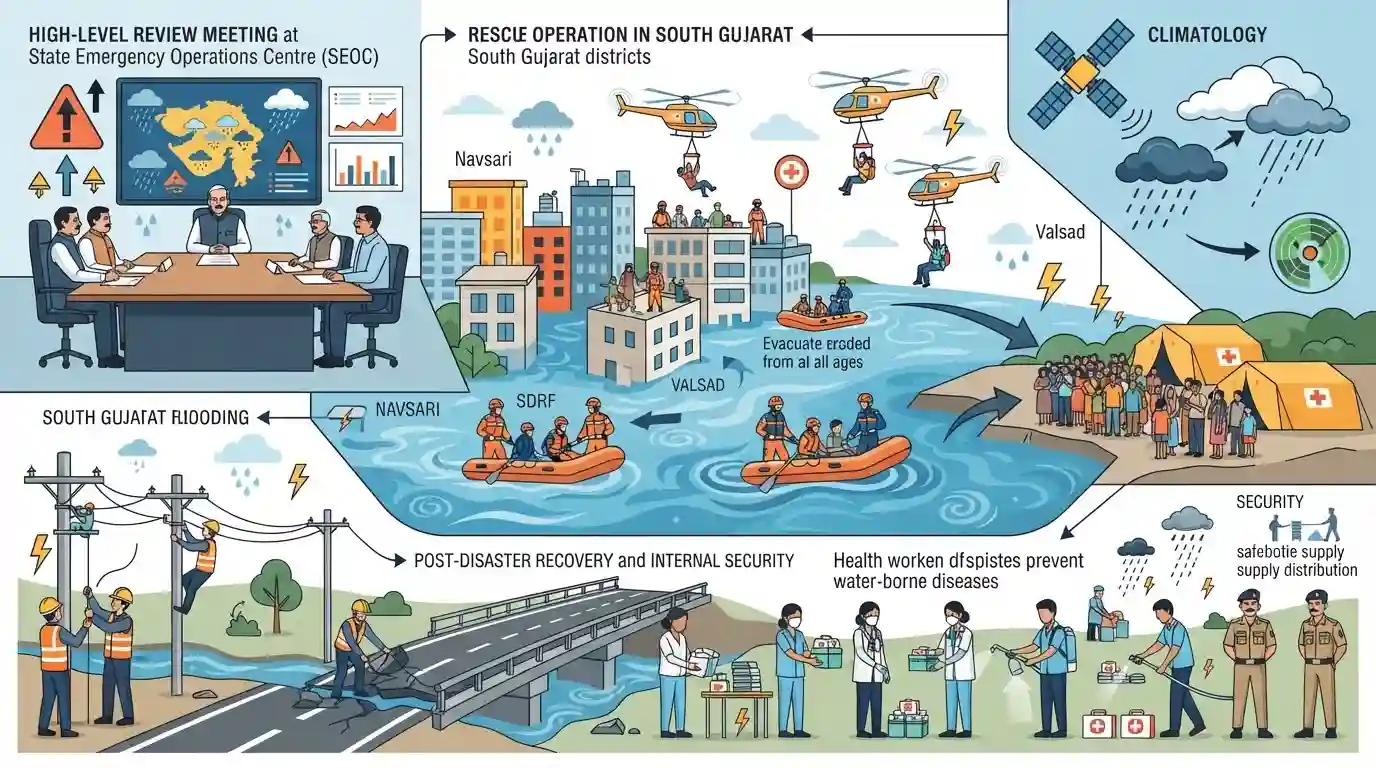
Highlights the structural response mechanisms for disaster management (NDRF, SDRF, SEOC) during extreme weather events. Relevant for studying the role of meteorological departments in forecasting and the socio-economic impacts of erratic rainfall and urban flooding due to climate change.
સારાંશ
Gujarat Chief Minister Bhupendra Patel conducted a high-level review of the state's rain situation at the State Emergency Operations Centre (SEOC), ordering a high alert amid heavy rainfall forecasts by the IMD. Widespread flooding, particularly in South Gujarat districts like Navsari and Valsad, has necessitated the deployment of multiple NDRF and SDRF teams, leading to the successful evacuation of over 22,000 people. The state machinery is also preparing for post-disaster recovery, focusing on restoring electricity, repairing infrastructure, and preventing health crises due to water-borne diseases.
મુખ્ય મુદ્દા
- Gujarat CM Bhupendra Patel reviewed extreme rainfall and flooding at the State Emergency Operations Centre (SEOC) in Gandhinagar.
- Heavy downpours have severely impacted South Gujarat, resulting in the evacuation of over 22,000 residents from Navsari and Valsad.
- Four National Disaster Response Force (NDRF) teams alongside State Disaster Response Force (SDRF) units have been deployed across South Gujarat and Saurashtra for rescue efforts.
- The administration is focusing on post-rainfall recovery operations, prioritizing road repairs, infrastructure restoration, and measures to prevent waterborne diseases.
મહત્વપૂર્ણ શબ્દો
National Disaster Response Force (NDRF)

A specialized national force established under the Disaster Management Act, 2005, tasked with expert search, rescue, and relief operations during severe natural and man-made disasters.
UPSC context
Crucial for GS Paper 3 (Disaster Management). Tests knowledge of India's statutory emergency response framework and internal security mechanisms.
State Disaster Response Force (SDRF)
A state-level specialized emergency force constituted under the Disaster Management Act, 2005, designed to provide swift, localized response and immediate relief during disasters.
UPSC context
Relevant for GS Paper 3 (Disaster Management). Highlights the decentralized tier of India's disaster response and centre-state administrative coordination.
State Emergency Operations Centre (SEOC)
A centralized command-and-control hub at the state level that leverages real-time data, AI, and GIS to coordinate disaster preparedness, early warnings, and emergency response efforts.
UPSC context
Essential for GS Paper 3 (Disaster Management). Illustrates institutional mechanisms, e-governance, and ICT integration in modern crisis management.
India Meteorological Department (IMD)
India's principal agency under the Ministry of Earth Sciences responsible for meteorological observations, weather forecasting, climate modeling, and issuing early warnings for natural hazards.
UPSC context
Vital for GS Paper 1 (Geography) and GS Paper 3 (Disaster Management). Tests understanding of early warning systems and climatology.
પ્રિલિમ્સ ટ્રેપ
The State Disaster Response Fund (SDRF) is entirely funded and managed by the respective State Governments.
SDRF is primarily funded by the Union Government based on Finance Commission recommendations. The Centre contributes 75% for general category states and 90% for special category states.
સંલગ્ન સ્થિર ખ્યાલો
What meteorological factors drive intense localized rainfall along India's West Coast during the monsoon?
- Offshore Troughs: An elongated low-pressure area parallel to the coast, often stretching from Gujarat to Kerala, which draws in massive moisture.
- Moisture Convergence: These troughs enhance the convergence of moisture-laden South-West Monsoon winds against the physical barrier of the Western Ghats.
- Orographic Effect: The Ghats force the moist air to ascend rapidly, leading to extreme, concentrated precipitation on the windward side and coastal plains.
How is the State Disaster Response Fund (SDRF) structured under the Disaster Management Act, 2005?
- Statutory Backing: Constituted under Section 48 (1) (a) of the DM Act, 2005, it is the primary fund available with State Governments for responses to notified disasters.
- Funding Ratio: The Centre contributes 75% of SDRF allocations for general category states and 90% for special category states (Northeast and Himalayan).
- Release Mechanism: Annual Central contributions are released in two equal installments as per the recommendations of the Finance Commission.
આંતર-વિષય પેટર્ન
Offshore Troughs & Coastal Flooding
The intersection of monsoon climatology (offshore troughs) and urban geography (poor drainage in coastal plains) is a classic UPSC Mains theme for assessing disaster vulnerability.
Post-Disaster Public Health Governance
Flood recovery links directly to public health governance. Post-disaster surges in waterborne and vector-borne diseases test the efficacy of local municipal administration and early warning systems.

Prelims 2026 will likely test the exact Centre-State funding ratios of SDRF alongside the meteorological triggers of West Coast flooding.
સંલગ્ન PYQ · 2
સંલગ્ન PYQ · 2
- 2021GPSC_PRELIMSGS1
The 15ᵗʰ Finance Commission recommended Grants-in-Aid falls into five broad categories. Which of the following is NOT in the said categories?
- 2026GPSC_PRELIMSGS1
Consider the following statements regarding climate change: 1. Floods and droughts are increasing in India. 2. There has been a sharp increase in the number of tropical cyclones in India. 3. Humidity levels are gradually increasing in the regions of central India. Which of the above statement/s is/are correct?
