Gandhinagar Foundation Day features urban greening and welfare schemes
Source:punjabkesari ↗
Why It Matters
This multi-faceted state event encapsulates a wide array of flagship Central and State schemes crucial for the GPSC Prelims. It provides a practical case study of convergence in governance—simultaneously executing urban afforestation ('Ek Ped Maa Ke Naam'), water conservation ('Catch the Rain'), microcredit for informal sectors (PM SVANidhi), and public health outreach (ICDS, TB-Free India). Understanding the objectives and target beneficiaries of these specific schemes is essential for the policy and governance sections of the syllabus.
Summary
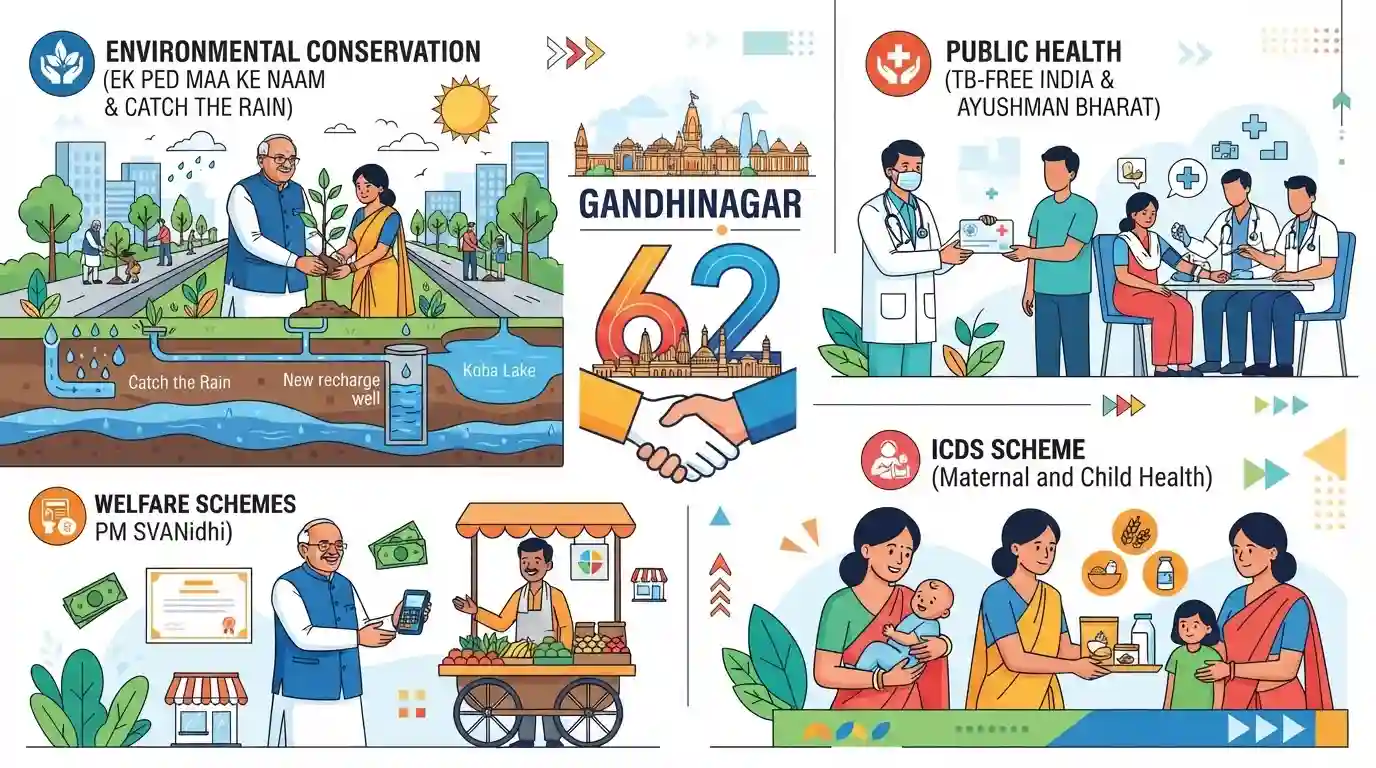
Gujarat Chief Minister Bhupendra Patel marked Gandhinagar's 62nd Foundation Day by spearheading a series of environmental and social welfare initiatives. The event highlighted urban greening through the Prime Minister's 'Ek Ped Maa Ke Naam' campaign and focused on water conservation with the launch of the 'Catch the Rain' project, featuring new recharge wells at Koba Lake. Emphasizing inclusive development, the administration distributed financial assistance under the PM SVANidhi Scheme for street vendors, health cards for the TB-Free India and Ayushman Bharat programs, and nutritional kits via the ICDS scheme to support maternal and child health.
Key Points
- Gujarat Chief Minister Bhupendra Patel led the 62nd Foundation Day celebrations of Gandhinagar.
- The celebrations featured significant environmental drives, including the 'Ek Ped Maa Ke Naam' campaign aimed at boosting urban afforestation and green belts.
- The 'Catch the Rain' initiative was launched at Koba Lake, focusing on groundwater conservation through the construction of rainwater harvesting recharge wells.
- Welfare schemes were actively promoted, with the distribution of checks under the PM SVANidhi Scheme to support street vendors with microcredit.
- Nutritional and health support was extended through the ICDS Supplementary Nutrition Scheme for maternal and child health, alongside the distribution of Ayushman and TB-Free India health cards.
Important Terms
Ek Ped Maa Ke Naam

A citizen-driven mass tree plantation campaign blending afforestation with emotional outreach, launched by the PM on World Environment Day 2024 to honor mothers.
UPSC context
GS-3 Environment. Evaluates knowledge of afforestation initiatives, climate action (SDG 15), and community engagement in environmental stewardship.
Catch the Rain
A nationwide decentralized water conservation campaign under Jal Shakti Abhiyan. It promotes rainwater harvesting ("where it falls, when it falls") and watershed development to recharge groundwater.
UPSC context
GS-3 Water Resources Management. Tests understanding of water security, decentralized conservation structures, and sustainable groundwater recharge strategies.
PM SVANidhi Scheme
A Central Sector micro-credit scheme offering collateral-free working capital loans (up to ₹50,000 in tranches) to urban/peri-urban street vendors to restart post-pandemic livelihoods.
UPSC context
GS-2 & GS-3 Welfare/Economy. Highly relevant for financial inclusion, informal sector empowerment, and post-COVID economic recovery.
ICDS Supplementary Nutrition Scheme
A nutritional support component of the broader ICDS program aiming to combat malnutrition in young children (under 6) and pregnant/lactating mothers through supplementary food provisions.
UPSC context
GS-2 Social Justice. Tests knowledge of public health interventions, early childhood development, and maternal health indicators in India.
Ayushman Bharat
India's flagship universal health coverage initiative comprising two pillars: Health and Wellness Centres (HWCs) for primary care, and PM-JAY for secondary/tertiary hospitalization insurance (₹5 lakh/family).
UPSC context
GS-2 Health/Governance. Core scheme for universal healthcare, out-of-pocket expenditure reduction, and public health policy assessment.
TB-Free India
A national initiative targeting complete elimination of tuberculosis in India by 2025 (five years ahead of global SDG targets) via advanced diagnostics, nutritional support (Nikshay Poshan), and community engagement.
UPSC context
GS-2 Public Health. Assesses understanding of disease elimination strategies, health scheme targets (NTEP), and India's disease burden challenges.
Prelims Trap
PM SVANidhi is a Centrally Sponsored Scheme administered by the Ministry of Social Justice.
PM SVANidhi is a Central Sector Scheme (100% central funding) managed by the Ministry of Housing and Urban Affairs (MoHUA), not Social Justice, and is not state-sponsored.
Static Concepts Connected
What distinguishes Central Sector Schemes from Centrally Sponsored Schemes?
- Funding Ratio: Central Sector schemes are 100% funded by the Union government. Centrally Sponsored schemes have a shared funding pattern (e.g., 60:40 or 90:10 between Centre and States).
- Implementation Machinery: Sector schemes are implemented mainly by Central government agencies, while Sponsored schemes are implemented by State governments.
- Examples: PM SVANidhi is a Central Sector Scheme, whereas ICDS is a Centrally Sponsored Scheme.
What are the core pillars of India's TB Elimination strategy?
- Early Diagnosis: Active case finding using decentralized molecular diagnostics (like CBNAAT and Truenat) to ensure early detection.
- Nutritional Support: The Ni-kshay Poshan Yojana provides Direct Benefit Transfer (DBT) to patients to ensure proper dietary intake during the intensive medication phase.
- Aggressive Timeline: India aims to eliminate TB by 2025 under the National Strategic Plan, five years ahead of the global UN SDG target of 2030.
Cross-Topic Patterns
Urban poverty & collateral-free credit
The shift of micro-credit from rural SHGs to urban street vendors (PM SVANidhi) highlights a critical policy pivot addressing post-pandemic urban informal sector vulnerabilities.
Urban floods & Sponge Cities
Linking 'Catch the Rain' recharge wells with urban afforestation reflects nature-based solutions to mitigate urban flooding and groundwater depletion, directly aligning with the 'Sponge Cities' concept.

TB elimination (2025 vs 2030 SDG) or PM SVANidhi's 'Central Sector' status are prime traps for multi-statement Prelims questions.
Linked PYQs · 4
Linked PYQs · 4
- 2026GPSC_PRELIMSGS1
Consider the following statements regarding the objectives of Forest Policy, 2018: 1. Controlling animal grazing in forests. 2. Promoting government and private partnership where forests have been destroyed. 3. Promoting greenbelts in cities. Which of the above statement/s is/are correct?
- 2022GPSC_PRELIMSGS1
Which of the following schemes facilitates bank loans to at least one Scheduled Caste/ Scheduled Tribe borrower and at least one woman borrower per bank branch for setting up greenfield enterprises?
- 2026GPSC_PRELIMSGS1
Which of the following statement(s) is/are true regarding the PM-WANI (Prime Minister Wi-Fi Access Network Interface) scheme? 1. It aims to provide affordable high-speed internet by allowing local shopkeepers and entrepreneurs to set up public Wi-Fi hotspots without requiring a license from the Department of Telecommunications. 2. The architecture of the scheme involves four layers: Public Data Offices (PDOs), Public Data Office Aggregators (PDOAs), App Providers and a Central Registry. Choose the correct option from the following.
- 2026GPSC_PRELIMSGS1
Consider the following statements regarding the drainage system of Kutch: 1. Most rivers in the Kutch region are ephemeral and non-perennial, carrying water only during the brief monsoon season. 2. The rivers originating from the central hilly tracts of Kutch invariably drain into the Arabian Sea directly. 3. The Luni River, after traversing through Rajasthan, dissipates into the marshy lands of the Rann of Kutch. Which of the above statements are correct?
