GSRTC Bus Fleet Expansion for Tribal Education Support
Source:thecsrjournal ↗
Why It Matters
Highlighting state-specific governance models in Gujarat, this initiative is a critical case study on how targeted transport infrastructure can bridge educational gaps, lower dropout rates, and uplift marginalized tribal communities in difficult terrains.
Summary
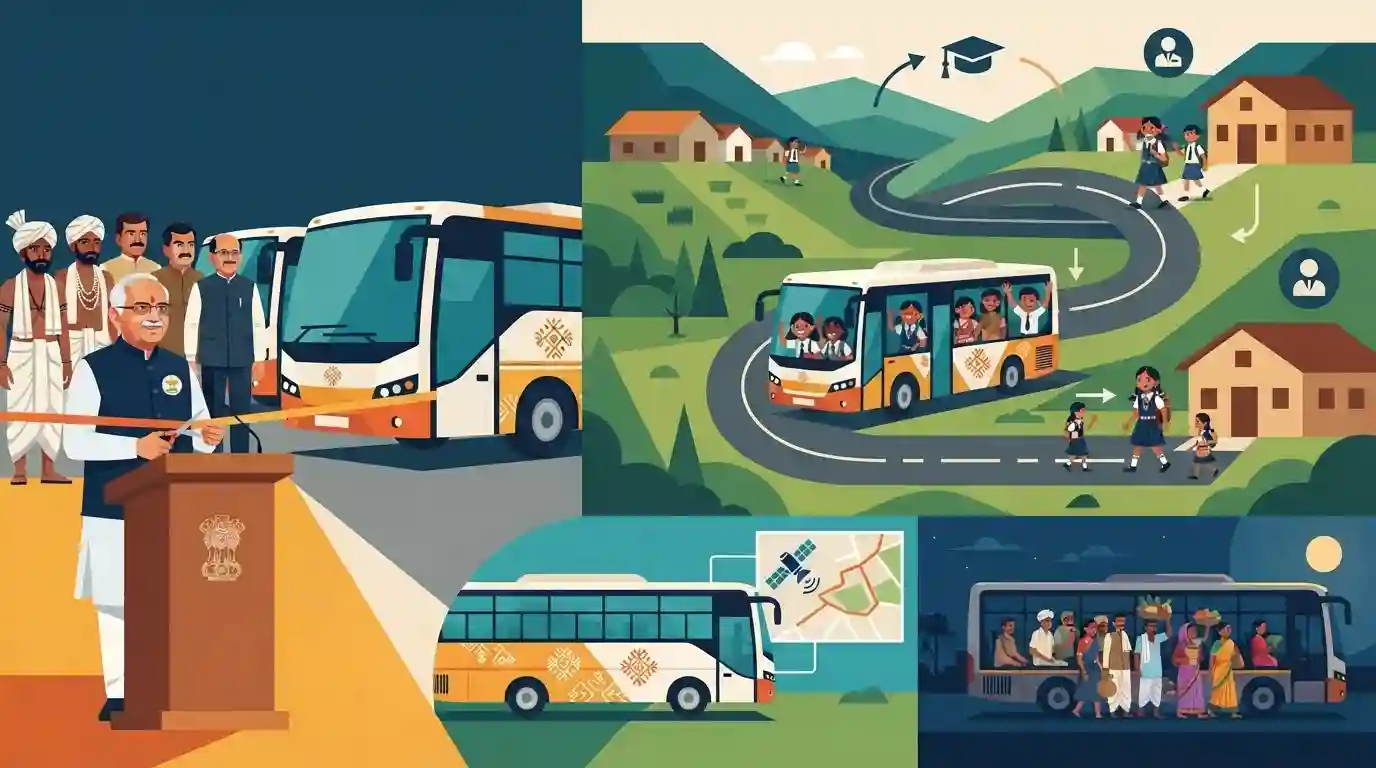
Gujarat Chief Minister Bhupendra Patel launched 139 new buses for tribal students under the 'Bhagwan Birsa Munda Janjatiya Gaurav Parivahan Seva' scheme. Designed to facilitate safe and timely transport in remote and hilly tribal tracts, the initiative seeks to enhance educational access, improve attendance, and lower dropout rates—especially for female students. This phase follows Prime Minister Narendra Modi's earlier launch of 111 buses on Janjatiya Gaurav Divas. Implemented jointly by the Tribal Development Department and GSRTC, the GPS-equipped buses will also generate local revenue by operating as standard passenger transport outside of school hours.
Key Points
- Gujarat CM Bhupendra Patel launched 139 new GSRTC buses from Gandhinagar for tribal students in remote and hilly regions.
- The launch is part of the 'Bhagwan Birsa Munda Janjatiya Gaurav Parivahan Seva', aiming to provide 250 buses at a cost of around ₹72 crore.
- The initiative, a joint project of the Tribal Development Department and GSRTC, targets improving school attendance and reducing dropout rates, particularly for girls.
- Buses feature GPS tracking for monitoring via a web portal and will double as regular passenger transport after school hours to ensure financial sustainability.
- The first batch of 111 buses under this scheme was launched by PM Narendra Modi on November 15, marking the 150th birth anniversary of Bhagwan Birsa Munda in Narmada district.
Important Terms
Bhagwan Birsa Munda Janjatiya Gaurav Parivahan Seva

A Gujarat state transport welfare scheme that deploys GPS-equipped buses to provide safe, reliable, and free commuting for tribal students from remote and hilly areas to schools and colleges.
UPSC context
GS Paper II: Welfare schemes for vulnerable sections; tests understanding of governance and state-led educational access for Scheduled Tribes.
Janjatiya Gaurav Divas
A national commemorative day celebrated on November 15 to honor the birth anniversary of tribal leader Bhagwan Birsa Munda and recognize the heritage and contributions of India's tribal communities.
UPSC context
GS Paper I: Modern Indian History and tribal uprisings; tests knowledge of regional leaders and subaltern resistance movements.
Gujarat State Road Transport Corporation (GSRTC)
A state-run public transport undertaking established in 1960 that provides extensive, reliable, and affordable bus connectivity across the rural and urban regions of Gujarat and its neighboring states.
UPSC context
GS Paper III: Infrastructure and economic development; tests understanding of state transport utilities in promoting rural-urban connectivity.
Tribal Development Department (Gujarat)
An administrative department of the state government tasked with designing, executing, and monitoring socio-economic, educational, and infrastructural development schemes for Scheduled Tribes in Gujarat.
UPSC context
GS Paper II: Welfare mechanisms for vulnerable populations; tests governance frameworks targeting tribal integration and social justice.
Bhagwan Birsa Munda
A charismatic 19th-century tribal freedom fighter and folk hero who spearheaded the historic 'Ulgulan' (Munda Rebellion) against British exploitation and forest rights violations in Chotanagpur.
UPSC context
GS Paper I: Indian freedom struggle and tribal revolts; tests historical knowledge of grassroots resistance against colonial rule.
Prelims Trap
The Fifth Schedule's administrative protections and tribal schemes apply uniformly to all Indian states with scheduled tribe populations.
The Fifth Schedule excludes the tribal-dominated Northeastern states of Assam, Meghalaya, Tripura, and Mizoram, which are governed under the Sixth Schedule.
Static Concepts Connected
What are the criteria for declaring an area as a Scheduled Area under the Fifth Schedule?
- Preponderance: The area must have a dominant tribal population relative to other communities.
- Compactness: The region must possess a reasonable size and geographic compactness for viable administration.
- Backwardness: There must be a marked economic disparity and lack of development compared to neighboring areas.
What was the significance of the Ulgulan (Great Tumult) led by Birsa Munda?
- The Cause: Opposed the colonial land settlement system and the exploitation of tribal land by intermediaries (dikus).
- Birsait Sect: Birsa Munda established a monotheistic faith, challenging both traditional superstitions and Christian missionary activities.
- Legislative Impact: Forced the British administration to pass the Chotanagpur Tenancy Act, 1908, which banned non-tribal land transfers.
Cross-Topic Patterns
Transport policy as social justice
Spatial connectivity acts as a non-monetary intervention to reduce gender-based dropout rates and achieve SDG 4 and SDG 5 in isolated geographies.
Ulgulan rebellion and modern FRA
The historical fight against 'dikus' (outsiders) over land alienation links directly to contemporary protections under the Forest Rights Act, 2006.

Prelims 2026 may link tribal welfare infrastructure schemes to Fifth/Sixth Schedule distinctions and the 1908 Chotanagpur Tenancy Act.
Linked PYQs · 3
Linked PYQs · 3
- 2025GPSC_PRELIMSGS1
Which of the following statements is/are correct regarding the G-SAFAL scheme?
- 2024GPSC_PRELIMSGS1
The criteria for declaration of Scheduled areas include: 1. Preponderance of tribal population 2. Compactness and reasonable size of the area 3. Economic backwardness of the area as compared to neighbouring areas Select the correct answer code:
- 2017GPSC_PRELIMSGS1
Which educational Institution is having Adivasi Museum in Gujarat ?
