Gujarat Enhances Collectors Powers For Government Land Allotment
Source:indianmasterminds ↗
આ શા માટે મહત્વનું છે
Understanding the delegation of financial and administrative powers to district authorities (Collectors and DDOs) is crucial for GPSC Class 1-2 aspirants. It highlights the state\'s governance reforms aimed at improving the ease of doing business, reducing bureaucratic delays, and accelerating rural and infrastructural development.
સારાંશ
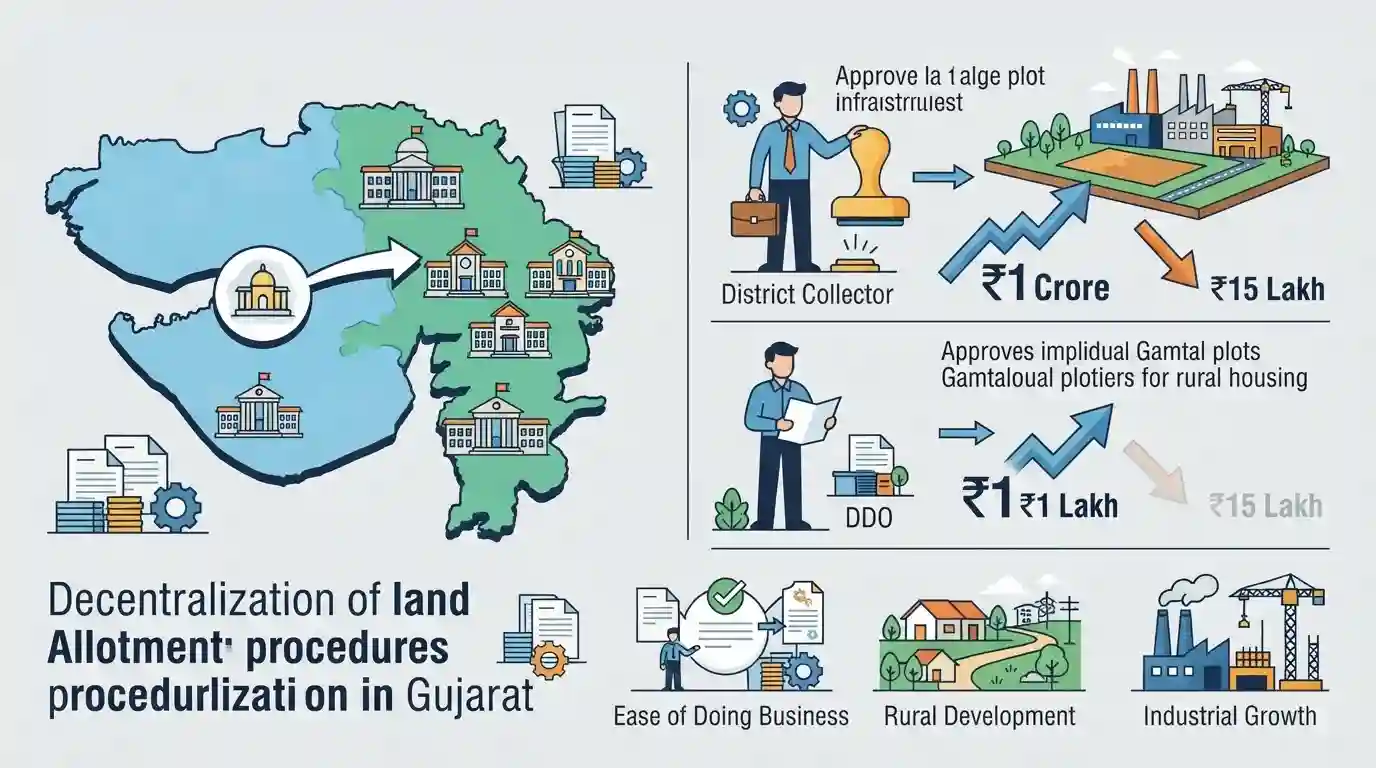
The Gujarat government has decentralised land allotment procedures to improve the Ease of Doing Business and accelerate development projects across the state. Chief Minister Bhupendra Patel announced a significant increase in the financial powers of District Collectors and District Development Officers (DDOs) for allocating government land and rural Gamtal plots. Under the revised limits, Collectors can allot land up to ₹1 crore (previously ₹15 lakh) for state boards, while DDOs can approve Gamtal plots up to ₹1 lakh for individual residences. This administrative reform eliminates the need for applicants to travel to Gandhinagar, empowering district-level authorities to process land cases efficiently, thereby boosting infrastructure, industrial growth, and rural development.
મુખ્ય મુદ્દા
- Gujarat CM Bhupendra Patel significantly enhanced the financial powers of District Collectors and District Development Officers (DDOs) regarding the allotment of government land and Gamtal plots.
- The move aims to improve the Ease of Doing Business, accelerate infrastructure, industrial, and social projects, and simplify administrative procedures by reducing the need to travel to Gandhinagar.
- For District Collectors, the financial limit to allot land for State Government Boards was increased from ₹15 lakh to ₹1 crore (up to 2 hectares), and limits for residential and commercial purposes were also raised.
- For DDOs, financial powers for allotting Gamtal plots for individual residential purposes were raised from ₹20,000 to ₹1 lakh, reducing delays in rural areas.
- District Collectors can now grant extensions up to three years for depositing land premium or possession prices if not done within the stipulated 90 days.
મહત્વપૂર્ણ શબ્દો
District Land Valuation Committee

A district-level statutory body in Gujarat that assesses the financial value, possession price, and premium of government lands designated for public allocation or compensatory afforestation.
UPSC context
Useful for GS Paper 2 (Functions of the States) and GS 3 (Land Economics). Tests decentralized land governance mechanisms.
State Treasury
The central financial repository holding revenues, taxes, and fees collected by a state government, including land allotment premiums, managed under constitutional provisions for the Consolidated Fund of the State.
UPSC context
Connects to GS Paper 2 and 3 (Government Budgeting, Mobilization of Resources). Tests knowledge of state financial administration.
Gamtal Plots
Village site lands or rural residential plots designated by the Gujarat government for community use and housing. Their allocation is managed locally to prevent encroachment and support rural infrastructure expansion.
UPSC context
Covers GS Paper 2 (Governance) and GS 3 (Land Reforms) regarding state-level land management and rural housing policies.
District Development Officer (DDO)
The chief executive of the District Panchayat in Gujarat, responsible for implementing rural development and welfare schemes. DDOs now possess enhanced financial powers to allocate government land locally.
UPSC context
Important for GS Paper 2 (Devolution of Powers) and rural administration topics. Tests understanding of local government structures.
District Collector
The principal administrative officer of a district, responsible for revenue administration and land records. Their enhanced financial powers allow for faster land allotments to speed up state development projects.
UPSC context
Relevant for GS Paper 2 (Role of Civil Services) and GS 3 (Land Reforms). Tests understanding of district-level bureaucracy.
Ease of Doing Business
Regulatory reforms—such as decentralizing government land allotments—that reduce bureaucratic red tape, simplify compliance, and create a conducive environment for industries to invest and complete projects rapidly.
UPSC context
Vital for GS Paper 2 (Governance) and GS 3 (Economic Development). Tests awareness of regulatory simplification and investment promotion.
પ્રિલિમ્સ ટ્રેપ
The administrative and land allotment powers of District Collectors are uniform across all states, mandated by IAS Cadre Rules.
Land (Entry 18) and Local Government (Entry 5) are State subjects. Each state government independently delegates specific financial and land administration powers to district officials.
સંલગ્ન સ્થિર ખ્યાલો
How is jurisdiction over land and local administration defined constitutionally?
- State List Entry 18: Land, including rights over land, tenures, transfer, and revenue administration, is exclusively a State subject.
- State List Entry 5: Local government, including district boards, municipalities, and rural administration, falls squarely under the State Legislature's domain.
- G.V.K. Rao Committee: Recommended the creation of a District Development Commissioner (DDO) to oversee rural development and Zila Parishads in 1985.
How is Ease of Doing Business (EoDB) currently measured for Indian states?
- World Bank Discontinuation: The World Bank permanently scrapped its global EoDB index in 2021 due to data manipulation irregularities.
- DPIIT's BRAP: The Department for Promotion of Industry and Internal Trade evaluates states using the Business Reforms Action Plan (BRAP).
- NITI Aayog's IFI: Launched in 2026, this index assesses state-level business ecosystems to fill the global EoDB gap, driving competitive federalism.
આંતર-વિષય પેટર્ન
Administrative decentralization + Rural empowerment
Empowering DDOs for rural land allotment reflects the broader governance theme of devolving functional autonomy to district levels, operationalizing the true spirit of decentralized rural development.
Competitive Federalism + Ease of Doing Business
As global EoDB indices fade, states are undertaking targeted regulatory reforms—like decentralizing land approvals—to boost their performance in domestic frameworks like DPIIT's BRAP and NITI Aayog's IFI.

Expect a 2026 Mains question linking the decentralization of financial powers to district authorities with improved Ease of Doing Business.
સંલગ્ન PYQ · 3
સંલગ્ન PYQ · 3
- 2022GPSC_PRELIMSGS1
As per the 73rd Constitutional Amendment Act of Panchayati Raj, who specifies a "Village"?
- 2025GPSC_PRELIMSGS1
According to the Socio-Economic Review, 2024-2025 of Gujarat, Gujarat comes in ______ category in Logistic Ease Across Different States (LEADS), 2024.
- 2026GPSC_PRELIMSGS1
Consider the following Assertion and Reason: Assertion (A): The Constitution of India now provides a mechanism for a regular flow of funds to Panchayati Raj Institutions. Reason (R): Panchayati Raj institutions have been greatly handicapped in the performance of their assigned duties by paucity of funds. Which of the following is correct with respect to the above?
