West Asia Conflict Impact on Domestic Fuel and Energy Security
Source:Indian Express ↗
Why It Matters
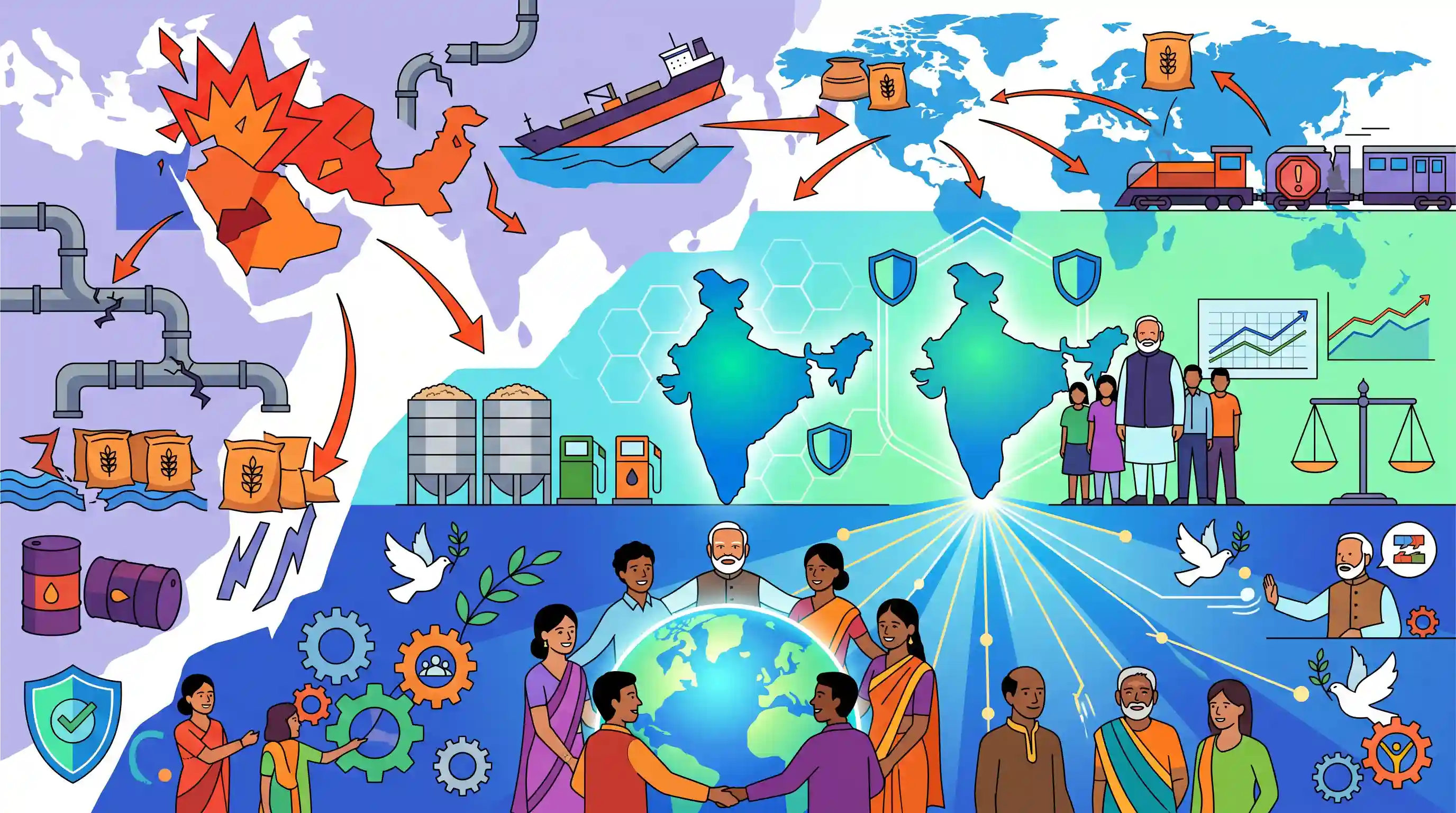
This highlights the direct connection between regional conflicts (West Asia) and India's macroeconomic stability (fuel and grain supplies). It illustrates how India uses the principle of "Vasudhaiva Kutumbakam" in its diplomatic and political messaging regarding global peace.
Summary
Gujarat Chief Minister Bhupendra Patel advised party workers to exercise patience and avoid overreacting to rumors, highlighting the global disruptions caused by ongoing conflicts in West Asia. He noted that while the crisis has jeopardized the global supply of essential goods like fuel and grains, the Indian government, under PM Modi's leadership, has successfully maintained stable prices and uninterrupted domestic supplies. Drawing on the principle of "Vasudhaiva Kutumbakam," he emphasized the need for global peace rather than rejoicing over India's relative stability amidst international instability.
Key Points
- The ongoing geopolitical conflict in West Asia creates risks for global supply chains, notably for energy resources like petrol, diesel, and gas, as well as food grains.
- Despite global volatility, the Indian government has managed to ensure uninterrupted domestic supplies and stable prices of essential commodities, shielding citizens from supply shocks.
- India invokes the ethos of "Vasudhaiva Kutumbakam" (the world is one family) to advocate for global peace and restraint, rather than celebrating domestic stability at the expense of global turmoil.
Important Terms
Vasudhaiva Kutumbakam

"The world is one family." An ancient Indian philosophy from the Maha Upanishad emphasizing global unity, interconnectedness, and shared responsibility for collective well-being.
UPSC context
GS II (International Relations) & GS IV (Ethics); central to India’s soft power and its moral-led "Global South" diplomacy.
Energy Security
The uninterrupted availability of energy sources at an affordable price, encompassing long-term strategic investments and short-term resilience to supply shocks.
UPSC context
GS III (Economy/Energy); vital due to India's high import dependency (~85%) on crude oil and natural gas.
Supply Chain Resilience
The capacity of a global production network to withstand and recover from disruptions caused by geopolitical conflicts, pandemics, or trade protectionism.
UPSC context
GS III (Economy); relevant to the "China Plus One" strategy and India's aim to become a global manufacturing hub.
West Asia Geopolitics
The political and economic dynamics of the Middle East, a region critical to India for energy supplies, fertilizers, and maritime trade routes.
UPSC context
GS II (International Relations); focuses on regional stability, the Strait of Hormuz, and safety of the Indian diaspora.
Strategic Autonomy
The ability of a nation to pursue its national interests and adopt independent foreign policy choices without being constrained by external powers or blocs.
UPSC context
GS II (International Relations); explains India’s balanced stance in major global conflicts and its mediator role.
Imported Inflation
A rise in domestic price levels caused by an increase in the cost of imported goods, especially essentials like crude oil and fertilizers.
UPSC context
GS III (Economy); tests the linkage between global geopolitical shocks and domestic fiscal/monetary stability.
Prelims Trap
India's Strategic Petroleum Reserves (SPRs) currently hold enough crude oil to meet the IEA's 90-day benchmark.
India's Phase I SPRs (5.33 MMT) cover only about 9.5 days of demand. Even adding OMCs' stock (64.5 days), India falls short of the IEA's 90-day benchmark.
Static Concepts Connected
Where are India's Strategic Petroleum Reserves (SPRs) located and how are they managed?
- Phase I locations: Visakhapatnam (Andhra Pradesh), Mangaluru (Karnataka), and Padur (Karnataka) house India's Phase I reserves, with a total capacity of 5.33 MMT stored in underground rock caverns.
- Phase II expansion: Phase II expansions are planned at Chandikhol (Odisha) and Padur (Karnataka) under a Public-Private Partnership (PPP) model to further boost energy security.
- Managing authority: Managed by Indian Strategic Petroleum Reserves Limited (ISPRL), a wholly owned subsidiary of the Oil Industry Development Board (OIDB) under the Ministry of Petroleum and Natural Gas.
Which maritime chokepoints are critical for India's West Asian energy imports?
- Strait of Hormuz: Connects the Persian Gulf to the Gulf of Oman. It is an unavoidable transit route for nearly 40-50% of India's crude oil imports from the Middle East.
- Bab-el-Mandeb Strait: Connects the Red Sea to the Gulf of Aden. Instability here forces commercial shipping to detour around Africa's Cape of Good Hope, severely inflating freight costs.
Cross-Topic Patterns
West Asia crisis & Imported Inflation
Global supply chain disruptions via Bab-el-Mandeb spike freight and crude prices. This acts as a transmission channel for imported inflation, widening India's Current Account Deficit and pressuring the Rupee.
Maha Upanishad in Foreign Policy
'Vasudhaiva Kutumbakam' (from Chapter 6 of the Maha Upanishad) routinely frames India's soft power, transitioning from the overarching G20 theme to guiding its non-escalatory stance during West Asian conflicts.

Map-based questions linking West Asian chokepoints (Hormuz, Bab-el-Mandeb) to macroeconomic impacts (imported inflation) are highly probable.
Linked PYQs · 2
Linked PYQs · 2
- 2025MainsGS2
"Energy security constitutes the dominant kingpin of India's foreign policy, and is linked with India's overarching influence in Middle Eastern countries.” How would you integrate energy security with India's foreign policy trajectories in the coming years?
- 2024MainsGS2
‘The West is fostering India as an alternative to reduce dependence on China's supply chain and as a strategic ally to counter China's political and economic dominance.’ Explain this statement with examples.
