Unified Taluka Planning Committee reform for decentralized governance
Source:aninews ↗
આ શા માટે મહત્વનું છે
Highlights ongoing state-level administrative reforms to strengthen grassroots democracy and decentralised planning. Understanding the structural reorganization at the taluka (block) level is highly relevant for GPSC's local governance and administration syllabus.
સારાંશ
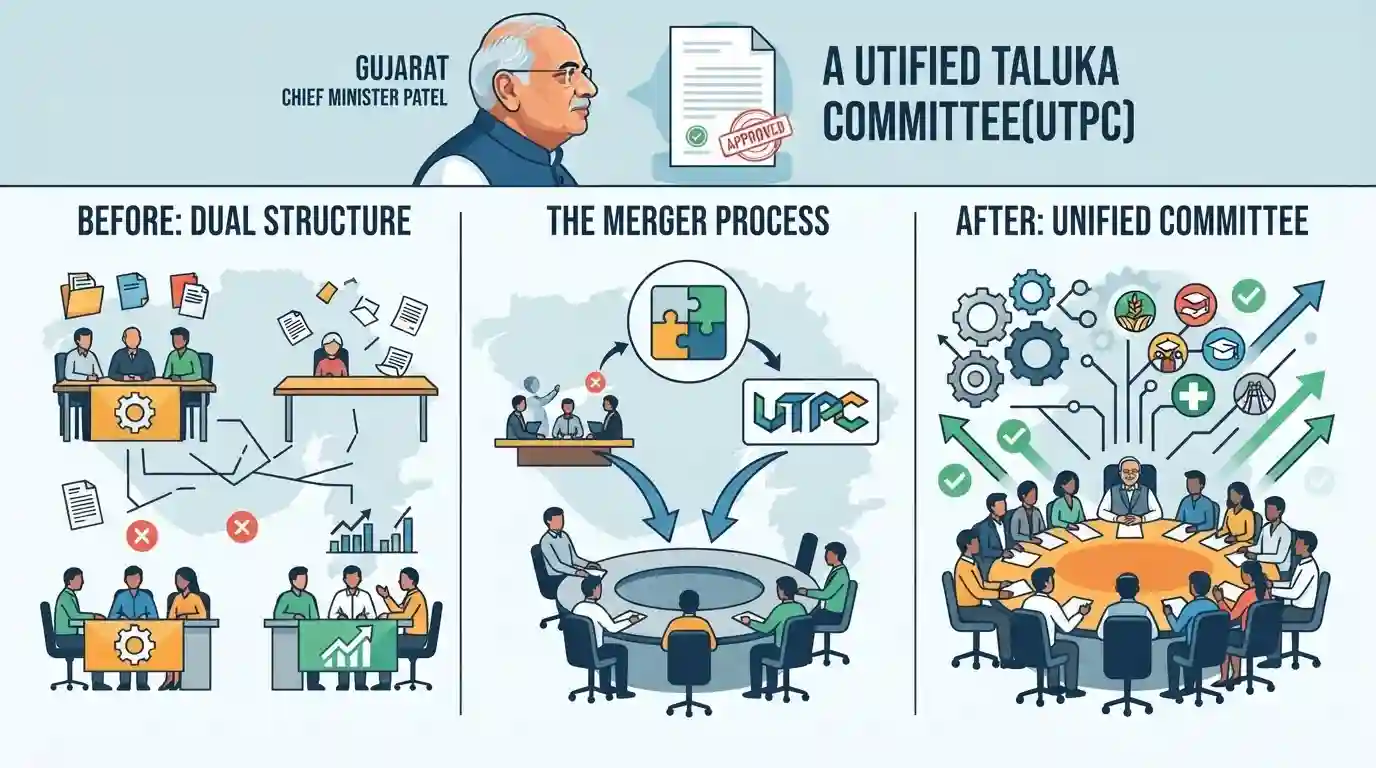
Gujarat Chief Minister Bhupendra Patel has approved the formation of an 18-member Unified Taluka Planning Committee (UTPC) to streamline local governance and decentralized planning. Following the recommendations of the Gujarat Administrative Reforms Commission (GARC), the new committee merges the existing Taluka Planning Committee and the Aapno Taluko-Vibrant Taluko (ATVT) executive body into a single entity. Chaired by the Taluka Panchayat President, the UTPC aims to eliminate administrative duplication, enhance departmental coordination, and make taluka-level development planning more systematic and result-oriented.
મુખ્ય મુદ્દા
- The Gujarat government has formed an 18-member Unified Taluka Planning Committee (UTPC) to streamline local development.
- The UTPC replaces the dual-track system of the existing Taluka Planning Committee and the ATVT executive bodies, preventing duplication of work.
- This reform is based on the recommendations of the Fourth Report of the Gujarat Administrative Reforms Commission (GARC), submitted in August 2025.
- The UTPC will be chaired by the President of the Taluka Panchayat, with the Sub-Divisional Magistrate (SDM) as Co-Chairperson and the Taluka Development Officer (TDO) as Member Secretary.
મહત્વપૂર્ણ શબ્દો
Unified Taluka Planning Committee (UTPC)

An 18-member unified local body in Gujarat that merges previous planning committees to streamline sub-district decentralized planning, resolve administrative overlap, and accelerate development.
UPSC context
GS Paper II: Local self-government, decentralized planning, and administrative reforms in rural governance.
Gujarat Administrative Reforms Commission (GARC)
A state commission chaired by Dr. Hasmukh Adhia that recommends administrative, digital, recruitment, and local governance reforms for "Viksit Gujarat @ 2047."
UPSC context
GS Paper II: Administrative reforms, citizen-centric governance, and regional public policy implementation.
Aapno Taluko-Vibrant Taluko (ATVT)
A sub-district, citizen-centric governance initiative launched in Gujarat to empower local citizens, drive grass-roots planning, and facilitate rapid socio-economic growth.
UPSC context
GS Paper II: Decentralized planning, grass-roots democracy, and state-specific governance models.
Taluka Panchayat
The intermediate tier of India’s three-tier Panchayati Raj system at the sub-district level, responsible for executing rural development schemes and local administration.
UPSC context
GS Paper II: Panchayati Raj Institutions, local governance, and democratic decentralization under the 73rd Amendment.
Aapno Taluko-Vibrant Taluko (ATVT) executive body
The sub-district planning committee in Gujarat, led by the Prant Officer (SDM), responsible for executing felt-need local development works under the ATVT initiative.
UPSC context
GS Paper II: Local self-government machinery, administrative committees, and grass-roots infrastructure project management.
પ્રિલિમ્સ ટ્રેપ
Taluka-level planning committees are constitutionally mandated bodies under Article 243ZD of the Constitution of India.
Article 243ZD mandates District Planning Committees (DPCs) and Article 243ZE mandates Metropolitan Planning Committees (MPCs). Intermediate (taluka/block) level planning entities are state-legislated or executive-created structures, not constitutional bodies.
સંલગ્ન સ્થિર ખ્યાલો
What is the constitutional mandate and composition of District Planning Committees (DPCs)?
- Constitutional Mandate: Article 243ZD (inserted by the 74th Amendment Act) mandates every state to constitute a DPC to consolidate plans prepared by panchayats and municipalities.
- Elected Representation: At least four-fifths (80%) of the members of a DPC must be elected by the elected members of the district panchayat and municipalities.
- State Discretion: The state legislature is empowered to make provisions regarding the composition and the manner in which the chairpersons of such committees are chosen.
What is the role of the intermediate tier in the Panchayati Raj system?
- Structural Linkage: The 73rd Amendment mandates a three-tier system, where the intermediate tier (Taluka/Block Panchayat) acts as a link between Gram Panchayats and the Zilla Parishad.
- Population Exemption: States with a population not exceeding 20 lakhs have the option to not constitute the intermediate tier.
- Functional Integration: It acts as the primary developmental unit where departmental schemes are integrated by block-level executive officers (TDO/BDO) and elected members.
આંતર-વિષય પેટર્ન
Decentralization vs. Bureaucratic Control
The dual-leadership model (Elected President + SDM) reflects the structural tension between elected local self-governments and the state's centralized bureaucratic machinery.
Administrative Reforms & Parallel Bodies
Gujarat's GARC reforms mirror the Union Second ARC (6th Report) recommendations, which strongly advocate for dissolving parallel bodies to strengthen PRIs.

2026 Polity questions may test the distinction between constitutional planning bodies (Article 243ZD) and state-specific executive mergers.
સંલગ્ન PYQ · 3
સંલગ્ન PYQ · 3
- 2025GPSC_PRELIMSGS1
Which of the following statements about Local Self-Government in India is correct? 1. The Panchayati Raj System is based on the recommendations of the Balwant Rai Mehta Committee (1957). 2. The 73ʳᵈ Amendment Act, 1992 provided for the establishment of three-tier Panchayati Raj institutions in all states. 3. The 11ᵗʰ Schedule of the Indian Constitution deals with powers and responsibilities of Panchayati Raj institutions. 4. The State Election Commission is responsible for conducting elections to both Panchayati Raj institutions and State Legislatures. Select the correct answer using the codes below:
- 2020GPSC_PRELIMSGS1
Which of the following statements are correct regarding Ashok Mehta Committee recommendations on panchayat raj system? 1. The nyaya panchayats should be kept as separate bodies from that of development of panchayats. 2. There should be an official participation of political parties at all levels of panchayat elections. 3. The nyaya panchayats should be presided over by a qualified judge.
- 2019GPSC_PRELIMSGS1
Which of the following statements is/are correct regarding Ashok Mehta Committee Report (1978)? 1. Committee recommended for two-tier system of Panchayati Raj. 2. A district should be the first point for decentralization below the state-level. 3. ZilaParishad should be the executive body and should be responsible for planning at the district level.
