Gujarat Urban Development Policy and Green Cover Mandate Initiatives
Source:indianmasterminds ↗
Why It Matters
Highlights key state-level policies on urbanization and environmental sustainability (urban green cover), alongside efforts to document regional historical heritage (Vadnagar), which are highly relevant for GPSC governance, environment, and culture sections.
Summary
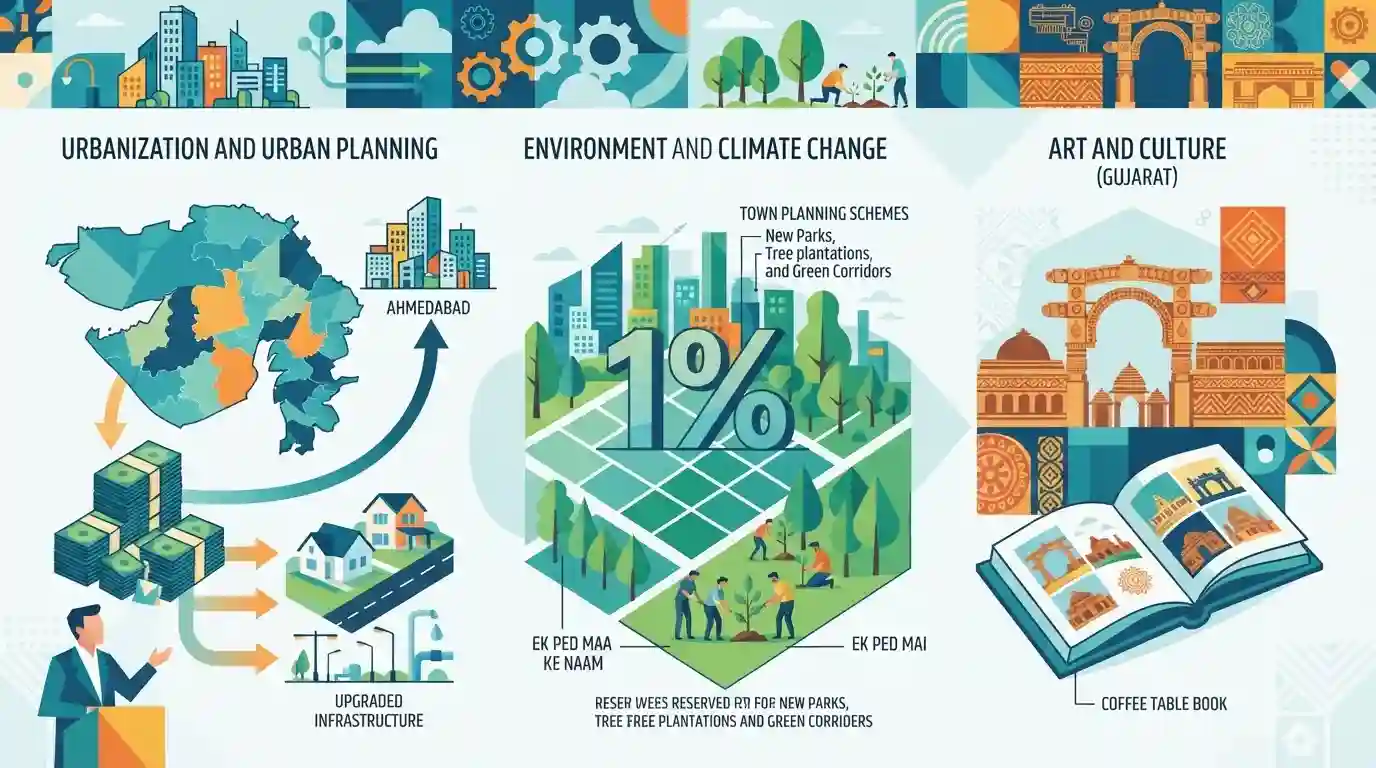
Gujarat Chief Minister Bhupendra Patel has announced a ₹3,850 crore allocation for urban development under the Swarnim Jayanti Mukhyamantri Shaheri Vikas Yojana. The funds will improve civic amenities across 17 municipal corporations and 152 municipalities, with Ahmedabad receiving the highest share. Addressing climate change, the state mandated reserving 1% of land in Town Planning Schemes for green cover, aligning with the 'Ek Ped Maa Ke Naam' initiative. Additionally, the cultural heritage of Vadnagar was highlighted through the release of a dedicated coffee table book.
Key Points
- Gujarat CM allocated ₹3,850 crore to 17 municipal corporations and 152 municipalities under the Swarnim Jayanti Mukhyamantri Shaheri Vikas Yojana.
- Ahmedabad received the highest financial allocation of ₹870 crore for urban infrastructure and public services.
- To boost urban green cover and address climate change, 1% of land in Town Planning (TP) Schemes will now be reserved for tree plantation, such as gardens and oxygen parks.
- The initiative aligns with environmental campaigns like 'Ek Ped Maa Ke Naam' and promotes local artisans through 'Swadeshi Melas'.
- The state government also released a coffee table book titled 'Anant Anadi Vadnagar: Varsa thi Vikas ni Gaurav Gatha' to document and promote the historical heritage of Vadnagar.
Important Terms
Swarnim Jayanti Mukhyamantri Shaheri Vikas Yojana

A flagship urban development scheme of the Gujarat government launched in 2010 to upgrade infrastructure, including water supply, drainage, and basic civic amenities across municipal corporations and smaller municipalities.
UPSC context
Relevant for GS Paper 2 and 3. Highlights state-level urbanization strategies and infrastructure funding mechanisms.
Ek Ped Maa Ke Naam
A mass tree-plantation campaign launched on World Environment Day 2024. It encourages citizens to plant trees in honor of their mothers, promoting afforestation, community participation, and ecological balance.
UPSC context
Important for GS Paper 3 (Environment). Tests knowledge of community-driven climate change mitigation and conservation initiatives.
Government of Gujarat
The state administrative authority, currently focusing on sustainable urban development by allocating significant infrastructure funds and mandating a 1% land reservation for green cover in its Town Planning Schemes.
UPSC context
Useful for GS Paper 2 (Governance) as a case study for proactive state-level urban planning and climate policy.
Prelims Trap
Vadnagar emerged as a prominent urban center only during the medieval Solanki rule, featuring exclusively Hindu architecture.
Vadnagar is India's oldest continuously living city (800-1400 BCE), pre-dating the Solankis. It bridges the post-Harappan 'Dark Age' and houses significant ancient Buddhist monasteries.
Static Concepts Connected
Why is Vadnagar archaeologically significant for Ancient Indian History?
- Continuous Habitation: Excavations reveal multi-religious settlements dating to 800-1400 BCE, challenging the myth of a post-Harappan 'Dark Age'.
- Buddhist Heritage: Archaeologists unearthed a 2nd-7th century CE Buddhist monastery featuring votive stupas and a unique swastika-like layout.
- Fortified City: It is recognized as India's oldest continuously living city situated within a single fortification.
How does the Town Planning Scheme (TPS) differ from traditional land acquisition?
- Land Pooling Model: It uses non-coercive land pooling and plot reconstitution rather than forceful state acquisition.
- Infrastructure Creation: Local bodies secure portions of the pooled land specifically for public infrastructure, like roads and green spaces.
- Equitable Appreciation: Original owners retain a smaller but developed land parcel, directly benefiting from the resulting property value appreciation.
Cross-Topic Patterns
Climate Action in Micro-Urban Planning
Mandating 1% land for green cover in local TP schemes shifts climate action from macro-level national goals to statutory micro-level urban governance, aligning with SDG 11 (Sustainable Cities).
Cultural Heritage as a Development Anchor
Highlighting Vadnagar’s ancient multi-religious habitation links archaeological preservation directly to modern urban development, mirroring heritage-led economic planning frameworks like the national PRASHAD scheme.

Vadnagar's continuous habitation and Buddhist links are highly likely to appear in Prelims 2026 as a multi-statement Ancient History question.
Linked PYQs · 2
Linked PYQs · 2
- 2026GPSC_PRELIMSGS1
Consider the following statements regarding the objectives of Forest Policy, 2018: 1. Controlling animal grazing in forests. 2. Promoting government and private partnership where forests have been destroyed. 3. Promoting greenbelts in cities. Which of the above statement/s is/are correct?
- 2021GPSC_PRELIMSGS1
Which of the following statements are correct regarding Vadnagar Buddhist Monastery? 1. This Buddhist Monastery belonging to the 2nd-7th century AD is within the fortified area of Vadnagar. 2. The monastery had two votive stupas and an open central courtyard around which initially nine cells were constructed. 3. The arrangement of cells around the central courtyard creates a swastika-like pattern.
