Gujarat reports rising Chandipura virus cases and fatalities
Source:ommcomnews ↗
આ શા માટે મહત્વનું છે
The Chandipura virus outbreak highlights ongoing vulnerabilities in public health systems against regional, vector-borne and zoonotic diseases. It demonstrates the critical necessity for proactive disease surveillance, effective vector-control interventions, and rapid diagnostic capabilities to prevent localized outbreaks from causing high pediatric mortality.
સારાંશ
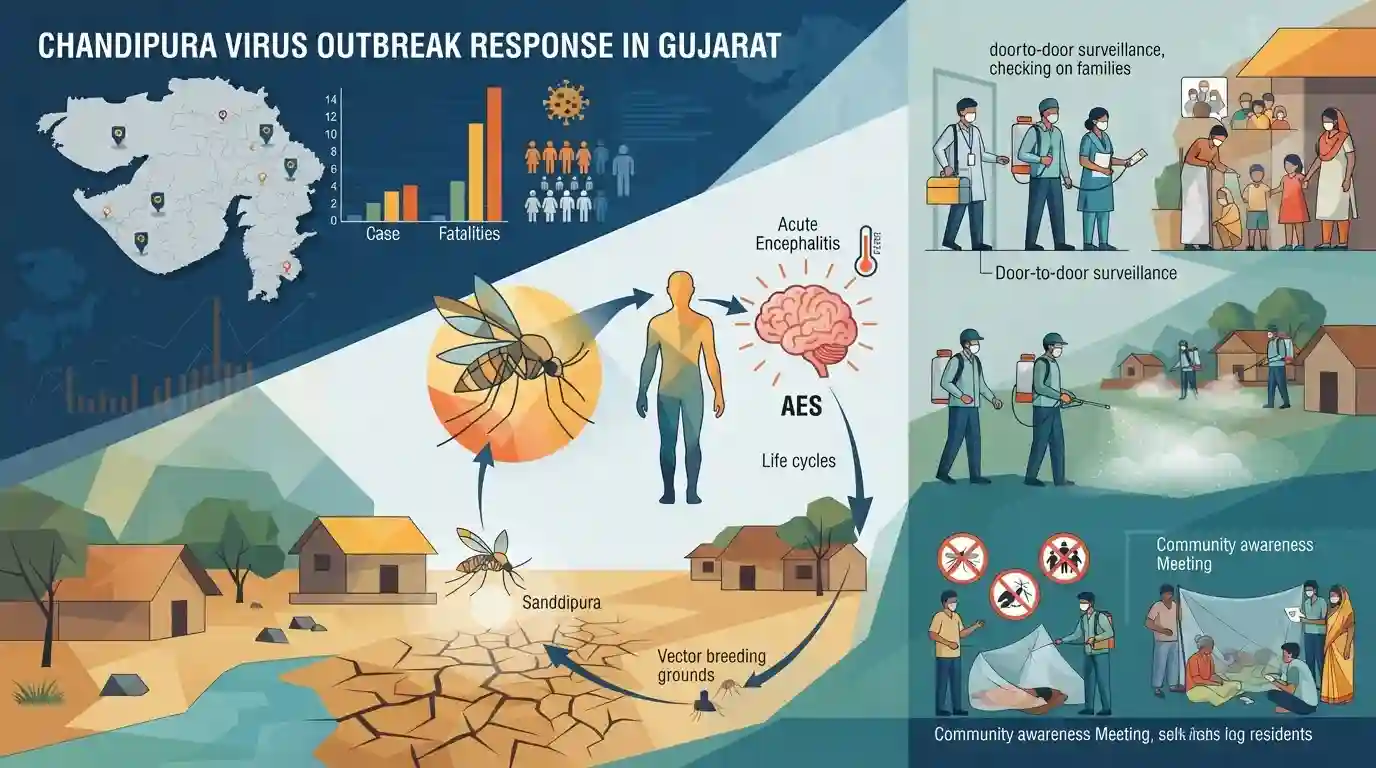
Gujarat is combating a significant outbreak of the vector-borne Chandipura virus, recording 39 confirmed cases and 23 fatalities, predominantly among children. The virus, transmitted by sandflies, causes acute encephalitis syndrome. The state health authorities have rapidly ramped up vector-control measures, such as insecticide spraying, and initiated rigorous door-to-door surveillance to mitigate the spread of the disease.
મુખ્ય મુદ્દા
- Gujarat has recorded 217 suspected Chandipura virus cases, with 39 confirmed positive and 23 deaths.
- The Chandipura virus is primarily transmitted by sandflies and leads to acute encephalitis syndrome (AES), which can be rapidly fatal in young children.
- The outbreak notably gained attention in Panchmahal district, spreading to involve several talukas and districts.
- The State Health Department is conducting door-to-door surveillance, sample collection, and extensive insecticide spraying to control the sandfly population.
મહત્વપૂર્ણ શબ્દો
Chandipura virus

A neurotropic RNA virus of the Rhabdoviridae family, primarily transmitted by sandflies. It causes rapid-onset brain inflammation (encephalitis) with a high fatality rate, predominantly affecting children under 15 years of age.
UPSC context
High-yield for GS-3 (Science & Tech) and GS-2 (Health) regarding viral diseases, vector transmission, and public health management.
Acute Encephalitis Syndrome (AES)
A complex of neurological manifestations characterized by an acute onset of fever and mental status changes, like confusion or coma. It can be caused by various viruses, bacteria, fungi, or toxins.
UPSC context
Frequently tested in Prelims (causative agents) and GS-2 Health (disease management, regional outbreaks, and child mortality).
Sandfly
Small, blood-sucking insect vectors (Phlebotomine) that transmit infectious diseases such as Visceral Leishmaniasis (Kala-azar) and Chandipura virus. They typically breed in dark, humid crevices of muddy structures.
UPSC context
Crucial for GS-3 (Science/Ecology) and Prelims questions tracking disease transmission vectors and elimination programs like the NVBDCP.
Vector-borne diseases
Human illnesses caused by parasites, viruses, or bacteria transmitted by vectors like mosquitoes, sandflies, and ticks. They require rigorous environmental management and source-reduction strategies.
UPSC context
Relevant to GS-2 (Public Health) and GS-3 (Environment), linking climate change to vector habitat expansion and outbreak control policies.
પ્રિલિમ્સ ટ્રેપ
"Chandipura virus is primarily transmitted by mosquitoes, similar to the spread of Japanese Encephalitis."
Unlike JEV, which relies on Culex mosquitoes, Chandipura is transmitted by sandflies. UPSC often swaps vectors (mosquitoes vs. sandflies vs. ticks) to create false statements.
સંલગ્ન સ્થિર ખ્યાલો
Which distinct vectors are responsible for major endemic diseases in India?
- Sandflies: Primarily transmit Chandipura virus and Kala-azar (Visceral leishmaniasis). Breeding peaks during monsoons, often in cracks of rural mud walls.
- Culex Mosquitoes: The principal vectors for Japanese Encephalitis (JE) and Lymphatic Filariasis, heavily breeding in stagnant agricultural water like paddy fields.
- Hard Ticks: Responsible for transmitting Kyasanur Forest Disease (KFD), a viral hemorrhagic fever primarily endemic to the Western Ghats region.
What comprises the Acute Encephalitis Syndrome (AES) classification?
- Clinical Definition: A broad group of clinically similar neurologic manifestations involving acute-onset fever, altered mental status, and potentially seizures.
- Viral Causes: Japanese Encephalitis Virus (JEV) is the predominant cause in India. Other viral causes include Chandipura, Nipah, Enteroviruses, and Zika.
- Non-Viral Causes: AES is not exclusively viral. Scrub typhus (a bacterium), along with various other bacteria and fungi, can also trigger the syndrome.
આંતર-વિષય પેટર્ન
Climate change & vector spread
Irregular monsoon patterns and higher humidity alter the spatial distribution of Phlebotomine sandflies, expanding Chandipura and Kala-azar risks into previously unaffected districts.
AES and malnutrition linkages
AES outbreaks historically show severe mortality among children with acute malnutrition, linking public health infrastructure, immunity, and schemes like Poshan Abhiyan to viral survival rates.

Expect a 'match the following' question in Prelims 2026 pairing lesser-known viral diseases (Chandipura, KFD, Nipah) with their vectors.
સંલગ્ન PYQ · 1
સંલગ્ન PYQ · 1
- 2025GPSC_PRELIMSGS1
______ initiated its withdrawal from the World Health Organization (WHO) on January 20, 2025 citing mishandling of the COVID-19 pandemic financial disparities and political influence concerns.
