Gujarat Census to Begin in April with Digital Self-Enumeration
Source:Indian Express ↗
Why It Matters
The Census provides the foundational data for all government planning and resource allocation. Understanding its statutory backing (Census Act 1948), the phases of enumeration, and the transition toward digital/self-enumeration is crucial for UPSC aspirants studying governance and public policy.
Summary
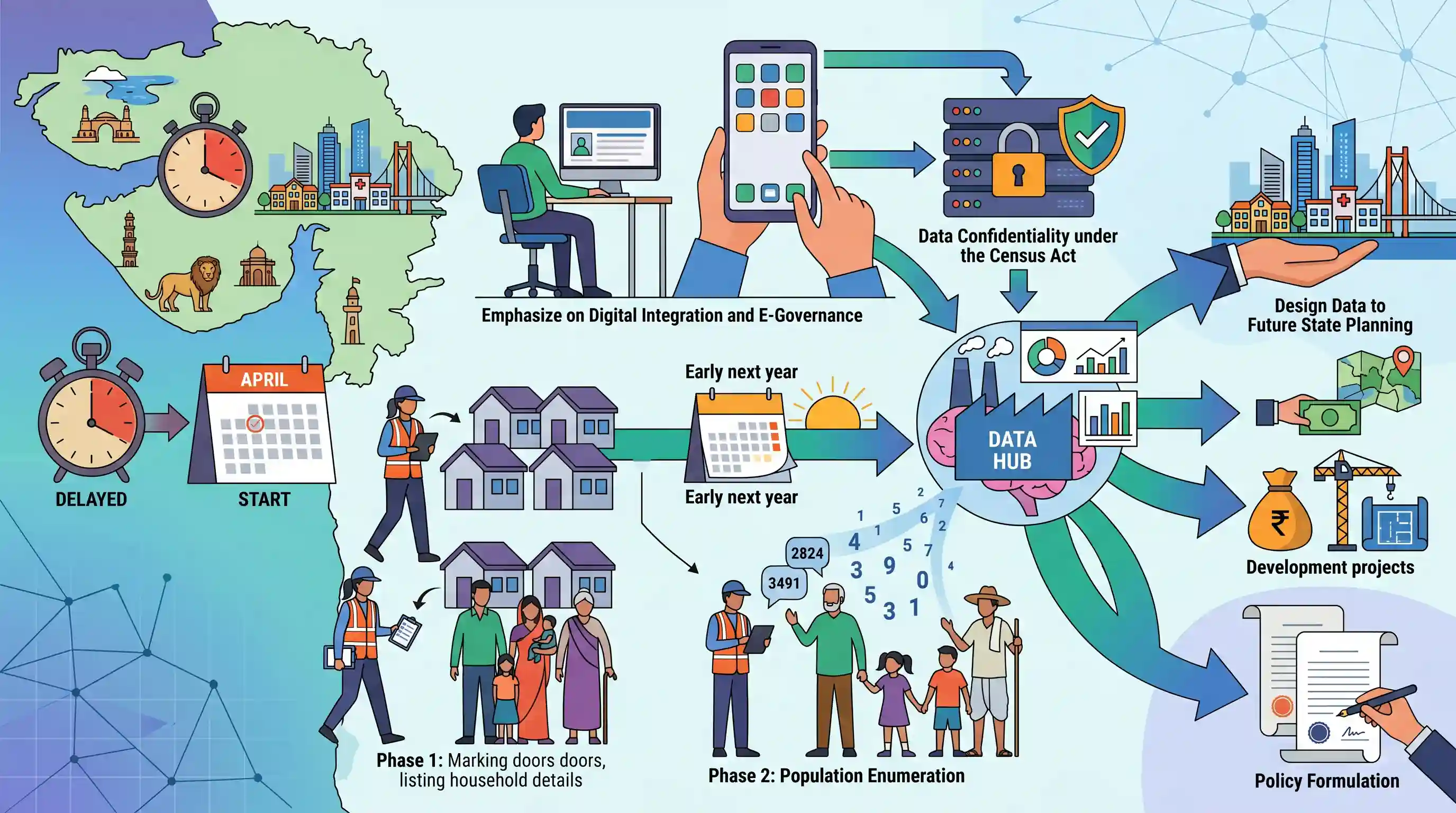
Gujarat is preparing to execute the long-delayed Census in a two-phase process beginning in April, featuring household listing followed by population enumeration early next year. Emphasizing digital integration, the exercise allows for self-enumeration prior to field visits. Conducted under the Census Act of 1948, the process ensures data confidentiality, aiming to generate essential statistical insights that will drive future state planning, resource allocation, and policy formulation.
Key Points
- Gujarat is set to conduct the delayed Census in two phases, with the house listing and housing census starting in April.
- The population enumeration phase is scheduled to follow in February of the next year.
- Citizens will have the option of self-enumeration through an online portal for 15 days prior to the start of the field survey, highlighting a push towards e-governance.
- Data collected under the Census Act of 1948 remains strictly confidential and is restricted to statistical analysis for state planning and policy formulation.
Important Terms
Office of the Registrar General of India (RGI)

A permanent office under the Ministry of Home Affairs responsible for conducting decennial censuses and maintaining the Civil Registration System (births and deaths) across India.
UPSC context
GS II (Governance). Key statutory body for national demographic statistics, vital for policy planning and federal resource allocation.
Census Act, 1948
The legal framework for India's decennial census. It mandates truthful reporting by citizens while guaranteeing strict confidentiality of data, even from judicial scrutiny.
UPSC context
GS II (Polity). Relates to constitutional subjects (Entry 69, Union List) and legislative backing for administrative operations.
Houselisting and Housing Census
The first phase of the Census that lists all structures and households while gathering data on housing conditions, basic amenities, and household assets.
UPSC context
GS I (Demography). Important for assessing living standards and providing the structural frame for accurate population counting.
Population Enumeration
The second census phase involving the collection of individual-level demographic, social, and economic data to provide a comprehensive profile of the national population.
UPSC context
GS I (Social Issues). Core data source for delimitation, reservation policies, and socio-economic profiling of India.
Self-Enumeration
A digital feature allowing citizens to submit their census information through a web portal or mobile app prior to an enumerator's field visit.
UPSC context
GS II (E-Governance). Reflects the shift to "Digital Census" to improve data accuracy and administrative efficiency.
General Administration Department (GAD)
A state-level department responsible for administrative coordination and logistics, often serving as the nodal agency for executing national mandates like the Census.
UPSC context
GS II (State Governance). Illustrates state machinery's role in cooperative federalism during large-scale national exercises.
Prelims Trap
Census demographic data is admissible as evidence in court to resolve citizenship or property disputes.
Section 15 of the Census Act, 1948 explicitly makes individual Census records strictly confidential. They are neither open to public inspection nor admissible as court evidence.
Static Concepts Connected
What is the Constitutional and statutory framework for the Indian Census?
- Constitutional Status: Census is listed in Entry 69 of the Union List (Seventh Schedule), making it an exclusive domain of the Parliament.
- Statutory Backing: Conducted under the Census Act of 1948, which dictates the duties of officers and guarantees data confidentiality.
- Nodal Agency: Executed by the Office of the Registrar General and Census Commissioner, under the Ministry of Home Affairs.
What are the distinct phases of the decadal Census?
- Phase I (House Listing): Assesses housing stock, amenities, and assets of households. It forms the base for the population enumeration.
- Phase II (Population Enumeration): Captures demographic, socio-economic, cultural, and migration data of individuals. Usually conducted months after Phase I.
Cross-Topic Patterns
Census as the Delimitation Trigger
The completion of this delayed Census is the constitutional trigger required for the next delimitation exercise and the implementation of the Nari Shakti Vandan Adhiniyam (106th Amendment).
Digital Enumeration vs. Digital Divide
The shift to digital self-enumeration highlights e-governance integration but also tests the limits of the DPDP Act 2023 and internet penetration in rural hinterlands.

Expect a 2026 multi-statement question contrasting Census Act 1948 confidentiality with state 'surveys', linked to the delimitation trigger.
Linked PYQs · 3
Linked PYQs · 3
- 2024PrelimsGS1
The total fertility rate in an economy is defined as:
- 2024MainsGS1
What is the concept of a 'demographic winter'? Is the world moving towards such a situation? Elaborate.
- 2023PrelimsGS1
Consider the following: 1. Demographic performance 2. Forest and ecology 3. Governance reforms 4. Stable government 5. Tax and fiscal efforts For the horizontal tax devolution, the Fifteenth Finance Commission used how many of the above as criteria other than population area and income distance?
