Climate Resilient Infrastructure and Cement Concrete Roads
Source:Indian Express ↗
ఇది ఎందుకు ముఖ్యం
This development serves as an excellent case study on climate adaptation and building disaster-resilient infrastructure ('Build Back Better') in urban planning, detailing financial relief mechanisms for disaster-struck municipal areas and emphasizing occupational safety for first responders.
సారాంశం
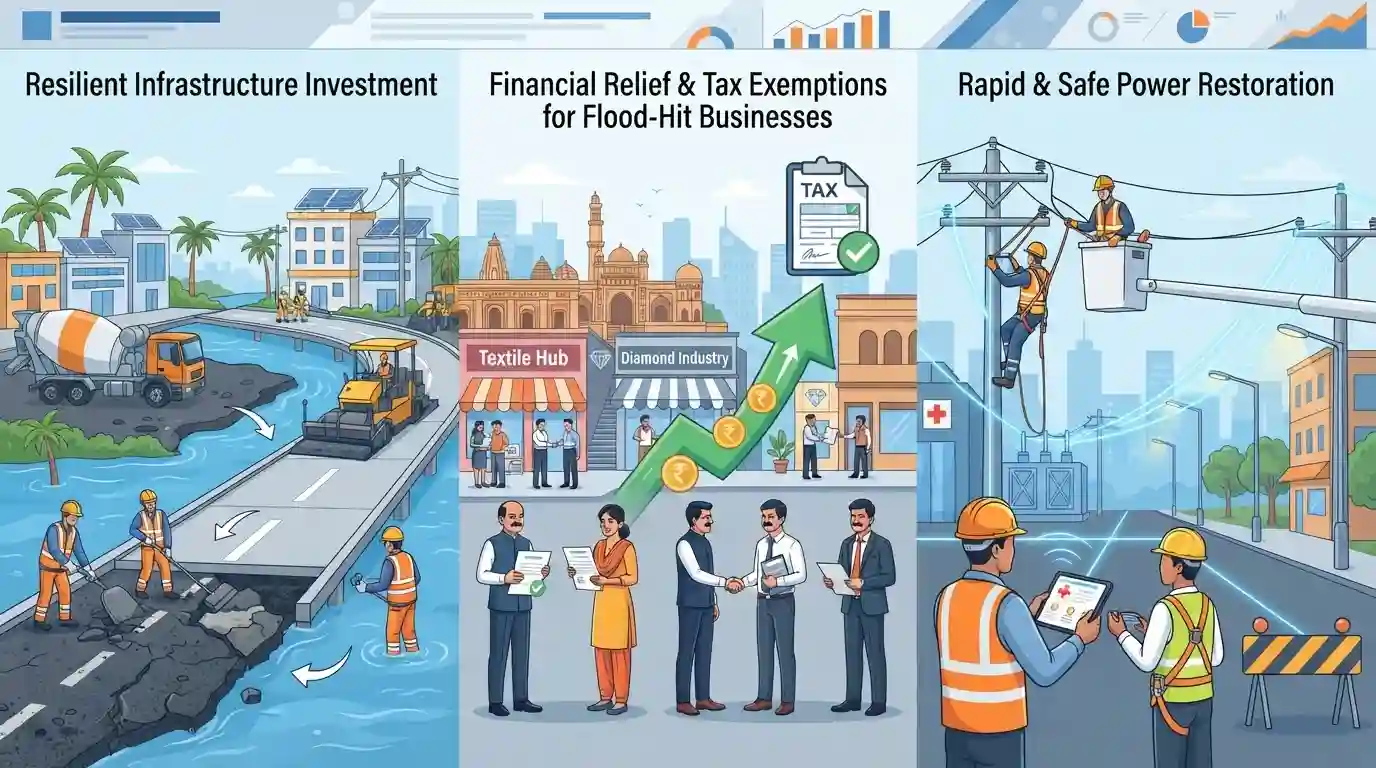
The Gujarat government has decided to replace asphalt roads with Cement-Concrete (CC) roads in all municipal corporations, municipalities, and flood-prone village areas to build climate-resilient transport infrastructure. Additionally, the state announced extensive financial relief and tax exemptions for flood-hit businesses in Surat and Ahmedabad, alongside guidelines emphasizing worker safety during rapid power restoration in rain-affected regions.
ముఖ్య అంశాలు
- The Gujarat Cabinet mandated replacing asphalt with Cement-Concrete (CC) roads for all internal roads in municipal corporations, municipalities, and waterlogging-prone village roads to prevent recurring monsoon damage.
- Despite higher initial capital expenditures, CC roads are prioritized for their durability, lower long-term maintenance costs, and ability to withstand heavy traffic during monsoons.
- Post-flood economic assistance was declared, featuring a transparent video-verified survey for Ahmedabad and a recovery package for Surat that includes one-time financial aid, loan interest subventions, and a one-year tax holiday for affected units.
- Power sector departments successfully restored electricity across 1,197 affected villages within hours, repairing extensive damage to feeders, poles, and transformers.
- Chief Minister Bhupendra Patel issued strict directives emphasizing worker safety, prohibiting shortcuts or non-usage of safety gear during hazardous power restoration works.
ముఖ్యమైన పదాలు
Climate-Resilient Infrastructure

Public and private infrastructure systems designed, built, and operated to withstand, adapt to, and recover quickly from extreme climate hazards, ensuring continuous services.
UPSC context
GS-III: Infrastructure & Disaster Management. Tests strategies for climate adaptation and resilient transport networks.
Sendai Framework Priority 4
A global disaster risk reduction priority focusing on enhancing disaster preparedness for effective response and implementing the "Build Back Better" concept in recovery and reconstruction.
UPSC context
GS-III: Disaster Management. Tests international frameworks for risk reduction and sustainable post-disaster rehabilitation.
White Topping
An engineering technique of overlaying an existing worn bituminous (asphalt) road with a layer of portland cement concrete to improve durability and mitigate urban heat.
UPSC context
GS-III: Infrastructure & Technology. Tests eco-friendly construction techniques and urban development policies.
Stress Absorbing Membrane Interlayer
A high-performance geotextile or fibre-reinforced sheet laid over a road base before asphalt application to absorb traffic pressure and prevent cracking.
UPSC context
GS-III: Infrastructure & Scientific Innovation. Tests knowledge of advanced materials for road durability.
Suvidhapath Yojana
A developmental scheme of the Gujarat state government aimed at converting asphalt roads in waterlogging-prone and heavy-traffic village settlements into durable concrete surfaces.
UPSC context
GS-II: Welfare Schemes & Governance. Tests state-level rural infrastructure interventions.
Gujarat Cabinet
The executive committee of the Gujarat State Government, chaired by the Chief Minister, responsible for shaping policies and approving major infrastructure outlays.
UPSC context
GS-II: State Executive & Legislature. Tests understanding of cabinet decisions in state governance.
ప్రిలిమ్స్ ఉచ్చు
Flexible pavements distribute vehicle wheel loads through structural slab action, while rigid pavements distribute loads downwards layer-by-layer through grain-to-grain contact.
This reverses engineering realities. Rigid pavements act as structural slabs bridging cavities, whereas flexible pavements transfer loads grain-to-grain, making them highly vulnerable to subgrade deformation.
అనుసంధానమైన స్థిర భావనలు
What is the difference between flexible and rigid pavements?
- Load Distribution: Flexible pavements transfer loads downward layer-by-layer through grain-to-grain contact; rigid pavements distribute loads over a wide area using slab action and high flexural rigidity.
- Moisture Resilience: Flexible pavements are highly sensitive to moisture and flood damage; rigid concrete pavements offer superior water resistance, durability, and a lifespan of 20-30 years.
- Lifecycle Costs: Flexible pavements have low initial capital costs but high maintenance; rigid pavements require high upfront investment but incur minimal long-term maintenance costs.
What is Priority 4 of the Sendai Framework?
- Core Mandate: It focuses on Enhancing Disaster Preparedness for Effective Response and to "Build Back Better" in recovery, rehabilitation, and reconstruction phases.
- Build Back Better: It advocates utilizing disaster recovery as an opportunity to integrate disaster risk reduction into development, ensuring built infrastructure is more resilient than before.
అంతర-అంశ నమూనాలు
Pavement materials & Urban Heat Islands
Replacing asphalt with concrete increases urban surface albedo, reflecting solar radiation to mitigate the Urban Heat Island effect while reducing municipal street-lighting energy consumption.
Municipal finance & State-led CapEx
With Indian municipal revenues stagnating at 1% of GDP, state cabinets must bypass crippled ULB finances to directly fund capital-intensive climate adaptations like white-topping.

Sendai Priority 4 (Build Back Better) structural adaptations in municipal infrastructure are highly likely to be tested under GS-3 in 2026.
అనుసంధాన PYQలు · 3
అనుసంధాన PYQలు · 3
- 2024MainsGS3
Flooding in urban areas is an emerging climate-induced disaster. Discuss the causes of this disaster. Mention the features of two such major floods in the last two decades in India. Describe the policies and frameworks in India that aim at tackling such floods.
- 2024MainsGS3
What is disaster resilience? How is it determined? Describe various elements of a resilience framework. Also mention the global targets of Sendai Framework for Disaster Risk Reduction (2015–2030).
- 2023MainsGS2
“The states in India seem reluctant to empower urban local bodies both functionally as well as financially.” Comment.
