Gujarat Budget Fiscal Health And Revenue Priorities Analysis
Source:prsindia ↗
Why It Matters
Essential for understanding state-level fiscal health, revenue collection mechanisms, public expenditure priorities, and debt indicators in Gujarat, which directly corresponds to economic governance questions in GPSC exams.
Summary
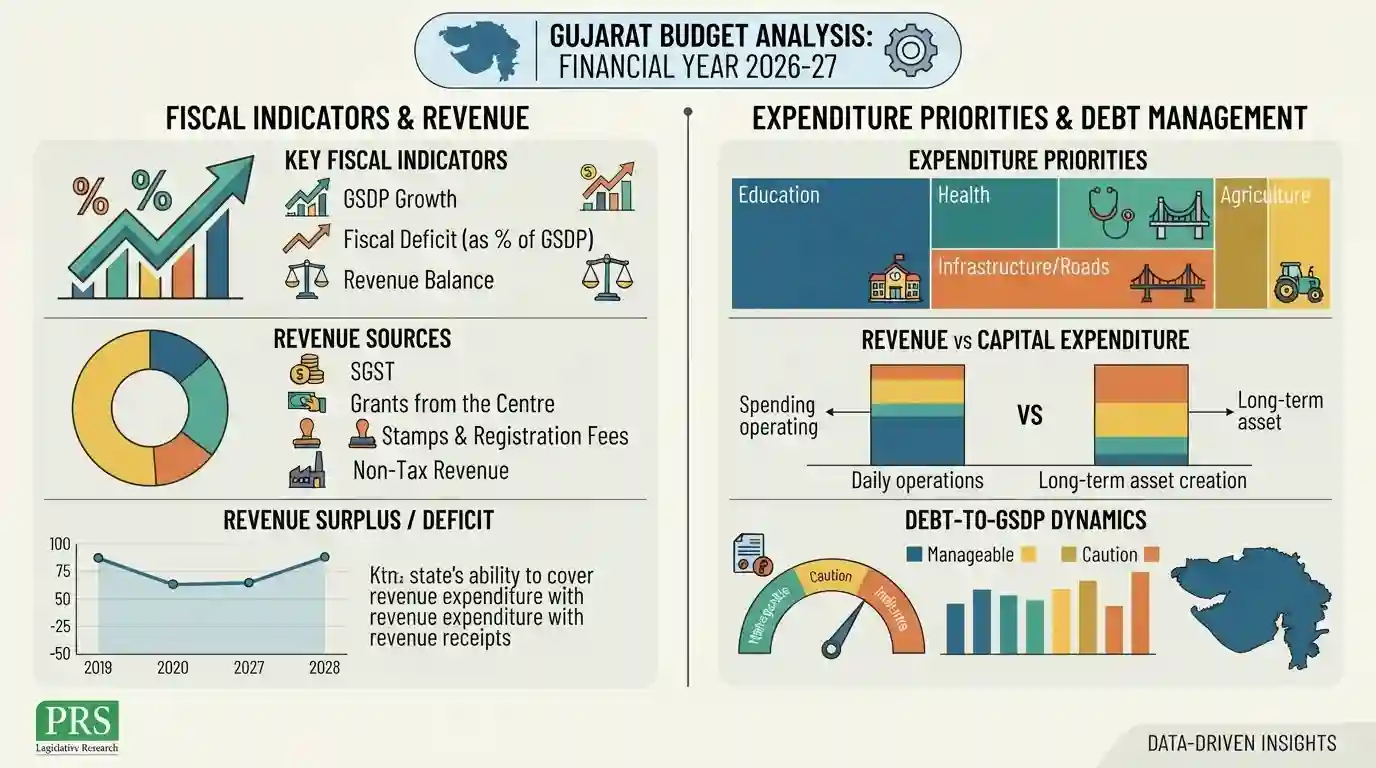
This article from PRS Legislative Research analyzes the Gujarat Budget for the financial year 2026-27, examining key fiscal indicators, revenue sources, expenditure priorities, debt-to-GSDP dynamics, and overall fiscal management of the state government.
Key Points
- The Gujarat Budget Analysis for 2026-27 provides a detailed breakdown of the state's projected revenues, expenditures, fiscal deficit, and debt profile.
- State budgets focus on capital outlay, tax and non-tax revenues, and allocation to key developmental and social sectors like education, health, and infrastructure.
- Fiscal parameters such as debt-to-GSDP ratio and fiscal deficit relative to FRBM targets are critical indicators of Gujarat's financial health.
Important Terms
PRS Legislative Research

An independent research institution in India that tracks and analyzes legislative policy, government bills, policies, and state/union budgets to promote informed legislative debate.
UPSC context
Useful for GS Paper II (Polity & Governance — parliamentary research and accountability) and economic policy tracking.
Government of Gujarat
The elected executive branch of the state of Gujarat, responsible for framing state policies, presenting annual state budgets, and managing regional administration and public finances.
UPSC context
Crucial for GPSC and GS Paper II/III (State administration, governance, and regional fiscal governance).
Prelims Trap
revenue deficit of ₹25,587 crore leading to fiscal stress
Aspirants often confuse revenue deficit with revenue surplus. Gujarat's budget projects a revenue SURPLUS, meaning revenue receipts exceed revenue expenditure.
Static Concepts Connected
What are the key fiscal indicators monitored under the FRBM Act for state governments?
- Fiscal Deficit: Fiscal Deficit: Generally capped around 3% of GSDP, with permissible deviations under recommendations of the Finance Commission.
- Revenue Balance: Revenue Deficit: States are encouraged to maintain a revenue surplus or zero revenue deficit to ensure borrowings fund capital formation.
- Debt Profile: Debt-to-GSDP Ratio: Measures overall debt sustainability against the state's total economic output.
Cross-Topic Patterns
State Budgets and Capital Outlay Trends
Gujarat's focus on capital outlay and regional economic planning connects state fiscal health with broader cooperative federalism and capital expenditure trends across Indian states.
FRBM Targets and Fiscal Consolidation
Adherence to FRBM targets and revenue surplus management links state-level fiscal responsibility with national macroeconomic stability and debt sustainability.

Expect match-the-following or statement-based questions on Gujarat's fiscal deficit percentage, GSDP growth, and revenue surplus targets.
Linked PYQs · 3
Linked PYQs · 3
- 2025GPSC_PRELIMSGS1
Consider the following statements: 1. Gujarat has the second lowest debt-to-gross state domestic product (GSDP) ratio among all states 2. A low debt-to-GSDP ratio denotes an unhealthy financial position Which of the statement(s) given above is/are correct?
- 2026GPSC_PRELIMSGS1
Primary deficit is the difference between __________________.
- 2026GPSC_PRELIMSGS1
As per the Union Budget 2025-26, arrange the following sources of government revenue in descending order of their share in the government's total receipts: 1. GST and other taxes 2. Borrowing and other liabilities 3. Income Tax 4. Corporation Tax Choose the correct option from the following.
