Gujarat Adopts Uniform Civil Code Following Article 44 Implementation
Source:drishtiias ↗
Why It Matters
Crucial for understanding state-level initiatives regarding Directive Principles of State Policy (Article 44) and the federal dynamics of enacting personal law reforms in India.
Summary
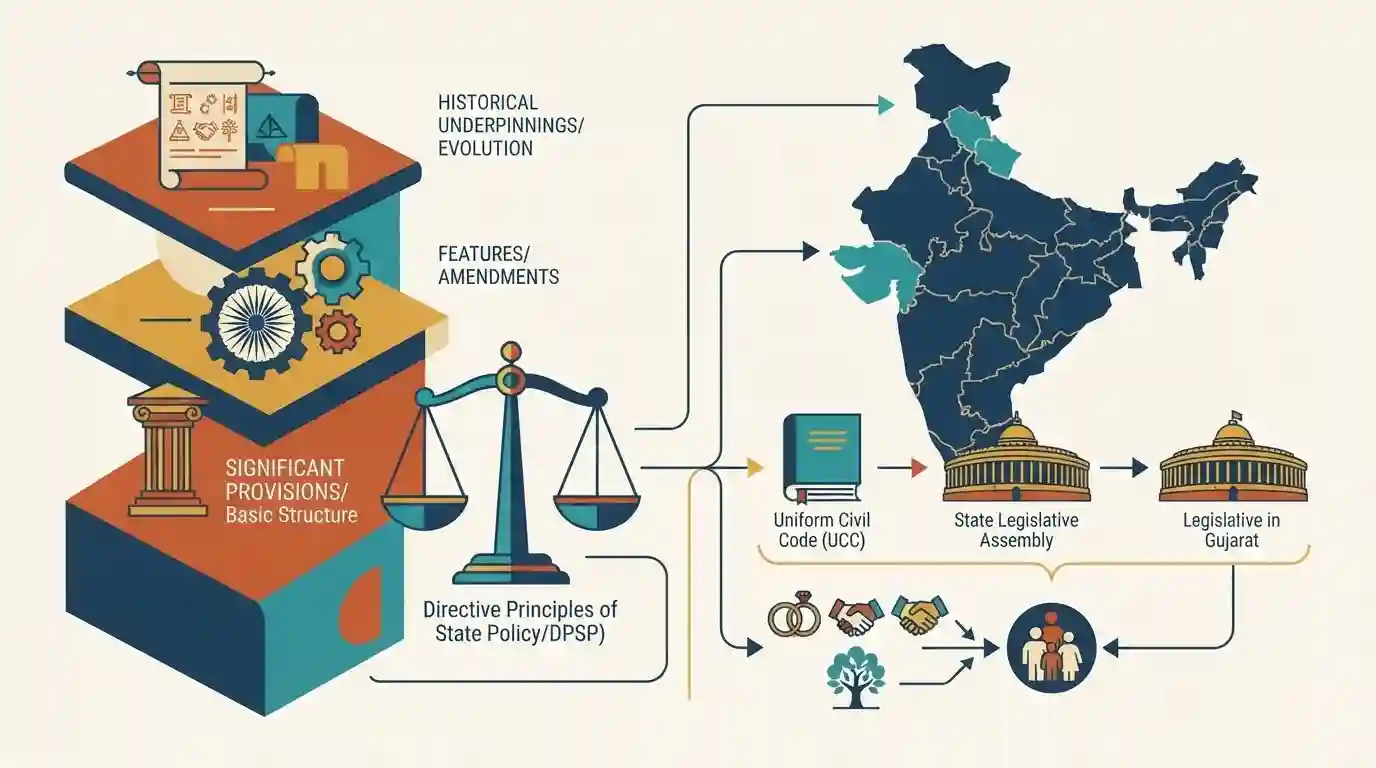
Gujarat has emerged as the second state in India to adopt/pursue a Uniform Civil Code (UCC), following Uttarakhand. This development highlights the growing implementation of Article 44 of the Directive Principles of State Policy at the state level, standardizing personal laws regarding marriage, divorce, and inheritance.
Key Points
- Gujarat has become the second state in India (after Uttarakhand) to adopt or move towards the implementation of a Uniform Civil Code (UCC).
- Uniform Civil Code relates to Article 44 of the Constitution of India, which is a Directive Principle of State Policy (DPSP) aiming to secure a common set of personal laws for all citizens across the country.
- State-level legislations on UCC touch upon issues of concurrent list jurisdiction, personal laws, and legal uniformity.
Important Terms
Uniform Civil Code

A proposal to formulate and implement personal laws that apply uniformly to all citizens of India irrespective of their religion, covering matters like marriage, divorce, and inheritance.
UPSC context
Important for GS Paper II (Indian Constitution, Federalism, and Legislative competence). Tests understanding of secularism and state-level policy implementation.
Article 44 of the Constitution
A constitutional provision under Part IV (Directive Principles of State Policy) that directs the State to endeavor to secure for all citizens a Uniform Civil Code throughout India.
UPSC context
Important for GS Paper II (DPSP and Constitutional Provisions). Tests the interplay between non-justiciable directives and state legislation.
Directive Principles of State Policy
Non-justiciable guidelines enshrined in Part IV of the Indian Constitution (Articles 36–51) that direct the government in framing laws and formulating social and economic policies.
UPSC context
Crucial for GS Paper II. Tests the philosophical foundations of welfare state governance and implementation challenges.
Static Concepts Connected
What are the key constitutional provisions and judicial milestones regarding the Uniform Civil Code (UCC) in India?
- Constitutional Basis:: Article 44 of Part IV directs the State to secure for citizens a Uniform Civil Code throughout the territory of India; DPSPs are non-justiciable.
- Legislative Competence:: Personal laws (marriage, divorce, inheritance) fall under Entry 5 of the Concurrent List (List III) of the Seventh Schedule.
- Judicial Precedents:: Landmark rulings like Shah Bano (1985) and Sarla Mudgal (1995) urged Parliament to move toward enacting a UCC to remove gender discrimination in personal laws.
Cross-Topic Patterns
UCC vs. Federalism & Concurrent List Legislative Power
While Article 44 is a non-justiciable DPSP, federal dynamics allow states to legislate under Concurrent List subjects like personal law, leading to multi-state legal fragmentation.

Expect statement-based Qs on Article 44, DPSP non-justiciability, Concurrent List entries, and constitutional exemptions for STs under state UCC laws.
Linked PYQs · 2
Linked PYQs · 2
- 2017GPSC_PRELIMSGS1
Which Article of the Constitution directs the state to Endeavour secure uniform Civil Code throughout the country ?
- 2025GPSC_PRELIMSGS1
Which of the following statements accurately reflect/(s) the provisions of the Indian Constitution? Statements: 1. The Directive Principles of State Policy (DPSP) are enforceable by the courts. 2. The Indian Constitution provides a federal system with unitary features. 3. The Fundamental Rights can be amended by the Parliament without any restrictions. Which of the statement/statements given above is/are correct?
