State Budget Presentation and Legislative Assembly Procedures
Source:Indian Express ↗
Why It Matters
Understanding the procedural workings of State Legislatures, the presentation of the state budget, and the constitutional duties of the Governor provides a practical context to the static syllabus of Polity and Governance.
Summary
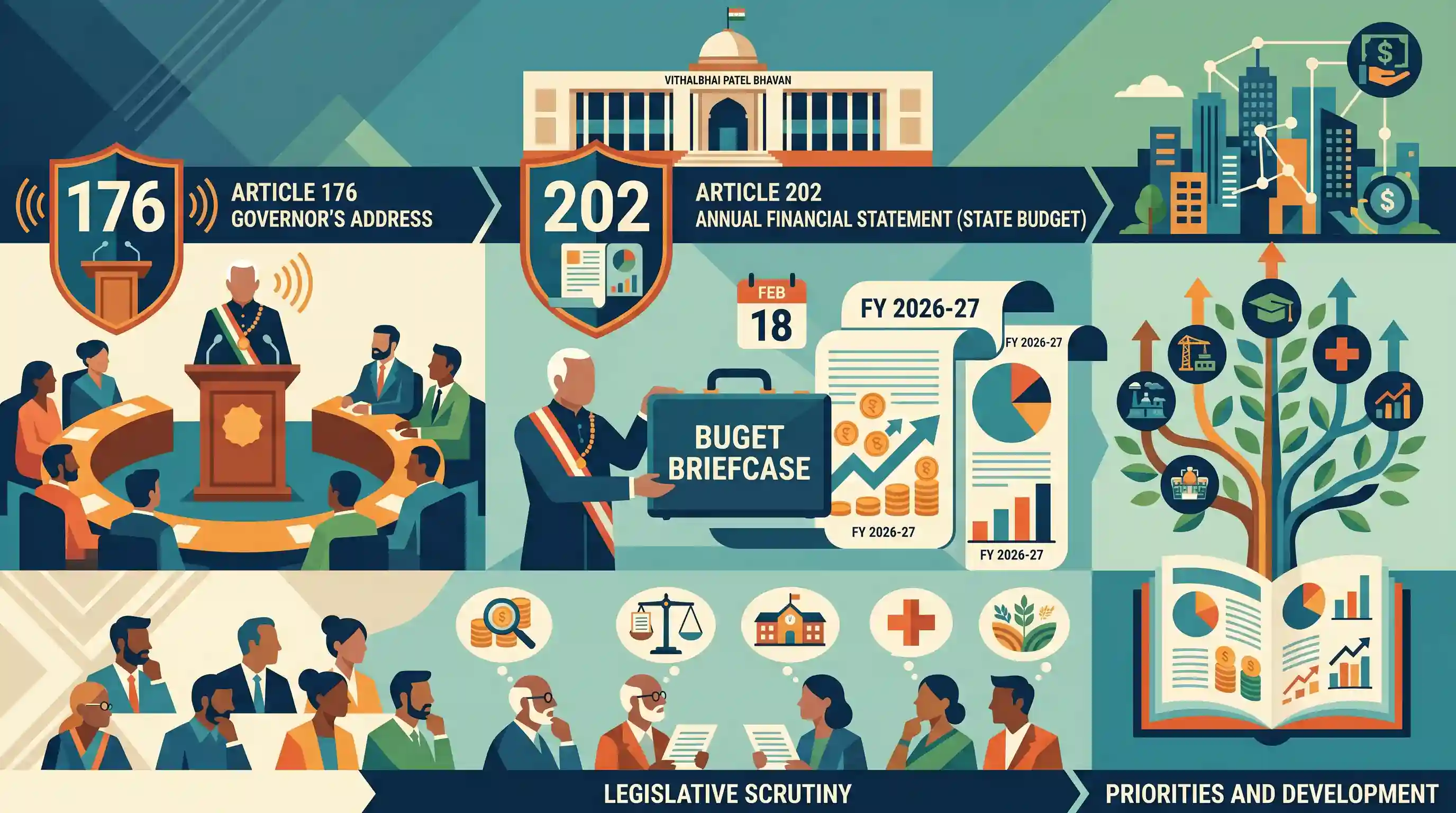
The Gujarat Legislative Assembly is set to commence its budget session, with the presentation of the state budget for the financial year 2026-27 scheduled for February 18. This session is constitutionally significant as it involves the Governor's customary address and legislative scrutiny of the state's Annual Financial Statement, setting the financial and developmental priorities for the upcoming fiscal year.
Key Points
- The Gujarat Legislative Assembly's budget session is set to commence shortly.
- The state budget for the financial year 2026-27 will be presented on February 18.
- State budget sessions are critical legislative procedures under Article 202 of the Constitution, requiring the presentation of the Annual Financial Statement to the assembly.
- Such sessions conventionally begin with a customary address by the State Governor under Article 176, outlining the government's policies and achievements.
Important Terms
Annual Financial Statement (State Budget)

Commonly known as the State Budget, this document details the government's estimated receipts and expenditure for a financial year, as mandated by Article 202 of the Indian Constitution.
UPSC context
GS Paper II (Polity) and III (Economy); tests knowledge of state financial procedures and executive-legislative accountability.
Article 176
A constitutional provision requiring the Governor to address the Legislative Assembly at the commencement of the first session of each year and after every general election.
UPSC context
GS Paper II (Polity); central to questions on the Governor's role, discretionary powers, and federal tensions.
Gujarat Legislative Assembly
The unicameral law-making body of Gujarat, comprising 182 directly elected members. It exercises control over state finances and holds the executive accountable through debates and legislative scrutiny.
UPSC context
GS Paper II; relates to State Legislature structure, functions, and constitutional provisions under Articles 168-212.
Consolidated Fund of the State
The primary fund of a state where all revenues, loans, and recoveries are credited. Under Article 202, no money can be withdrawn from it except through legislative appropriation.
UPSC context
GS Paper II/III; essential for understanding the mechanics of the budget, charged expenditure, and legislative control over the purse.
Governor’s Special Address
A constitutional requirement where the Governor outlines the state government's policy agenda and legislative priorities at the start of the budget session, acting on the Council of Ministers' advice.
UPSC context
GS Paper II; tests the ceremonial versus discretionary nature of the Governor's office in a parliamentary democracy.
Prelims Trap
The Governor can return a State Money Bill to the legislative assembly for reconsideration.
Under Article 200, the Governor cannot return a Money Bill for reconsideration. They can only give assent, withhold assent, or reserve it for the President.
Static Concepts Connected
When is the Governor mandated to address the State Legislature?
- Post-Election Session: At the commencement of the first session after each general election to the Legislative Assembly.
- Annual First Session: At the commencement of the first session of each year (traditionally the Budget session).
- Cabinet Drafted: The speech outlines the government's policies and achievements, and is drafted by the state cabinet, not the Governor personally.
What are the key constitutional provisions for a State Budget?
- Constitutional Nomenclature: The Constitution uses the term 'Annual Financial Statement', not 'Budget', under Article 202.
- Governor's Duty: The Governor shall "cause to be laid" the statement of estimated receipts and expenditures before the House(s).
- Appropriation Bill: No money can be legally withdrawn from the state's Consolidated Fund without an Appropriation Act passed under Article 204.
Cross-Topic Patterns
Governor's Assent & Judicial Scrutiny
The power of the Governor to withhold assent to state bills (Article 200) has reached the Supreme Court recently, making the interplay between state budgets, bills, and the Governor highly relevant.
State Borrowings & Article 293
State budget estimates are increasingly constrained by Article 293(3), which requires Centre's consent for state borrowing if prior Central loans remain outstanding.

Expect a multi-statement question comparing Article 176 (Governor's address) and Article 87 (President's address) amid recent state rows.
Linked PYQs · 3
Linked PYQs · 3
- 2019PrelimsGS1
With reference to the Legislative Assembly of a State in India, consider the following statements : 1. The Governor makes a customary address to Members of the House at the commencement of the first session of the year. 2. When a State Legislature does not have a rule on a particular matter, it follows the Lok Sabha rule on that matter. Which of the statements given above is/are correct?
- 2023MainsGS2
Discuss the role of Presiding Officers of state legislatures in maintaining order and impartiality in conducting legislative work and in facilitating best democratic practices.
- 2024PrelimsGS1
With reference to Union Budget, consider the following statements : 1. The Union Finance Minister on behalf of the Prime Minister lays the Annual Financial Statement before both the Houses of Parliament. 2. At the Union level, no demand for a grant can be made except on the recommendation of the President of India. Which of the statements given above is/are correct?
