Gujarat Organized Crime Act Amendment and Bharatiya Nyaya Sanhita
Source:Indian Express ↗
Why It Matters
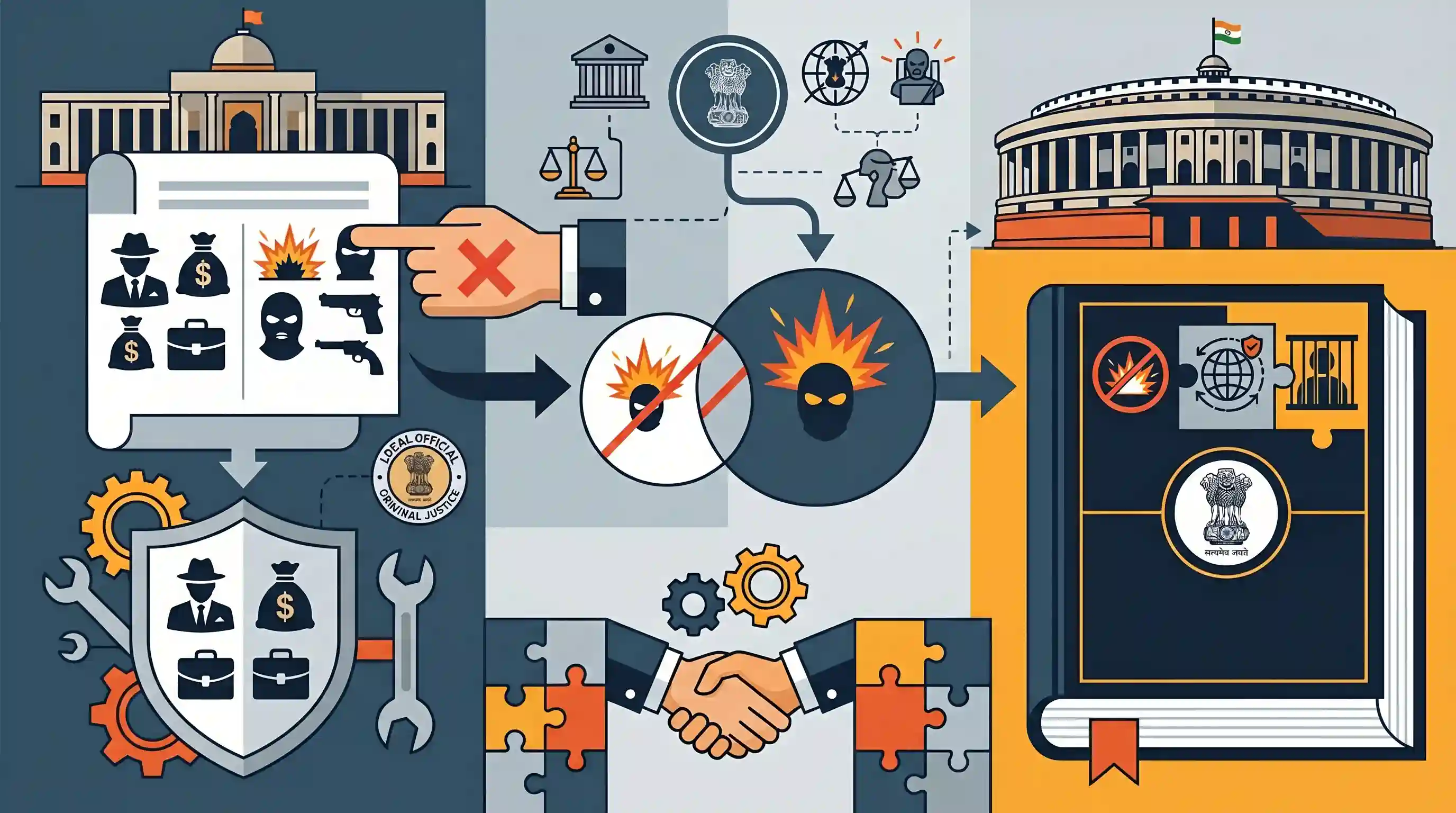
The amendment highlights the evolving legislative landscape concerning internal security and criminal justice in India. It serves as a practical example of how the newly enacted Bharatiya Nyaya Sanhita (BNS) is superseding specific state-level criminal provisions, reflecting important themes in federalism, concurrent list subjects, and the legal framework combating terrorism and organized crime.
Summary
The Gujarat Assembly has passed the GujCTOC Amendment Bill 2026, effectively removing the word 'terrorism' from the state's 11-year-old anti-terror law and renaming it the Gujarat Control of Organised Crime Act (GujCOC). The decision was prompted by the implementation of the new central criminal code, the Bharatiya Nyaya Sanhita (BNS), 2023. Specifically, Section 113 of the BNS provides a comprehensive definition and penalties for 'terrorist acts', rendering the overlapping provisions in the state legislation redundant. This legislative adjustment highlights the ongoing harmonization of state and central laws concerning criminal justice and internal security.
Key Points
- The Gujarat Assembly passed the GujCTOC Amendment Bill 2026, dropping the word 'terrorism' from the Act's title and provisions.
- The Act will now be renamed the Gujarat Control of Organised Crime Act (GujCOC).
- The amendment follows the nationwide enforcement of the Bharatiya Nyaya Sanhita (BNS), 2023.
- Section 113 of the BNS explicitly defines and penalizes terrorist acts, making the state-level provisions on terrorism redundant.
- This move reflects the realignment of state laws with the newly overhauled central criminal justice framework, touching upon the distribution of legislative powers under the Concurrent List.
Important Terms
Gujarat Control of Terrorism and Organised Crime (GujCTOC) Act

A 2015 state legislation (assented in 2019) designed to curb terrorism and criminal syndicates. It featured stringent provisions like admissibility of police confessions and extended detention periods.
UPSC context
GS-III (Internal Security); GS-II (Statutory Bodies). Relevant for discussing special state laws versus central anti-terror frameworks like UAPA.
GujCTOC Amendment Bill 2026
Legislation passed in March 2026 that removes 'terrorism' from the GujCTOC Act, renaming it the Gujarat Control of Organised Crime Act (GujCOC) to avoid legal overlap with central laws.
UPSC context
GS-II (Polity/Legislative Process). Tests understanding of legislative harmonization and the impact of the new criminal codes on state-level statutes.
Bharatiya Nyaya Sanhita (BNS) 2023
India's new primary criminal code replacing the Indian Penal Code (IPC). It modernizes definitions, introduces new offenses like mob lynching, and specifically codifies terrorism as a general criminal offense.
UPSC context
GS-II (Criminal Justice System). Fundamental for questions on legal reforms, decolonization of laws, and the shift from IPC to BNS.
Section 113 of BNS
A specific clause in the BNS that defines a 'terrorist act' as any act intending to threaten India's unity, integrity, sovereignty, or economic security through violent or hazardous means.
UPSC context
GS-III (Security). Crucial for analyzing how terrorism is now defined in general law versus special laws like UAPA.
Organised Crime
Unlawful activities like extortion, land grabbing, and contract killing carried out by a syndicate for economic gain. After 2026, the Gujarat state law focuses exclusively on this.
UPSC context
GS-III (Internal Security). Tests the ability to distinguish between terrorism (political/ideological) and organized crime (pecuniary/economic) in legal frameworks.
Legislative Harmonization
The process of ensuring state laws align with central legislation to prevent jurisdictional conflict, duplication of investigation, and ensure uniform application of the criminal justice system.
UPSC context
GS-II (Federalism/Centre-State Relations). Important for discussing how new central codes (BNS, BNSS) necessitate amendments in state-specific acts.
Prelims Trap
States lack constitutional authority to enact anti-terror laws because National Security falls exclusively under the Union List.
States can legislate on terror under 'Criminal Law' (Concurrent List). However, under Article 254 (Doctrine of Repugnancy), states must align their laws to prevent conflict with superseding Central codes like BNS.
Static Concepts Connected
How does Article 254 resolve Central-State legislative conflicts?
- General Rule: If a State law contradicts a Central law on a Concurrent List subject, the Central law prevails over the repugnant state provisions.
- Presidential Exception: A repugnant State law can remain valid within that specific state if it was reserved for and received the President's formal assent.
- Parliamentary Override: Despite Presidential assent, Parliament retains the power to enact subsequent legislation modifying or repealing the state law.
What conceptually distinguishes Organised Crime from Terrorism?
- Core Motive: Organised crime seeks continuous illicit financial gain, whereas terrorism aims to achieve political, ideological, or religious objectives through mass fear.
- State Interaction: Organised syndicates prefer to subvert the state discreetly via corruption; terrorists directly challenge state sovereignty and legitimacy publicly.
- Symbiotic Link: Despite distinct motives, they heavily overlap: terrorist groups rely on organised crime networks (narcotics, extortion) for their operational funding.
Cross-Topic Patterns
Dual terror definitions: BNS & UAPA
Section 113 of BNS 2023 supplements, rather than replaces, the UAPA. This dual-track legal framework raises critical GS2 federalism and prosecutorial discretion debates.
Presidential veto on State Bills
Historical Presidential rejections of GujCTOC highlight how the Centre uses Article 201 (reserving bills for President's consideration) to standardize concurrent subjects like criminal law nationwide.

Expect a multi-statement question on Article 254 (Repugnancy) linking state anti-terror laws, BNS 2023, and Concurrent List entries.
Linked PYQs · 4
Linked PYQs · 4
- 2022MainsGS3
Discuss the types of organised crimes. Describe the linkages between terrorists and organised crime that exist at the national and transnational levels.
- 2019MainsGS3
Indian Government has recently strengthened the anti-terrorism laws by amending the Unlawful Activities (Prevention) Act (UAPA), 1967 and the NIA Act. Analyze the changes in the context of prevailing security environment while discussing the scope and reasons for opposing the UAPA by human rights organizations.
- 2019MainsGS2
From the resolution of contentious issues regarding distribution of legislative powers by the courts, 'Principle of Federal Supremacy' and 'Harmonious Construction' have emerged. Explain.
- 2023PrelimsGS1
Consider the following statements: 1. According to the Constitution of India, the Central Government has a duty to protect States from internal disturbances. 2. The Constitution of India exempts the States from providing legal counsel to a person being held for preventive detention. 3. According to the Prevention of Terrorism Act, 2002, confession of the accused before the police cannot be used as evidence. How many of the above statements are correct?
