State Legislative Debate on Drug Trafficking and Seizures
Source:Indian Express ↗
Why It Matters
Drug trafficking is a major internal security threat for India, given its proximity to the Golden Crescent and Golden Triangle. State-level political debates on the issue highlight the practical challenges in law enforcement, coastal security, and inter-state coordination required to curb the drug menace.
Summary
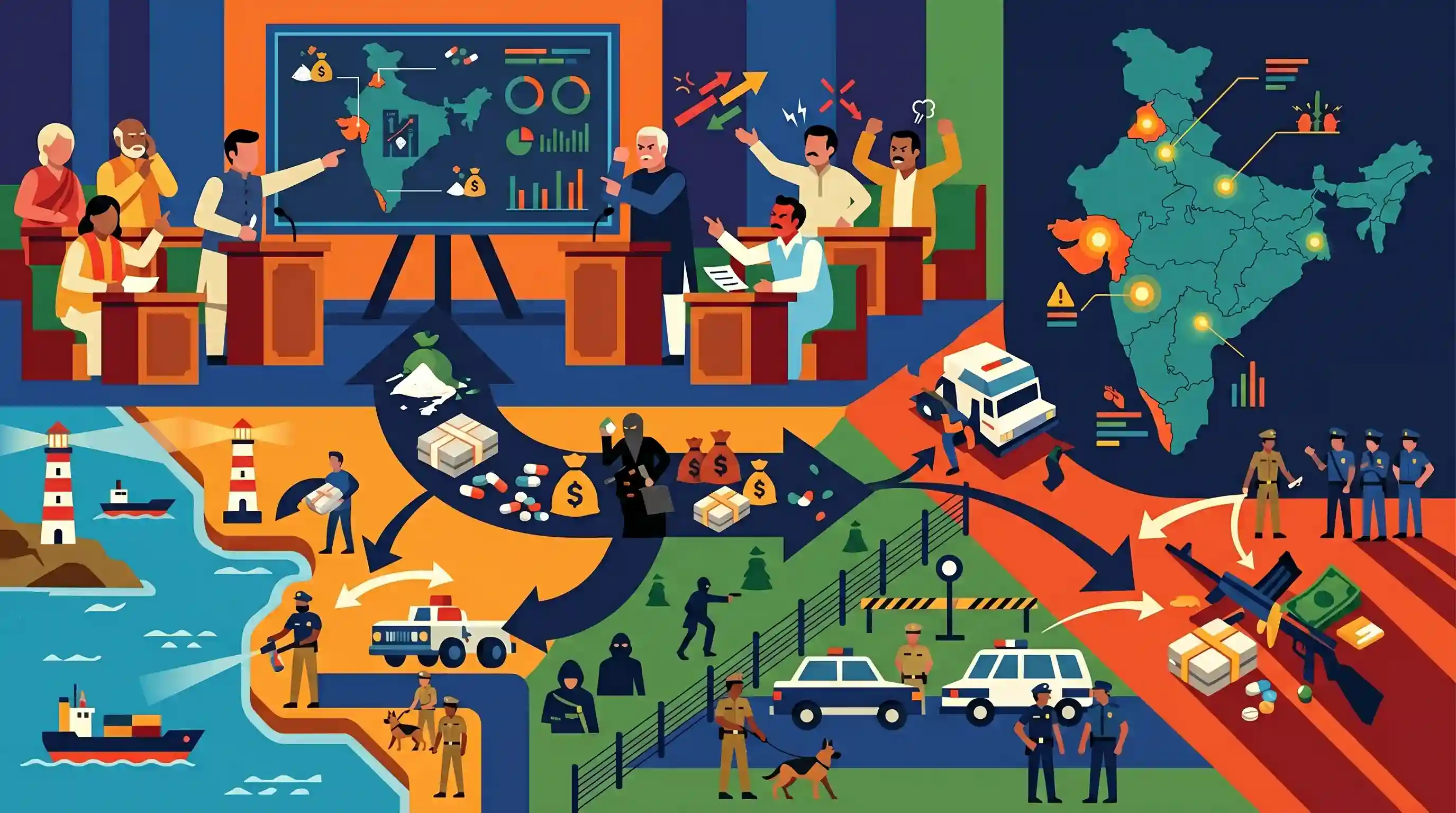
In a heated Budget Session debate in the Gujarat Assembly, the state government faced opposition scrutiny over drug seizures and the prevailing drug menace. In defense, a state minister compared Gujarat’s drug data with that of Punjab and Kerala, sparking political controversy. The discussion brings to the forefront the critical internal security challenges posed by drug trafficking through India's coastal and land borders, emphasizing how border states grapple with organized crime and narco-terrorism.
Key Points
- During the Budget Session of the Gujarat Assembly, a heated debate occurred regarding the state's drug situation and related seizures.
- A state minister defended the government's track record by drawing comparative data on drug seizures and consumption with other states, notably Punjab and Kerala.
- The political sparring highlights the broader internal security challenges of drug trafficking along both coastal (Gujarat, Kerala) and land borders (Punjab).
- The comparison underscores the ongoing public health and law and order issues posed by the drug menace across Indian states, and the political sensitivity of reporting such data.
Important Terms
Narco-terrorism

The symbiotic nexus where drug trafficking proceeds are used to finance terrorist operations, destabilizing national security and social order.
UPSC context
GS Paper III: Internal Security; tests understanding of the linkages between organized crime and terrorism.
NDPS Act, 1985
India's primary legal framework prohibiting unauthorized cultivation, production, possession, and trade of narcotics and psychotropic substances, except for medical use.
UPSC context
GS Paper II & III: Governance and Security; essential for laws and regulatory bodies.
Golden Crescent
The principal illicit opium-producing region comprising Afghanistan, Pakistan, and Iran, significantly impacting drug trafficking and security along India's western borders.
UPSC context
GS Paper III: Security challenges in border areas; geography-linked security threats.
Coastal Security
A multi-layered defense framework protecting maritime boundaries from smuggling, infiltration, and piracy through the Navy, Coast Guard, and Marine Police.
UPSC context
GS Paper III: Border Management; critical for maritime security and coastal state vulnerabilities.
Organized Crime
Structured criminal networks operating for profit through illegal activities like trafficking, often exploiting porous borders and corrupting public institutions.
UPSC context
GS Paper III: Internal Security; focuses on non-state actors and security challenges.
State Legislature
A state-level legislative body in India responsible for law-making, debating public policy, and holding the state executive accountable.
UPSC context
GS Paper II: Polity; tests structure and conduct of business in state assemblies.
Prelims Trap
Gujarat and Punjab are vulnerable to drug trafficking from the Golden Triangle.
Gujarat, Punjab, and Rajasthan are vulnerable to the Golden Crescent (Iran, Afghanistan, Pakistan), whereas the Golden Triangle affects India's Northeast.
Static Concepts Connected
How do the 'Golden Crescent' and 'Golden Triangle' impact India?
- Golden Crescent: Comprises Afghanistan, Iran, and Pakistan. Trafficking routes hit Western India (Punjab via land/drones, Gujarat/Maharashtra via maritime routes).
- Golden Triangle: Comprises Myanmar, Laos, and Thailand. Smuggling primarily occurs through porous land borders in Northeast India (Manipur, Mizoram, Nagaland).
- Double Vulnerability: India's geographic sandwiching between these two largest global illicit opium hubs makes it highly vulnerable as both a destination and a transit route.
What is the Narco Coordination Centre (NCORD) mechanism?
- Nodal Authority: Established by the Ministry of Home Affairs (MHA) to improve coordination among various central and state drug law enforcement agencies.
- Structure: Operates as a 4-tier mechanism (Apex, Executive, State, and District levels) to prevent fragmented approaches to drug control.
- Function: Complementary to the Narcotics Control Bureau (NCB), it leverages the e-NCORD portal for data sharing and actionable intelligence across jurisdictions.
Cross-Topic Patterns
Coastal vs. Land Border vulnerabilities
Punjab faces high-tech drone infiltrations bypassing border fences, while Gujarat grapples with maritime smuggling via dhows from the Makran Coast, requiring vastly different technology and policing approaches.
Narco-Terrorism and PMLA linkages
Drug proceeds from Western routes are often laundered using hawala networks to fund proxy insurgencies, connecting border management directly with the Prevention of Money Laundering Act (PMLA).

Mapping border states to the Golden Crescent/Triangle and identifying the specific mandates of NCORD vs NCB are likely 2026 Prelims targets.
Linked PYQs · 4
Linked PYQs · 4
- 2024MainsGS3
Explain how narco-terrorism has emerged as a serious threat across the country. Suggest suitable measures to counter narco-terrorism.
- 2018MainsGS3
India's proximity to two of the world's biggest illicit opium-growing states has enhanced her internal security concerns. Explain the linkages between drug trafficking and other illicit activities such as gunrunning, money laundering and human trafficking. What counter-measures should be taken to prevent the same?
- 2023MainsGS3
The use of unmanned aerial vehicles (UAVs) by our adversaries across the borders to ferry arms/ammunitions, drugs, etc., is a serious threat to the internal security. Comment on the measures being taken to tackle this threat.
- 2025MainsGS3
Why is maritime security vital to protect India's sea trade? Discuss maritime and coastal security challenges and the way forward.
