Drug Free Gujarat De Addiction Centres in District Hospitals
Source:theshillongtimes ↗
Why It Matters
Highlights crucial state-level health interventions, the application of e-governance (GeM) for transparent procurement, and governance tools like social audits that are directly relevant to Public Administration and Social Justice syllabus in GS2.
Summary
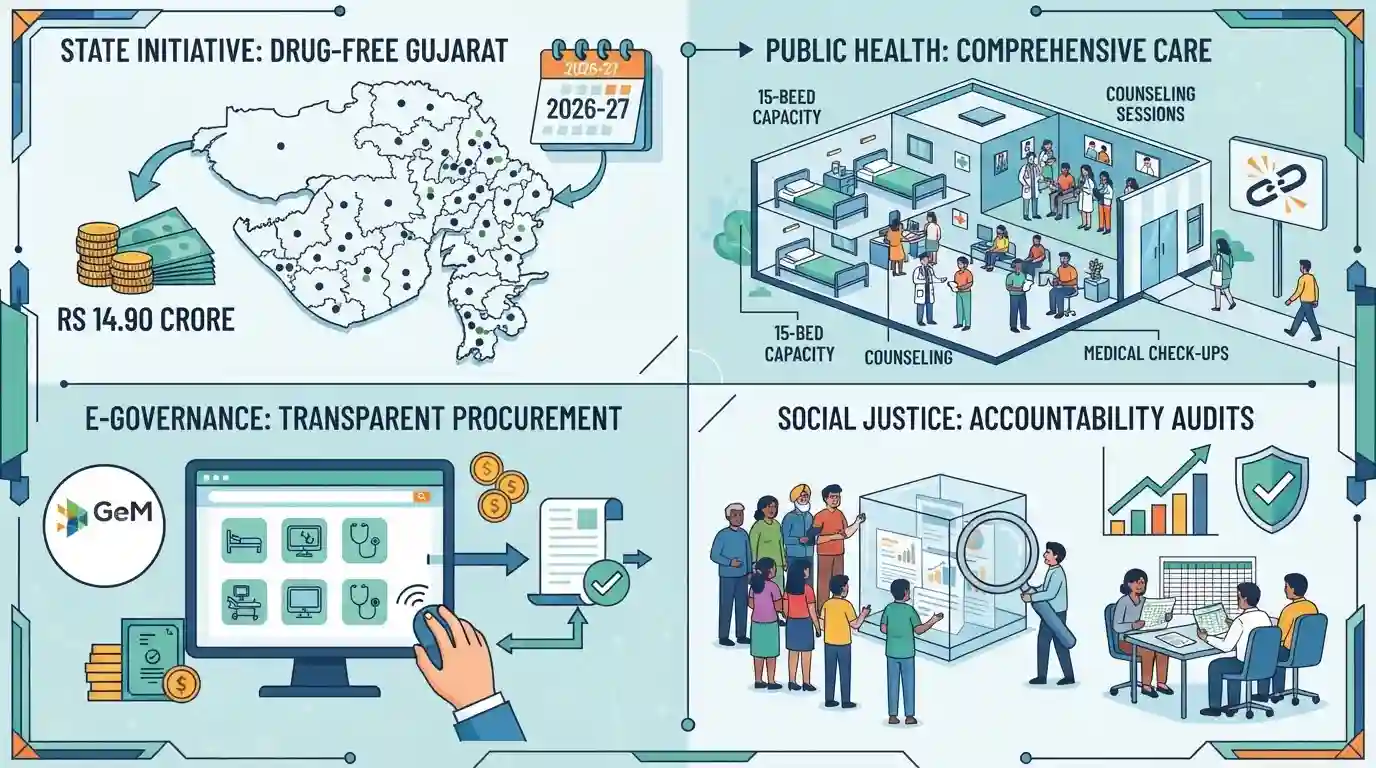
The Gujarat government has sanctioned Rs 14.90 crore for the 2026-27 financial year to establish 15-bed de-addiction centres across all 34 district hospitals under the 'Drug-Free Gujarat' initiative. These centres aim to provide comprehensive, multidisciplinary inpatient and outpatient rehabilitation and therapy services locally. Emphasizing accountability and transparency, all medical equipment procurement will be conducted via the Government e-Marketplace (GeM), accompanied by mandatory social audits and third-party project verification.
Key Points
- The Gujarat government approved Rs 14.90 crore to establish 15-bed de-addiction centres in all 34 district hospitals across the state.
- The centres are part of the 'Drug-Free Gujarat' initiative, aiming to provide accessible detoxification, mental healthcare, and rehabilitation locally.
- To maintain transparency, all required equipment for these centres will be procured through the Government e-Marketplace (GeM) portal.
- The initiative mandates regular monitoring, social audits, and third-party verification to ensure accountability and project effectiveness.
Important Terms
Government e-Marketplace (GeM)

An online public procurement portal launched in 2016 by the Ministry of Commerce and Industry to enable transparent, efficient, and inclusive buying of goods and services by government bodies.
UPSC context
GS Paper II (e-governance, administrative reforms) and GS Paper III (public procurement and economic growth).
Social Audit
A public, participatory process where citizens or beneficiaries examine official government records and physical assets of a scheme to verify expenditure, curb corruption, and ensure accountability.
UPSC context
GS Paper II (transparency, accountability, and citizen-led governance) and GS Paper IV (probity).
Nasha Mukt Bharat Abhiyaan (NMBA)
A national anti-drug campaign launched in 2020 by the Ministry of Social Justice and Empowerment to curb substance abuse through community mobilization, treatment, and rehabilitation.
UPSC context
GS Paper II (Social Justice, welfare mechanisms, public health, and vulnerable sections).
Third-Party Verification
An independent, objective assessment conducted by an external entity to evaluate the performance, outcome, and financial utilization of public projects or compliance standards.
UPSC context
GS Paper II (good governance, transparency, and administrative accountability mechanisms).
Drug-Free Gujarat
A state government campaign in Gujarat focusing on making addiction treatment accessible by establishing 15-bed de-addiction and multidisciplinary rehabilitation centres across all 34 district hospitals.
UPSC context
GS Paper II (state initiatives for public health and social welfare of vulnerable populations).
Prelims Trap
The Ministry of Home Affairs is the nodal agency for implementing the National Action Plan for Drug Demand Reduction (NAPDDR) in India.
MoSJE is the nodal ministry for drug demand reduction (rehabilitation and NAPDDR), while the Ministry of Home Affairs (MHA) handles supply reduction and enforcement.
Static Concepts Connected
What is India's constitutional and administrative framework for combating drug abuse?
- Article 47 DPSP: Directs the State to endeavor to prohibit consumption of intoxicating drinks and health-injurious drugs, except for medicinal use.
- Nodal Division: MoSJE controls drug demand reduction and NAPDDR, whereas the Ministry of Home Affairs manages supply reduction and law enforcement.
- Nasha Mukt Bharat: Launched by MoSJE in 2020, this community-driven preventive education campaign was expanded to cover all districts in 2023.
What are the core governance features of the Government e-Marketplace (GeM)?
- Nodal Ministry: Launched in 2016 under the Ministry of Commerce and Industry to digitize public procurement of goods and services.
- Usage Mandate: Mandatory for all central ministries and public sector undertakings; voluntary but highly encouraged for state-level government departments.
- Operational Goals: Ensures transparency, eliminates intermediaries, reduces administrative delays, and fosters participation of MSMEs and startups.
Cross-Topic Patterns
Digital Infrastructure and Federalism
States utilizing the Central Government e-Marketplace (GeM) for local healthcare procurement showcases cooperative federalism driven by shared digital public infrastructure.
Social Audits in Non-Wage Sectors
Extending social audits from traditional rural employment (MGNREGS) to healthcare and de-addiction programs reflects a growing trend of participatory social justice governance.

Multi-statement questions on Drug Demand Reduction (MoSJE) vs Supply (MHA) under Article 47, integrated with GeM/Social Audits, are likely in 2026.
Linked PYQs · 3
Linked PYQs · 3
- 2025GPSC_PRELIMSGS1
Which of the following statements is/are correct regarding the G-SAFAL scheme?
- 2025GPSC_PRELIMSGS1
Which of the following is/are true for e-Sampark? (i) e-Sampark is a mechanism to connect the government directly with citizens across India by running mailer, outbound dialling and SMS campaigns (ii) e-Sampark is a one-stop solution providing technical support and services towards a hassle-free admission process in academic institutions across the country
- 2022GPSC_PRELIMSGS1
One of the following is not a benefit of e-Governance to the citizens:
