Gujarat Announces Surat Flood Rehabilitation Package
Source:The Hindu ↗
આ શા માટે મહત્વનું છે
The article provides a practical case study of state-level disaster response focusing on economic rehabilitation. It is highly relevant for understanding how local governance mechanisms, tax relief, and institutional credit (tied to GST data) can be leveraged to support MSMEs and informal sectors recovering from urban flooding.
સારાંશ
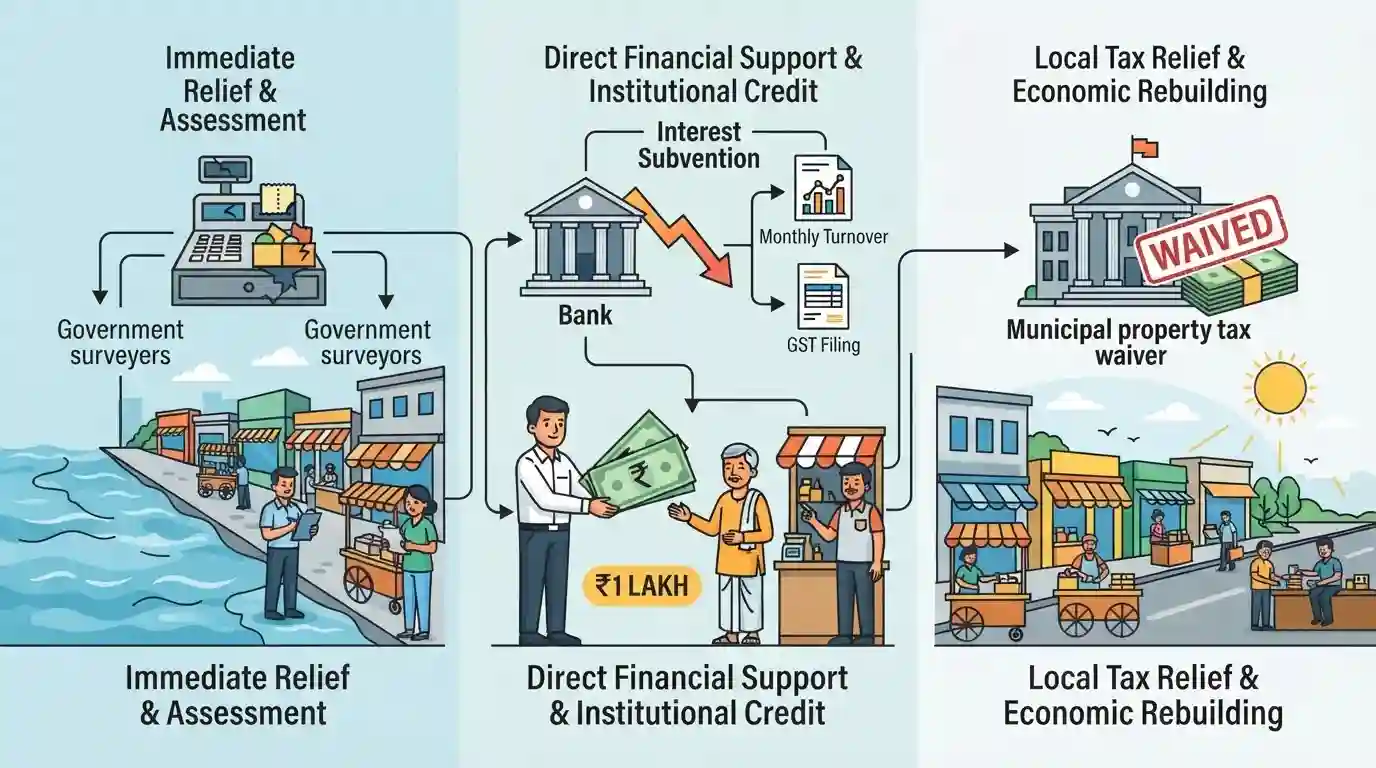
The Gujarat government has introduced a comprehensive financial rehabilitation package for traders, small cabin owners, and street vendors in Surat who were severely impacted by recent creek floods. The relief measures include direct financial assistance up to ₹1 lakh to restart businesses, interest subsidies on bank loans linked to monthly turnover and GST filings, and a complete waiver of municipal property taxes for one year in the affected zones. The initiative highlights a multi-pronged disaster recovery approach, integrating institutional credit support, local tax relief, and stringent survey-based assessments to rebuild the local urban economy.
મુખ્ય મુદ્દા
- The Gujarat government announced a targeted rehabilitation package offering up to ₹1 lakh in financial assistance to help flood-affected street vendors and traders in Surat resume their businesses.
- A one-year total waiver on municipal property tax has been implemented for residential and commercial properties in the affected areas.
- The package includes interest subsidies on business loans facilitated through banks, with the subsidy amounts scaled according to the traders' monthly turnover and GST returns.
- Relief and damage assessment will rely on formal surveys, digital photographs, and official documentation to verify claims and distribute aid efficiently.
- In a separate directive, District Collectors were instructed to ensure adequate fodder arrangements for cattle in areas receiving insufficient rainfall.
મહત્વપૂર્ણ શબ્દો
Goods and Services Tax (GST)

A comprehensive, destination-based indirect tax levied on the supply of goods and services in India, replacing multiple central and state taxes.
UPSC context
GS Paper III (Indian Economy); tests fiscal federalism, taxation structures, and financial compliance.
Banks and Financial Institutions
Regulatory-compliant entities that mobilize public savings, create credit, and provide essential monetary and transaction services to households and businesses.
UPSC context
GS Paper III (Indian Economy); tests financial sector stability, credit distribution, and economic inclusion.
Gujarat State Government
The subnational executive and legislative administration of Gujarat, constitutionally empowered to manage state subjects, disaster relief, and local development.
UPSC context
GS Paper II (Polity & Governance); tests Centre-State relations, executive powers, and regional disaster management.
પ્રિલિમ્સ ટ્રેપ
"Urban Disaster Management Authorities (UDMAs) are chaired by the District Collector."
Under the DM (Amendment) Bill 2024, UDMAs are actually chaired by the Municipal Commissioner, with the District Collector serving as the Vice-Chairperson.
સંલગ્ન સ્થિર ખ્યાલો
How is the State Disaster Response Fund (SDRF) constituted and funded?
- Statutory Backing: It is the primary fund for state-level emergency response, constituted under Section 48(1)(a) of the Disaster Management Act, 2005.
- Funding Ratio: The Centre contributes 75% for general category states and 90% for North-Eastern and Himalayan States.
- Finance Commission: Funding allocations and categorisation shifts (like moving preparedness to Mitigation Funds) are dictated by Finance Commission recommendations.
What are the primary anthropogenic and geographic drivers of urban flooding?
- Severe Concretisation: Altered local hydrology prevents groundwater percolation, drastically increasing flood peak run-offs by up to 8 times and flood volumes by up to 6 times.
- Drainage Encroachment: Urban planning failures lead to construction over natural sinks, wetlands, and traditional drainage channels, severely restricting water outflow.
- Topographical Factors: In low-lying or river-mouth cities, heavy rainfall often combines with high tides, causing a backwater effect that overwhelms local creeks (khadis).
આંતર-વિષય પેટર્ન
Disaster relief as a formalisation incentive
Linking disaster interest subsidies to GST filings pushes unorganised street vendors into the formal credit net, directly mirroring PM SVANidhi’s digital and financial inclusion goals.
Urban governance + Climate resilience
The introduction of dedicated Urban Disaster Management Authorities (UDMAs) signals the decentralisation of climate risk mitigation to municipal bodies, reinforcing the 74th Amendment.

Prelims 2026 will likely test the new Urban Disaster Management Authority (UDMA) hierarchy alongside 16th Finance Commission disaster funds.
સંલગ્ન PYQ · 3
સંલગ્ન PYQ · 3
- 2021GPSC_PRELIMSGS1
The 15ᵗʰ Finance Commission recommended Grants-in-Aid falls into five broad categories. Which of the following is NOT in the said categories?
- 2022GPSC_PRELIMSGS1
A State Legislature may provide for the representation of which of the following persons in a municipality? 1. Members of the Lok Sabha and the state legislative assembly representing constituencies that comprise wholly or partly the municipal area. 2. Teachers and graduates living within the municipal area. 3. Persons having special knowledge or experience in municipal administration. Select the correct answer code:
- 2026GPSC_PRELIMSGS1
As per the Union Budget 2025-26, arrange the following sources of government revenue in descending order of their share in the government's total receipts: 1. GST and other taxes 2. Borrowing and other liabilities 3. Income Tax 4. Corporation Tax Choose the correct option from the following.
