Gujarat fisheries adopt turtle safe nets to meet US export norms
Source:economic-times ↗
Why It Matters
This issue perfectly demonstrates the intersection between international trade regulations (Non-Tariff Barriers under WTO/US laws), indigenous technical solutions (ICAR-CIFT), and ecological conservation (protecting Olive Ridley and Green turtles). It highlights crucial aspects of Gujarat's economic policy, coastal livelihoods, and export promotion.
Summary
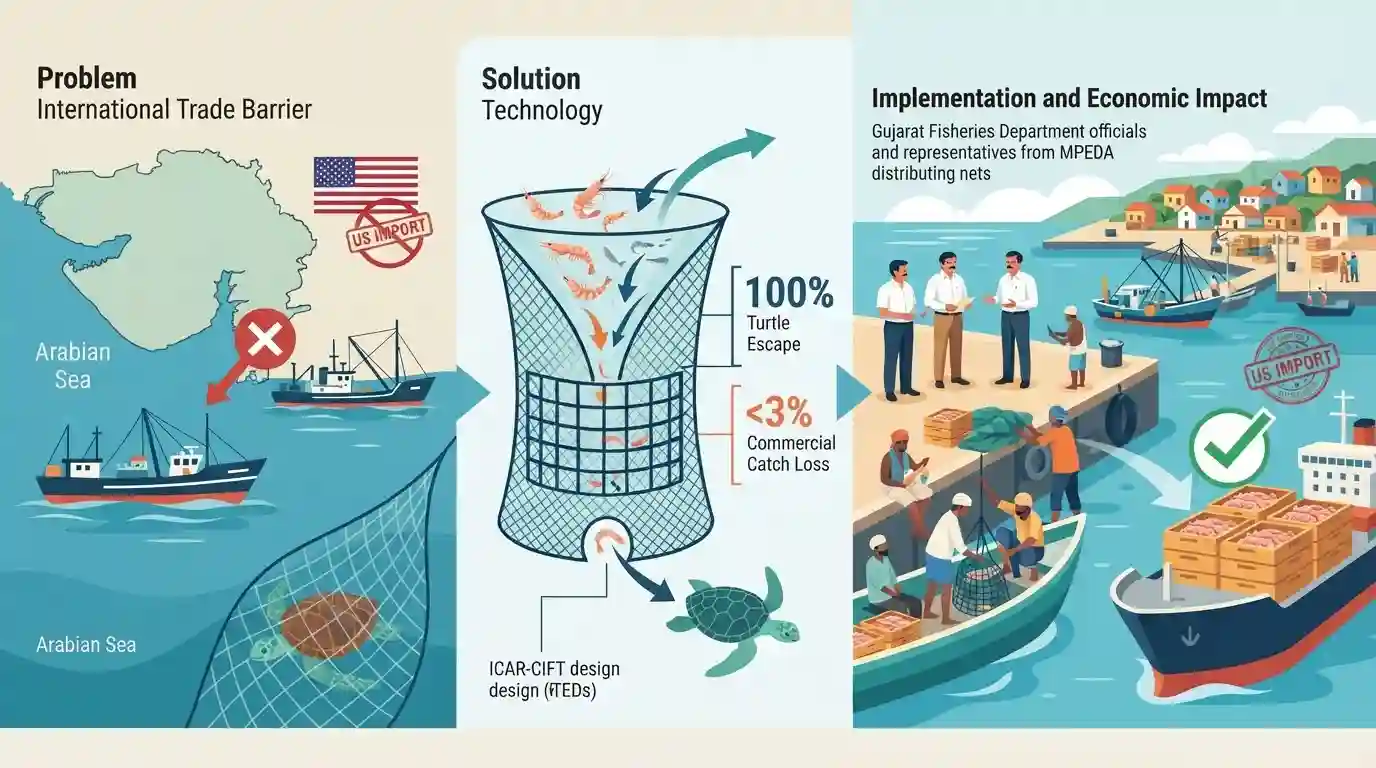
The article details Gujarat's initiative to distribute newly designed, turtle-safe fishing nets to commercial trawlers in order to bypass US non-tariff barriers on wild-caught shrimp imports. The US enforces a ban on wild-caught shrimp from countries not utilizing Turtle Excluder Devices (TEDs) to protect endangered sea turtles under Section 609 of Public Law 101-162. To resolve this, ICAR-CIFT developed a highly efficient TED that minimizes commercial catch loss to under 3% while ensuring 100% turtle escape. The implementation, coordinated by the Gujarat Fisheries Department and MPEDA, aims to restore lucrative export access to the US, benefiting Gujarat's extensive coastal economy and traditional fishermen.
Key Points
- Gujarat's fisheries department is promoting and distributing turtle-safe nets equipped with Turtle Excluder Devices (TEDs) to local shrimp trawlers.
- This initiative aims to comply with Section 609 of US Public Law 101-162, which prohibits the import of wild-caught shrimp from nations that do not mandate the use of TEDs on commercial fishing vessels.
- The modified TED, designed by the Kochi-based ICAR-Central Institute of Fisheries Technology (ICAR-CIFT), allows 100% of trapped sea turtles to escape safely while keeping commercial catch loss below 3%, addressing a major grievance of local fishermen.
- The targeted sea turtle species include the endangered Green turtle and vulnerable Olive Ridley turtle, both protected under Schedule I of India's Wildlife (Protection) Act, 1972, and known to inhabit and nest along India's coasts.
- Unlocking the US market for wild-caught shrimp will significantly boost the coastal economy of Gujarat (which has India's longest coastline of 1,600 km) and safeguard the livelihoods of traditional fishers.
- The Marine Products Export Development Authority (MPEDA), under the Union Ministry of Commerce and Industry, is facilitating inspections by US authorities to verify compliance and secure export clearances.
Important Terms
Section 609 of US Public Law 101-162

A US statutory provision banning imports of wild-caught shrimp from nations lacking certified sea turtle protection programs (such as using Turtle Excluder Devices) comparable to the US standard.
UPSC context
GS Paper-III (Economy/International Trade); tests understanding of non-tariff trade barriers, environmental regulations, and bilateral disputes impacting Indian exports.
GATT Article XX (General Exceptions)
A World Trade Organization (WTO) provision allowing member states to enact trade-restrictive measures necessary to protect human, animal, or plant life, or conserve exhaustible natural resources.
UPSC context
GS Paper-III (Economy/IR); covers WTO dispute settlements, environmental compliance frameworks, and trade-restrictive exceptions affecting global commerce.
Wildlife (Protection) Act, 1972
India's landmark conservation legislation providing legal frameworks to protect wildlife, including endangered sea turtles classified under Schedule I, which strictly prohibits hunting, capturing, or accidental killing.
UPSC context
GS Paper-I/III (Environment & Biodiversity); tests domestic environmental laws, species conservation schedules, and ecological protection obligations.
Pradhan Mantri Matsya Sampada Yojana (PMMSY)
India's flagship development scheme launched in 2020 to bring about the Blue Revolution through sustainable and responsible development of the fisheries sector.
UPSC context
GS Paper-III (Economy/Government Schemes); tests knowledge of allied sector policies, coastal livelihoods, and fisheries infrastructure development.
Marine Products Export Development Authority (MPEDA)
A statutory body established in 1972 under the Ministry of Commerce & Industry, mandated to promote, regulate, and sustainably develop India’s marine products export industry.
UPSC context
GS Paper-III (Economy/Foreign Trade); covers national export promotion authorities, seafood standards, and international market development strategies.
ICAR-Central Institute of Fisheries Technology (ICAR-CIFT)
A premier national research institute under the Indian Council of Agricultural Research that designs, develops, and tests indigenous, sustainable fishing technologies and harvest gears.
UPSC context
GS Paper-III (S&T/Agriculture); tests awareness of scientific innovations, technological solutions for marine conservation, and national research institutions.
Gujarat Fisheries Department
The state government agency responsible for managing marine and inland fisheries, executing welfare schemes, and developing sustainable fishing infrastructure along Gujarat's extensive coastline.
UPSC context
GS Paper-III (Gujarat Economy/Regional Development); covers state-level coastal management, local welfare policies, and implementation of regional schemes.
Prelims Trap
MPEDA operates under the administrative control of the Ministry of Fisheries, Animal Husbandry and Dairying.
Candidates often assume all fisheries developmental bodies fall under the Ministry of Fisheries, but MPEDA is a statutory body under the Ministry of Commerce and Industry.
Static Concepts Connected
What is the significance of GATT Article XX (General Exceptions) under WTO rules?
- Environmental protection: Allows countries to restrict imports to protect human, animal, or plant life, or conserve exhaustible natural resources.
- Non-discriminatory Chapeau: Requires trade measures to not be applied as arbitrary, unjustifiable, or disguised restrictions on international trade.
- US-Shrimp Case: The Landmark dispute where WTO upheld that US could mandate turtle-safe nets, provided it treated all trading partners equally.
What are the structural updates in the Wildlife (Protection) Amendment Act, 2022?
- Schedule rationalisation: Reduced the total number of schedules from six to four, simplifying legal categorization.
- Schedule I protection: Retains the highest level of legal protection for endangered species like sea turtles.
- CITES alignment: Introduced a new schedule specifically to regulate species listed under CITES.
Cross-Topic Patterns
Non-tariff barriers and WTO Article XX
Analyzes how developed nations use domestic conservation laws as non-tariff barriers, highlighting the friction between WTO trade liberalisation and sovereign environmental standards.
Sustainable Blue Economy & Conservation
Links indigenous tech (ICAR-CIFT's TED) with PMMSY funding to upgrade fishing fleets, balancing coastal livelihoods with marine biodiversity conservation.

Questions may link PMMSY funding for TEDs, MPEDA's commerce ministry jurisdiction, and WTO's Article XX environmental exceptions.
Linked PYQs · 3
Linked PYQs · 3
- 2025GPSC_PRELIMSGS1
In a significant milestone for India's agricultural exports, the Agricultural and Processed Food Products Export Development Authority (APEDA) successfully completed India's first-ever commercial shipments of premium Sangola and Bhagwa pomegranates to ______.
- 2026GPSC_PRELIMSGS1
The 'Great Indian Bustard (GIB)' (Ghorad) is frequently seen in the news in the context of wildlife conservation efforts in western India. Consider the following statements regarding this species: 1. Currently, the highest surviving wild population of the Great Indian Bustard in India is located in the semi-arid grasslands of Gujarat. 2. It is a long-distance migratory bird that travels from Central Asia to the Indian subcontinent to escape harsh winters. Which of the above statement(s) is/are correct?
- 2025GPSC_PRELIMSGS1
Which of the following statements is/are correct regarding Foreign Direct Investment (FDI) in Gujarat? (A) Gujarat secured the first position in the country in terms of FDI equity inflows with 16.43% contribution in FDI during FY 2023-24. (B) USA, Mauritius, Singapore, UAE and Cayman Islands are among the top five countries attracting FDI Equity Inflow in Gujarat.
