Gujarat AI for Every Student Mission for School Education
Source:indianmasterminds ↗
Why It Matters
This initiative highlights regional policy measures taken by state governments to mainstream emerging technologies like AI into school education, serving as a key model for human capital development and digital empowerment.
Summary
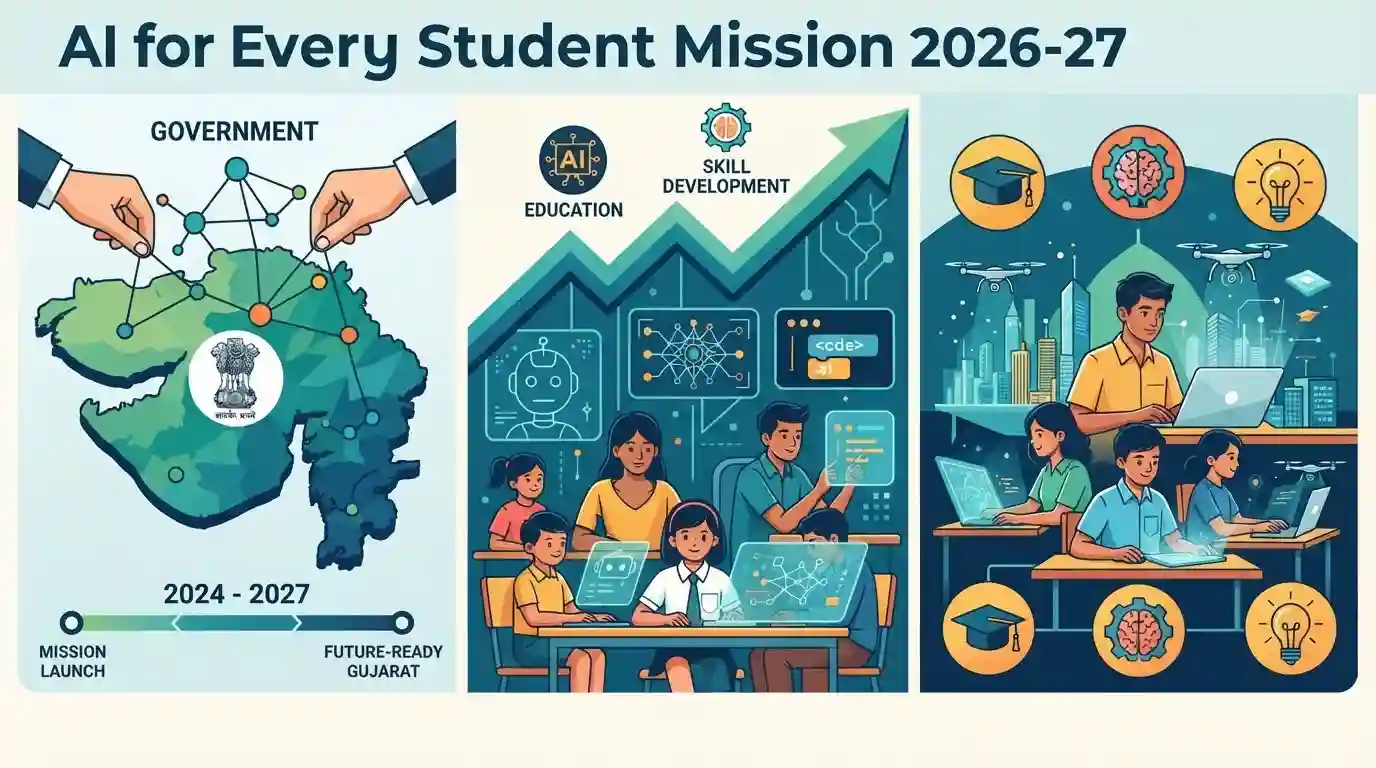
The Gujarat government has introduced the 'AI for Every Student Mission 2026-27', a transformative educational initiative designed to introduce artificial intelligence and emerging technologies to students across the state, preparing them for future technological advancements and skill requirements.
Key Points
- The Gujarat government launched the 'AI for Every Student Mission' for the academic year 2026-27 to integrate Artificial Intelligence education across schools.
- The mission aims to equip students with future-ready skills, foundational AI literacy, and computational thinking early in their education lifecycle.
- It aligns with broader national efforts to promote technology-driven education, digital public infrastructure, and skill development.
Important Terms
AI for Every Student Mission

A Gujarat state government educational policy designed to integrate artificial intelligence training across higher education institutions through a three-tier structure targeting lakhs of students and faculty.
UPSC context
Important for GPSC (Gujarat Public Service Commission) under state-specific initiatives, education policy, and skill development schemes for future readiness.
Government of Gujarat
The executive authority of Gujarat responsible for formulating state policies, allocating budgets, and executing developmental welfare schemes across various sectors like education and technology.
UPSC context
Relevant for GPSC General Studies papers concerning governance, state administration, policy implementation, and administrative machinery.
Prelims Trap
introductory 8-hour AI Foundation course targeting around 5 lakh students
Aspirants often assume state-level digital missions apply universally to all grades immediately, whereas structured 3-tier programs have specific target participant caps per tier.
Static Concepts Connected
What are the key pillars and targets of the National Education Policy (NEP) 2020 regarding school education?
- Access & Equity: Universal Access: Ensures universal access to school education from pre-primary at age 3 to Class 12 by 2030.
- Pedagogical Structure: Curriculum Shift: Replaces the 10+3 structure with a 5+3+3+4 design covering foundational, preparatory, middle, and secondary stages.
- Vocational Focus: Skill Integration: Introduces coding and vocational crafts from Class 6 onwards with practical internships.
Cross-Topic Patterns
AI Education + NEP 2020 Implementation
State AI missions link directly with the National Education Policy (NEP) 2020 emphasis on critical thinking, coding, and vocational integration in school curriculums.
Faculty Capacity Building + Digital Governance
Upskilling 5,000 faculty members mirrors national capacity-building frameworks like Mission Karmayogis digital-first public sector training approach.

Gujarat's 3-tier AI mission metrics (5 lakh basic, 1 lakh domain, 20k advanced) are prime targets for matching/statement-based Prelims Qs.
Linked PYQs · 2
Linked PYQs · 2
- 2026GPSC_PRELIMSGS1
The education dimension of Human Development Index (HDI) is a composite of two indicators. Which are these two indicators?
- 2026GPSC_PRELIMSGS1
Which of the following best describes the core operational strategy of the Bhashini Mission launched by the Government of India?
