Gujarat Agricultural Land Ten Guntha SubDivision Policy
Source:Indian Express ↗
Why It Matters
Understanding state-specific land revenue rules, agricultural holding limits, and fragmentation issues is crucial for civil services aspirants studying regional governance, rural economic trends, and land administration in Gujarat.
Summary
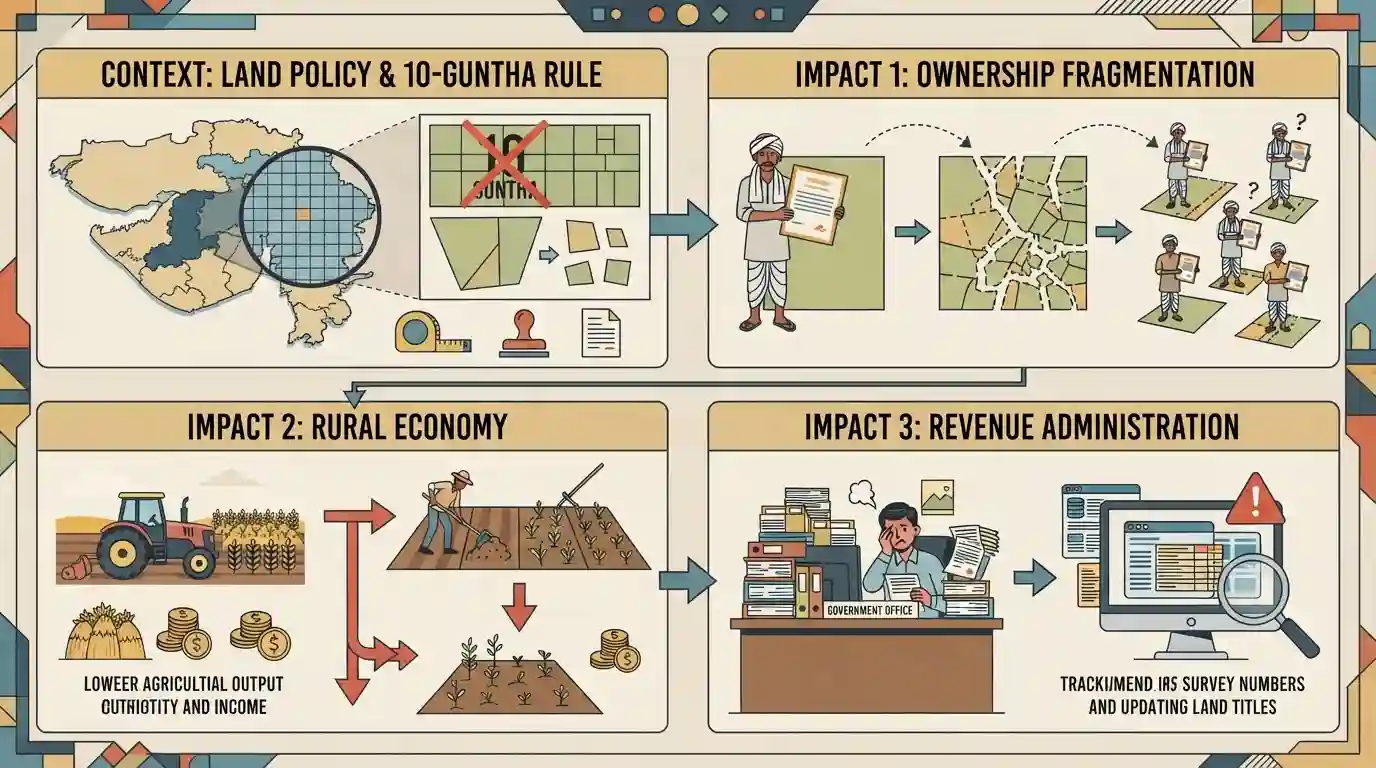
An analysis of the Gujarat agricultural land policy regarding the 10-guntha sub-division rule and survey numbers, detailing its impact on land ownership fragmentation, rural economy, and state land revenue administration.
Key Points
- The Gujarat government is addressing issues surrounding agricultural land sub-division limits, specifically focusing on the 10-guntha rule and survey number demarcations.
- A 'guntha' is a traditional unit of land area measurement widely used in Western and Southern India, where 40 gunthas equal one acre.
- Sub-division of agricultural land into fragments smaller than prescribed limits creates challenges for land management, title clarity, and agricultural productivity.
- Policy adjustments and digital land revenue record systems (like Garvi or Any RoR) seek to rationalize land partitioning while safeguarding against illegal commercial conversion.
Important Terms
Gujarat Tenancy and Agricultural Lands Act

A historical state legislation governing tenancy rights, land transfers, and land ceilings in Gujarat, designed to protect agricultural tenants and regulate rural land holdings.
UPSC context
GPSC Paper 2 / Polity & Governance; tests knowledge of state-level land reform laws, agrarian relations, and tenant protection frameworks.
Revenue Department Gujarat
The administrative body in Gujarat responsible for land revenue administration, maintenance of land records (such as 7/12 extracts), and implementation of agrarian land policies.
UPSC context
GPSC Paper 3 / Economy & Administration; tests understanding of state administrative machinery for land management and digital governance portals like AnyROR.
Government of Gujarat
The executive branch of the state government responsible for policy formulation, legislative amendments regarding agricultural land fragmentation, and governance in Gujarat.
UPSC context
GPSC General Studies; tests awareness of state governance, administrative policy implementation, and legislative actions affecting regional development.
Static Concepts Connected
What are the core objectives and provisions of the Gujarat Prevention of Fragmentation and Consolidation of Holdings Act (Tukda Dhara)?
- Origin & Goal: Enacted in 1947 to prevent excessive sub-division of agricultural holdings into uneconomic fragments, protecting agricultural productivity.
- Standard Sizes: Empowers the state government to prescribe standard sizes (such as the 10-guntha rule) for agricultural plots in specified local areas.
- Transfer Restrictions: Restricts transfer or lease of fragments below the prescribed standard size unless joined to an adjacent contiguous plot.
- Consolidation: Provides statutory framework for the consolidation of scattered holdings (Chakbandi) to improve operational efficiency for farmers.
Cross-Topic Patterns
Land Reforms + Digital Governance in Agriculture
State-level agrarian laws like the Tukda Dhara intersect with digital land titling projects (DILRMP), bridging historical land ceiling acts with modern blockchain or Torrens-style conclusive titling goals.
Agricultural Fragmentation + Farm Mechanization Economics
Excessive land sub-division directly hobbles cooperative farming and farm mechanization economics, linking rural revenue administration directly to state agricultural productivity trends.

Expect a statement-based question linking Tukda Dhara amendments, guntha measurements, and anti-fragmentation objectives in Gujarat.
Linked PYQs · 2
Linked PYQs · 2
- 2025GPSC_PRELIMSGS1
Consider the following statements with respect to land reforms in India: 1. One of the objectives of land reforms was to pass on the ownership of land from landlords to peasants 2. Land reforms resulted in decrease in the cultivation of cash crops Which of the statement(s) given above is/are correct?
- 2026GPSC_PRELIMSGS1
Consider the following statements with respect to urbanization in India: 1. The percentage increase in urban population has been consistently greater than the percentage increase in rural population for all decades since 1911 2. Urbanization process has got concentrated over time in large cities and developed regions, particularly during the period of last two decades Which of the above statement(s) is/are correct?
