Great Indian Bustard Conservation Action Plan in Gujarat
Source:plutusias ↗
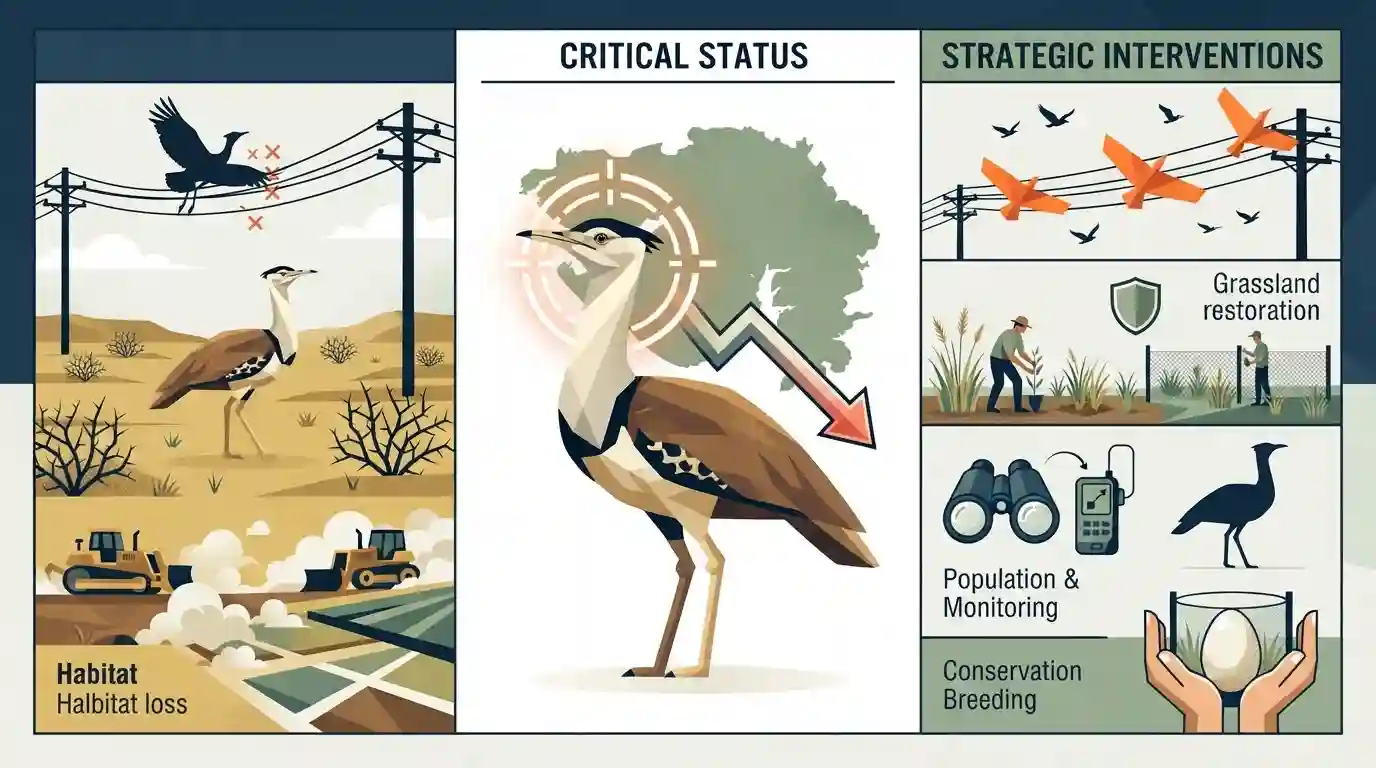
Why It Matters
Crucial for GPSC and UPSC aspirants tracking endangered species conservation, state-level environmental action plans, and issues relating to wildlife habitat protection against infrastructure bottlenecks.
Summary
The article outlines Gujarat's dedicated Action Plan for the conservation of the Great Indian Bustard (GIB), a critically endangered bird species endemic to the Indian subcontinent. It details threats like power-line collisions, habitat loss in semi-arid grasslands, and strategic protection measures undertaken by the state alongside national conservation frameworks.
Key Points
- The Gujarat government introduced a comprehensive action plan for the conservation of the Great Indian Bustard (GIB), locally known as Ghorad.
- GIB is one of the heaviest flying birds and is critically endangered, facing severe threats from high-tension power lines, habitat degradation, and feral dogs.
- While Rajasthan holds the highest surviving wild population of GIBs (primarily in Desert National Park), Gujarat's action plan focuses on protecting its remaining pockets, habitat restoration, captive breeding support, and mitigating overhead transmission lines.
- The species is protected under Schedule I of the Wildlife Protection Act, 1972, and listed under Appendix I of CITES and CMS.
Important Terms
Gujarat Action Plan For Great Indian Bustard Conservation

A strategic roadmap launched by Gujarat to protect the critically endangered Great Indian Bustard through landscape restoration, habitat management in Kachchh, and mitigation of infrastructure threats.
UPSC context
Important for GPSC/UPSC Mains (Environment & Ecology): Tests knowledge of state-level biodiversity conservation strategies and endangered species management.
Wildlife Protection Act 1972
India’s principal umbrella legislation providing legal protection to wild animals, birds, and plants, placing species like the Great Indian Bustard under the highest protection schedule.
UPSC context
Essential for Prelims and Mains: Tests statutory frameworks, wildlife protection schedules, and legal conservation mechanisms in India.
CMS Convention
An international treaty under the aegis of UNEP that provides a global platform for the conservation and sustainable use of migratory animals and their habitats.
UPSC context
Relevant for Environment and International Relations: Tests India's commitments under global biodiversity conventions and migratory species protection.
CITES Appendix I
The highest category of CITES listing comprising species threatened with extinction, prohibiting international commercial trade except in exceptional circumstances.
UPSC context
Important for Environment & Ecology: Tests understanding of international wildlife trade regulations and endangered species categorisation.
Gujarat Forest Department
The state government body responsible for implementing forest policies, wildlife conservation initiatives, and habitat restoration programs within Gujarat.
UPSC context
Relevant for Gujarat-specific administrative questions in GPSC: Tests state governance and institutional frameworks in forest and wildlife management.
Static Concepts Connected
What are the key statutory protections and international conventions governing the Great Indian Bustard?
- Schedule I: Wildlife Protection Act: Listed under Schedule I of the WPA, 1972, granting it the highest degree of legal protection in India.
- IUCN Status: IUCN Status: Categorized as Critically Endangered due to extremely rapid population declines.
- Global Treaties: Global Treaties: Listed under Appendix I of CITES and Appendix I of the Convention on Migratory Species (CMS).
Cross-Topic Patterns
GIB Conservation vs. Renewable Energy Transmission
The legal battles over undergrounding power lines to save the GIB intersect with renewable energy expansion goals in Thar and Kutch.
State Action Plans vs. Centrally Sponsored Schemes
State-level conservation action plans complement national species recovery programs under the umbrella of centrally sponsored schemes like Integrated Development of Wildlife Habitats.

Expect a statement-based question combining GIB legal protection status (Schedule I), IUCN status, and Supreme Court rulings on power lines.
Linked PYQs · 1
Linked PYQs · 1
- 2026GPSC_PRELIMSGS1
The 'Great Indian Bustard (GIB)' (Ghorad) is frequently seen in the news in the context of wildlife conservation efforts in western India. Consider the following statements regarding this species: 1. Currently, the highest surviving wild population of the Great Indian Bustard in India is located in the semi-arid grasslands of Gujarat. 2. It is a long-distance migratory bird that travels from Central Asia to the Indian subcontinent to escape harsh winters. Which of the above statement(s) is/are correct?
