Gujarat ACB books two policemen and middleman in bribery trap
Source:desh-gujarat ↗
Why It Matters
Highlights the operational aspects of anti-corruption frameworks (like the ACB) at the state level, providing a practical example of addressing grassroots-level police corruption and ensuring administrative accountability, which are key themes in GS Paper 2 (Governance) and GS Paper 4 (Ethics).
Summary
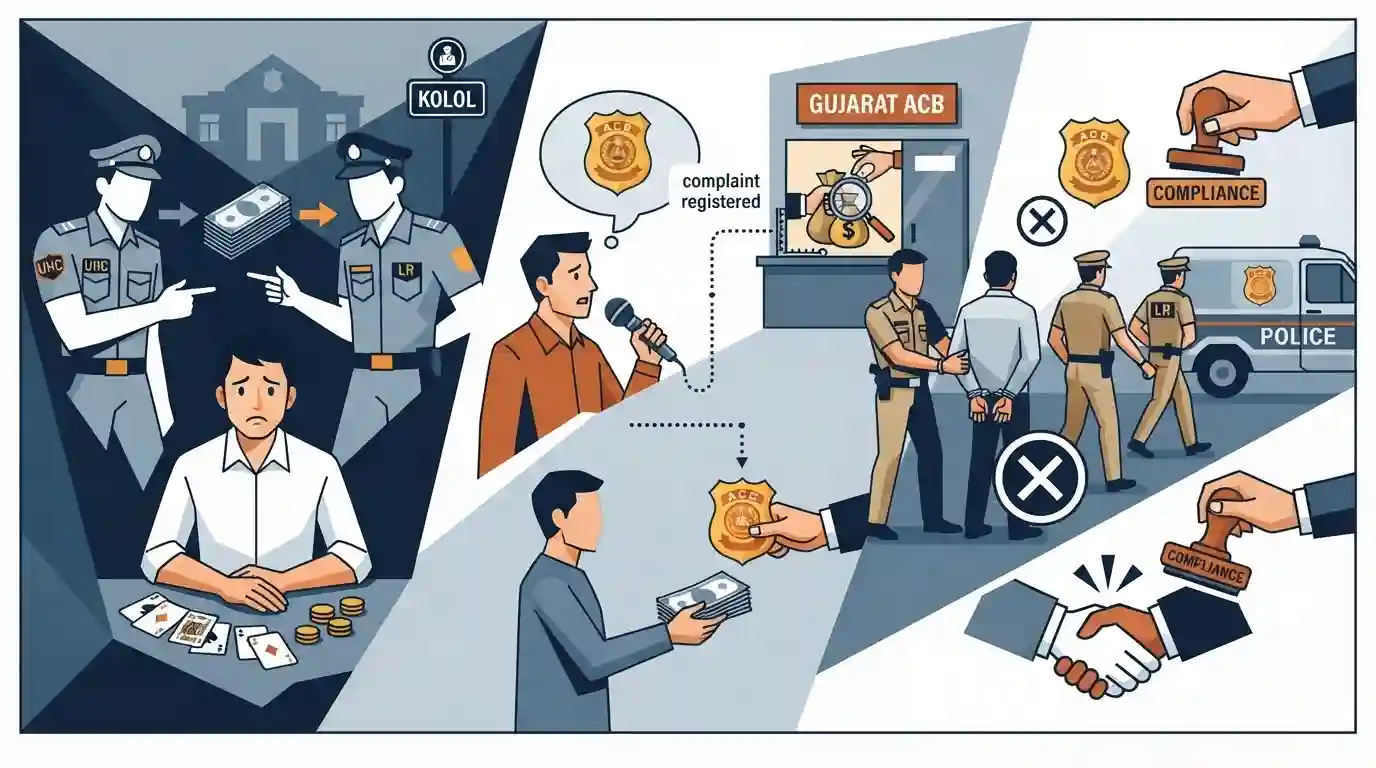
The Gujarat Anti-Corruption Bureau (ACB) has registered a bribery case against three individuals, including two policemen—an Unarmed Head Constable and a Lok Rakshak—attached to the Kalol taluka police station in Panchmahal district. The accused demanded a bribe of ₹15,000 from a complainant in exchange for not pursuing a gambling case against them for playing cards. Following the complaint, the ACB set up a trap and apprehended a middleman who was accepting the bribe on behalf of the police officials.
Key Points
- The Gujarat Anti-Corruption Bureau (ACB) booked two policemen and a middleman in a bribery case of ₹15,000.
- The accused include an Unarmed Head Constable and an Unarmed Lok Rakshak from the Kalol taluka police station in Panchmahal district.
- The bribe was demanded to prevent booking the complainant under gambling laws for playing cards.
- The middleman was caught red-handed accepting the bribe during an ACB trap orchestrated based on the complainant's tip.
Important Terms
Gujarat Anti-Corruption Bureau

Established in 1963, it is a state government agency under Gujarat's Home Ministry tasked with eradicating corrupt practices among public servants. It investigates bribery and disproportionate assets using laws like the Prevention of Corruption Act.
UPSC context
GS Paper 2 (Governance). Highlights state-level institutional mechanisms against corruption, transparency in public administration, and accountability frameworks.
Panchmahal Police
The district-level law enforcement agency in Gujarat's Panchmahal district, responsible for maintaining law and order, preventing crime, and enforcing regulations through a network of local police stations.
UPSC context
GS Paper 2/3 (Governance/Internal Security). Relevant for understanding district-level policing, grassroots law enforcement, and local administrative mechanisms.
Lok Rakshak
A police constable rank within the Gujarat Police force. Recruited by the Gujarat Police Recruitment Board, Lok Rakshaks are frontline personnel responsible for general law enforcement and public safety.
UPSC context
GS Paper 2 (Governance). Illustrates the structure of state police forces and the reliance on grassroots law enforcement capacity in public administration.
State Anti-Corruption Bureau (ACB)
State-level agencies in India empowered to investigate bribery and corruption cases involving state government employees, primarily enforcing the Prevention of Corruption Act, 1988.
UPSC context
GS Paper 2 (Governance/Institutions). Tests the distinction between state ACBs and the CBI, focusing on anti-corruption institutional frameworks.
Prelims Trap
Agencies always require prior government approval before investigating any corruption charge against a public servant.
Section 17A of the Prevention of Corruption Act mandates prior approval, but explicitly exempts 'trap cases' where the official is caught red-handed accepting a bribe.
Static Concepts Connected
What are the key provisions of the Prevention of Corruption (Amendment) Act, 2018?
- Bribe-giving criminalized: Giving a bribe is a distinct offence, though individuals coerced into paying can report it within 7 days for exemption.
- Prior approval: Section 17A mandates prior government sanction before investigating public servants, except in red-handed trap cases.
- Commercial entities: Expands anti-graft liability to include corporate entities, intermediaries, and middlemen acting on behalf of public servants.
How is the anti-corruption jurisdiction divided between the Centre and States?
- State ACBs: State-level Anti-Corruption Bureaus act as specialized agencies probing bribery and corruption cases involving state government employees.
- Central agencies: The CBI investigates central government employees and requires state consent (general or specific) to probe cases within state borders.
- CVC oversight: The Central Vigilance Commission (established via Santhanam Committee recommendations) exercises superintendence over the CBI for offences under the Prevention of Corruption Act.
Cross-Topic Patterns
Federal jurisdiction in anti-corruption
The distinct roles of State ACBs and the CBI often intersect with federalism debates, particularly regarding states withdrawing 'general consent' to the CBI under the DSPE Act.
Intermediaries and GS4 Ethics
Middlemen create an 'insulation layer' for corrupt officials. The 2018 PCA amendment explicitly targeting intermediaries is highly relevant for GS4 case studies on probity and corruption.

A multi-statement question on the Prevention of Corruption Act in 2026 will likely test the 'Section 17A trap case exemption' against CVC jurisdiction.
Linked PYQs · 4
Linked PYQs · 4
- 2022GPSC_PRELIMSGS1
Which one of the following is the principal agency for preventing corruption at the level of Central Government?
- 2026GPSC_PRELIMSGS1
Consider the following statements regarding the role of the 'Central Vigilance Commission' (CVC) and the anti-corruption framework in India: 1. The 'Central Vigilance Commission' was established on the recommendation of the 'Santhanam Committee'. 2. The Central Vigilance Commission works under the administrative control of the Investigation Bureau. 3. The Chairman and members of the Central Vigilance Commission cannot hold any office in the Central or State Government after retirement. Which of the above statements are correct?
- 2021GPSC_PRELIMSGS1
Which of the following statements are correct regarding Central Vigilance Commission (CVC) of India? 1. The CVC was established on the recommendations of the Santhanam Committee on prevention of corruption 2. The CVC is Apex vigilance body and free of control from any Executive Authority 3. The CVC consists of one Chief Vigilance Commissioner and not more than three vigilance Commissioners 4. The CVC was established in the year 1968 but the Central Vigilance Commission Act came into existence in the year 2001
- 2024GPSC_PRELIMSGS1
Public Administration is the study of
