Karnataka Guarantee Schemes and Fiscal Debate on State Welfare
Source:The Hindu ↗
Why It Matters
Provides a strong case study for answers on welfare schemes, the debate over 'freebies' versus empowerment, direct benefit transfers, and the fiscal implications of large-scale state welfare programs on public budgeting.
Summary
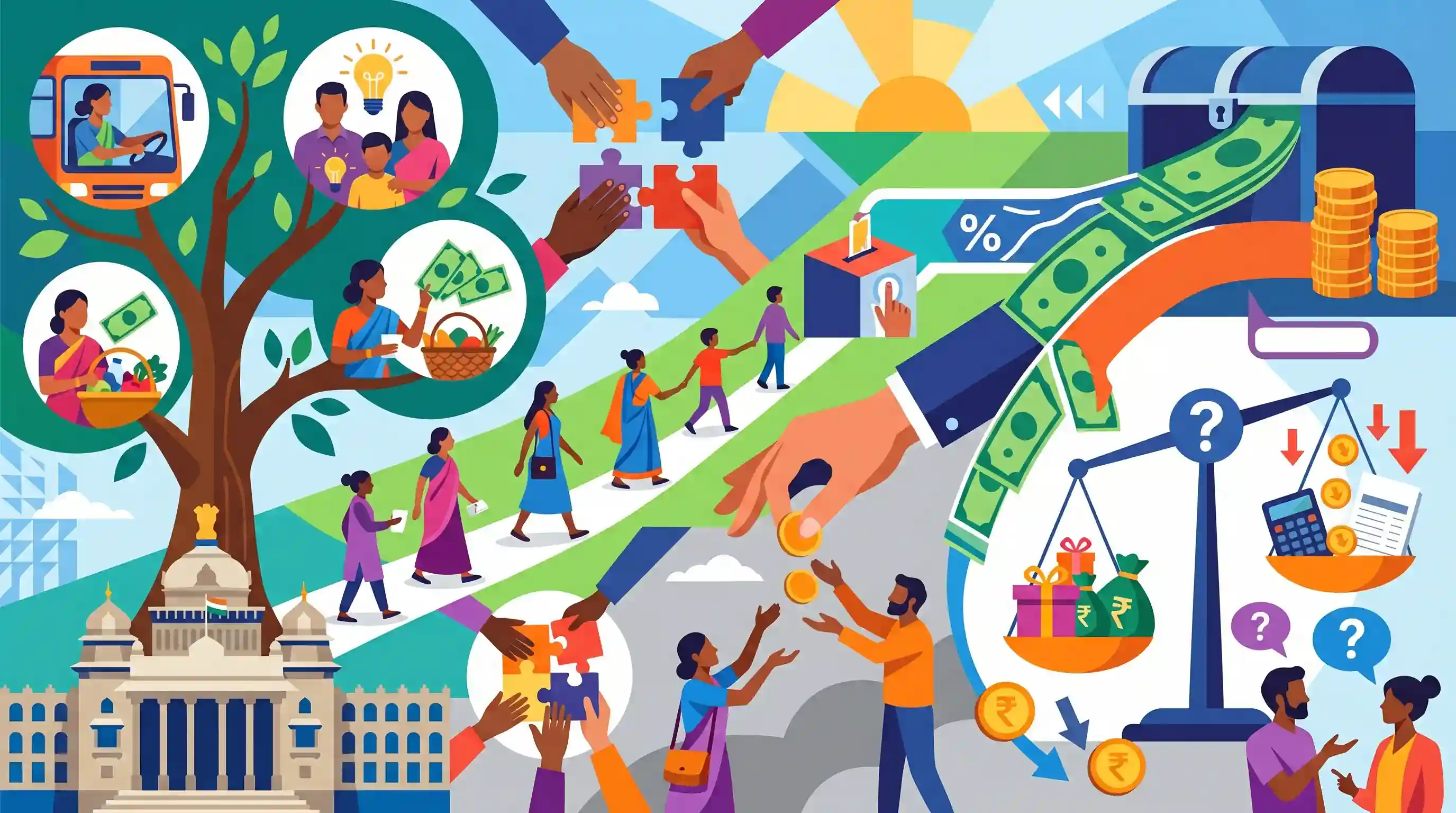
The article discusses the Karnataka government's successful implementation of five guarantee schemes, which Minister N.S. Boseraju claims have become a welfare model for the rest of India. Programs like Shakti, Gruha Jyothi, and Gruha Lakshmi focus heavily on the economic empowerment of women and marginalized communities. Designed to be universal, these schemes transcend caste and religious lines. To fund these initiatives, the state has earmarked ₹55,000 crore annually from its ₹4 lakh crore budget. The policies reflect a strong emphasis on social justice, poverty alleviation, and strengthening democratic participation, while simultaneously fueling the ongoing discourse on state fiscal health and the 'freebies' debate.
Key Points
- The Karnataka government is touting its five guarantee schemes as a national model for social welfare and economic empowerment.
- Major initiatives include the Shakti scheme (free bus travel for women), Gruha Jyothi (free electricity), and Gruha Lakshmi (direct monthly cash transfers to women).
- A new scheme, the Indira Aahara Kit, will provide food kits to economically vulnerable families starting in January 2026.
- These welfare measures are implemented universally, without any discrimination based on caste or religion.
- The state has allocated a massive ₹55,000 crore annually out of its ₹4 lakh crore budget to sustain these programs, raising debates on fiscal sustainability versus social justice.
Important Terms
Shakti scheme

A Karnataka flagship welfare initiative providing free bus travel for women and transgender residents on non-premium state-run buses.
UPSC context
GS Paper II (Governance) and Paper III (Women Empowerment); tests understanding of mobility as a tool for increasing Female Labour Force Participation (FLFP).
Gruha Lakshmi
A direct benefit transfer (DBT) program providing monthly financial assistance of ₹2,000 to female heads of households in Karnataka.
UPSC context
GS Paper II (Social Justice); examines social safety nets, financial inclusion, and the impact of cash transfers on rural poverty alleviation.
Gruha Jyothi
A utility subsidy scheme offering up to 200 units of free electricity monthly to residential households in Karnataka to reduce living costs.
UPSC context
GS Paper II (Welfare Schemes) and GS Paper III (Energy); relevant to debates on state fiscal health and universal versus targeted subsidies.
Indira Aahara Kit
A nutritional supplement package (dal, sugar, oil, salt) provided to BPL families in Karnataka, replacing a portion of the Anna Bhagya rice entitlement.
UPSC context
GS Paper II (PDS/Food Security); focuses on nutritional diversity, reforming the Public Distribution System, and addressing hidden hunger through non-cereal essential items.
Freebies Debate
The ongoing socio-economic and legal discussion regarding the sustainability of election-cycle welfare promises versus their role in human development and social justice.
UPSC context
GS Paper III (Economy/Fiscal Policy); tests knowledge of the FRBM Act, state debt sustainability, and Supreme Court observations on 'irrational' subsidies.
Five Guarantee Schemes
The collective policy framework of Karnataka's flagship programs aimed at bottom-up growth through universal basic services and financial support for marginalized groups.
UPSC context
GS Paper II (Governance); evaluates state-led development models and the shift toward "guarantee-based" welfare governance in India.
Prelims Trap
State schemes providing free electricity and unconditional cash are classified as 'merit goods' by the RBI.
The RBI clearly distinguishes "merit goods" (education, health with positive externalities) from non-merit "freebies" (free electricity, loan waivers). They are not synonymous in macroeconomic policy.
Static Concepts Connected
What differentiates Merit Goods from Freebies in macroeconomic policy?
- Merit Goods: Generate significant positive externalities (e.g., primary education, healthcare) where social benefits exceed private benefits, justifying state support.
- Freebies: Subsidies or transfers (e.g., free electricity) that primarily yield private benefits and are often viewed by institutions like the RBI as distorting expenditure priorities.
- Public Goods: Non-excludable and non-rivalrous goods (e.g., national defense, street lighting) that private markets cannot efficiently provide due to the free-rider problem.
What constitutional and statutory mechanisms regulate State government borrowing?
- Article 293(3): States require the Centre's explicit consent to raise new loans if they have any outstanding debts owed to the Government of India.
- FRBM Framework: State-level Fiscal Responsibility and Budget Management Acts generally mandate capping fiscal deficits at 3% of GSDP to ensure long-term macroeconomic stability.
Cross-Topic Patterns
Fiscal deficit vs. Capital Expenditure
Welfare guarantees consuming large chunks of state budgets (like Karnataka's 13.75%) directly crowd out capital expenditure, a persistent concern highlighted in the RBI's annual 'State Finances' report.
Mobility subsidies and FLFP
Free public transit for women addresses spatial barriers and safety concerns, directly linking state welfare policies to the broader macroeconomic goal of boosting Female Labour Force Participation (FLFP).

Expect a GS-3 question in 2026 contrasting unconditional cash transfers (UCTs) against capital expenditure regarding state fiscal health.
Linked PYQs · 5
Linked PYQs · 5
- 2019MainsGS2
Performance of welfare schemes that are implemented for vulnerable sections is not so effective due to absence of their awareness and active involvement at all stages of policy process. Discuss.
- 2023MainsGS2
“Development and welfare schemes for the vulnerable, by its nature, are discriminatory in approach.” Do you agree? Give reasons for your answer.
- 2022MainsGS2
Besides the welfare schemes, India needs deft management of inflation and unemployment to serve the poor and the underprivileged sections of the society. Discuss.
- 2025MainsGS3
Explain how the Fiscal Health Index (FHI) can be used as a tool for assessing the fiscal performance of states in India. In what way would it encourage the states to adopt prudent and sustainable fiscal policies?
- 2024MainsGS1
Distinguish between gender equality, gender equity and women's empowerment. Why is it important to take gender concerns into account in programme design and implementation?
