Macroeconomic Indicators and Resource Mobilization Trends
Source:The Hindu ↗
Why It Matters
GST collections act as a high-frequency indicator of domestic consumption and economic health. The four-year low in revenue growth signals potential softening of aggregate demand and highlights the vulnerability of the Indian economy to geopolitical uncertainties, crucial for questions on resource mobilization and economic slowdowns.
Summary
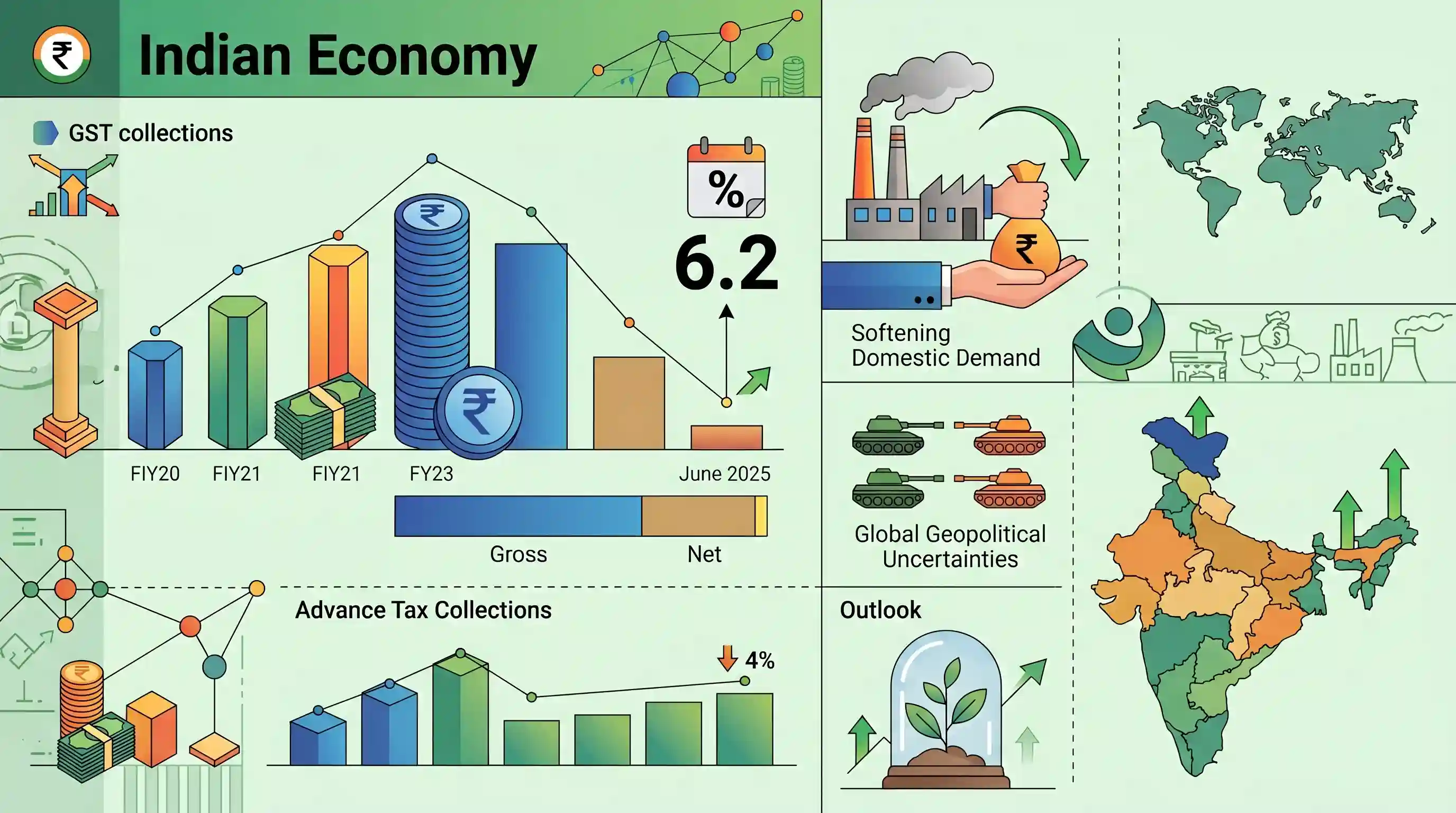
India's gross Goods and Services Tax (GST) collections for June 2025 recorded a four-month low of ₹1.85 lakh crore, marking a 6.2% year-on-year increase. This represents the slowest rate of growth in GST revenue in four years. The net collection, factoring in refunds, was ₹1.59 lakh crore. Tax experts note that the muted 6% growth in GST alongside a sub-4% increase in advance tax collections for the first quarter of FY26 indicates a softening of domestic demand and a cautious economic outlook, exacerbated by global geopolitical uncertainties. However, select regions such as Nagaland, Sikkim, and Ladakh showed robust revenue growth despite the broader national slowdown.
Key Points
- India's gross GST collection in June 2025 hit a four-month low of ₹1.85 lakh crore, reflecting a year-on-year growth of 6.2%, the slowest since June 2021.
- Net GST collections for June 2025, after accounting for refunds, stood at ₹1.59 lakh crore (a 3.3% year-on-year increase).
- The modest growth in GST collections, combined with less than 4% growth in advance tax collections for Q1 FY26, points toward softening consumer demand and a cautious macroeconomic outlook.
- Geopolitical uncertainties are cited as likely dampeners of overall consumer sentiment.
- Despite the national slowdown, remote regions including Nagaland, Sikkim, Tripura, Lakshadweep, and Ladakh demonstrated strong pockets of GST revenue expansion.
Important Terms
Goods and Services Tax (GST)

A comprehensive, destination-based indirect tax levied on the supply of goods and services. It replaced multiple central and state taxes to create a unified Indian market.
UPSC context
GS Paper III: Indian Economy; critical for understanding resource mobilization, fiscal federalism, and taxation reforms.
Advance Tax
Income tax paid in installments during the financial year on estimated income, rather than a lump sum at the end. It serves as a leading indicator of corporate profitability.
UPSC context
GS Paper III: Government Budgeting; tests knowledge of direct tax mechanisms and macroeconomic health indicators.
Net Tax Collection
The total tax revenue retained by the government after deducting refunds (e.g., for exports or overpayments) from the gross collection.
UPSC context
GS Paper III: Resource Mobilization; distinguishing between gross and actual revenue is vital for fiscal deficit analysis.
Domestic Demand
The total expenditure on goods and services by households, businesses, and the government within a country. It is a primary driver of India's GDP growth.
UPSC context
GS Paper III: Indian Economy and issues relating to growth; essential for analyzing economic stability and consumption-led growth.
Tax Buoyancy
An economic measure showing the responsiveness of tax revenue growth to changes in the country’s Gross Domestic Product (GDP).
UPSC context
GS Paper III: Government Budgeting; used to evaluate the efficiency of the tax system in a growing economy.
Mobilization of Resources
The process of generating and allocating financial, human, and physical resources for a country's development. Taxation is the most significant method for domestic financial mobilization.
UPSC context
UPSC GS Paper III Syllabus Topic; fundamental to understanding how the state funds public infrastructure and services.
Indirect Tax
A tax collected by an intermediary (like a retailer) from the consumer who bears the ultimate economic burden. GST is the most prominent example in India.
UPSC context
GS Paper III: Indian Economy; central to topics on tax structure and the impact of consumption taxes on inflation.
Prelims Trap
"India's absolute gross GST revenue collections have steadily declined over the last four years."
UPSC often swaps a "decline in growth rate" with an "absolute decline." While the growth rate hit a 4-year low, absolute collections still increased year-on-year.
Static Concepts Connected
What is the difference between Tax Buoyancy and Tax Elasticity?
- Tax Buoyancy: Measures the responsiveness of tax revenue growth to nominal GDP growth, including the impact of any discretionary tax policy or rate changes.
- Tax Elasticity: Measures tax revenue responsiveness to GDP changes, but strictly excludes the impact of any changes in tax rates, exemptions, or laws.
- Indicator Value: A buoyancy greater than 1 implies tax collections are rising faster than national income, reflecting strong macroeconomic momentum.
How does the destination-based principle of GST function?
- Revenue Accrual: Tax revenue legally accrues to the State where the final goods or services are consumed, rather than the State where they were manufactured.
- IGST Mechanism: Integrated GST (IGST) facilitates seamless input tax credit transfers and routes the final tax component to the consuming State in inter-state commerce.
- Economic Shift: This shifts fiscal advantages from traditional industrialized states (like Tamil Nadu or Gujarat) to populous or consumption-heavy states.
Cross-Topic Patterns
GST as a proxy for aggregate demand
Sluggish GST and direct advance tax collections correlate directly with softening Private Final Consumption Expenditure (PFCE), serving as high-frequency indicators for broader macroeconomic slowdowns.
Fiscal federalism and remote border economies
Robust GST growth in areas like Nagaland and Ladakh highlights how a destination-based consumption tax structure can financially benefit geographically challenging, non-manufacturing border economies.

Expect a 2026 Prelims question evaluating 'Tax Buoyancy' by linking slowing GST growth rates with nominal GDP and consumption trends.
Linked PYQs · 5
Linked PYQs · 5
- 2019MainsGS3
Enumerate the indirect taxes which have been subsumed in the Goods and Services Tax (GST) in India. Also, comment on the revenue implications of the GST introduced in India since July 2017.
- 2020MainsGS3
Explain the rationale behind the Goods and Services Tax (Compensation to States) Act of 2017. How has COVID-19 impacted the GST compensation fund and created new federal tensions?
- 2017PrelimsGS1
What is/are the most likely advantages of implementing 'Goods and Services Tax (GST)'? 1. It will replace multiple taxes collected by multiple authorities and will thus create a single market in India. 2. It will drastically reduce the 'Current Account Deficit' of India and will enable it to increase its foreign exchange reserves. 3. It will enormously increase the growth and size of economy of India and will enable it to overtake China in the near future. Select the correct answer using the code given below:
- 2018PrelimsGS1
Consider the following items : 1. Cereal grains hulled 2. Chicken eggs cooked 3. Fish processed and canned 4. Newspapers containing advertising material Which of the above items is/are exempted under GST (Goods and Services Tax)?
- 2006PrelimsGS1
Which one of the following is the correct statements? Service tax is a/an
