GST rate rationalization and private consumption impact
Source:Indian Express ↗
Why It Matters
It highlights the macroeconomic interplay between indirect tax reforms (fiscal policy) and inflation management (monetary policy goals). Understanding how GST rationalization impacts retail inflation and private consumption is crucial for GS Paper 3 topics on economic growth, resource mobilization, and taxation.
Summary
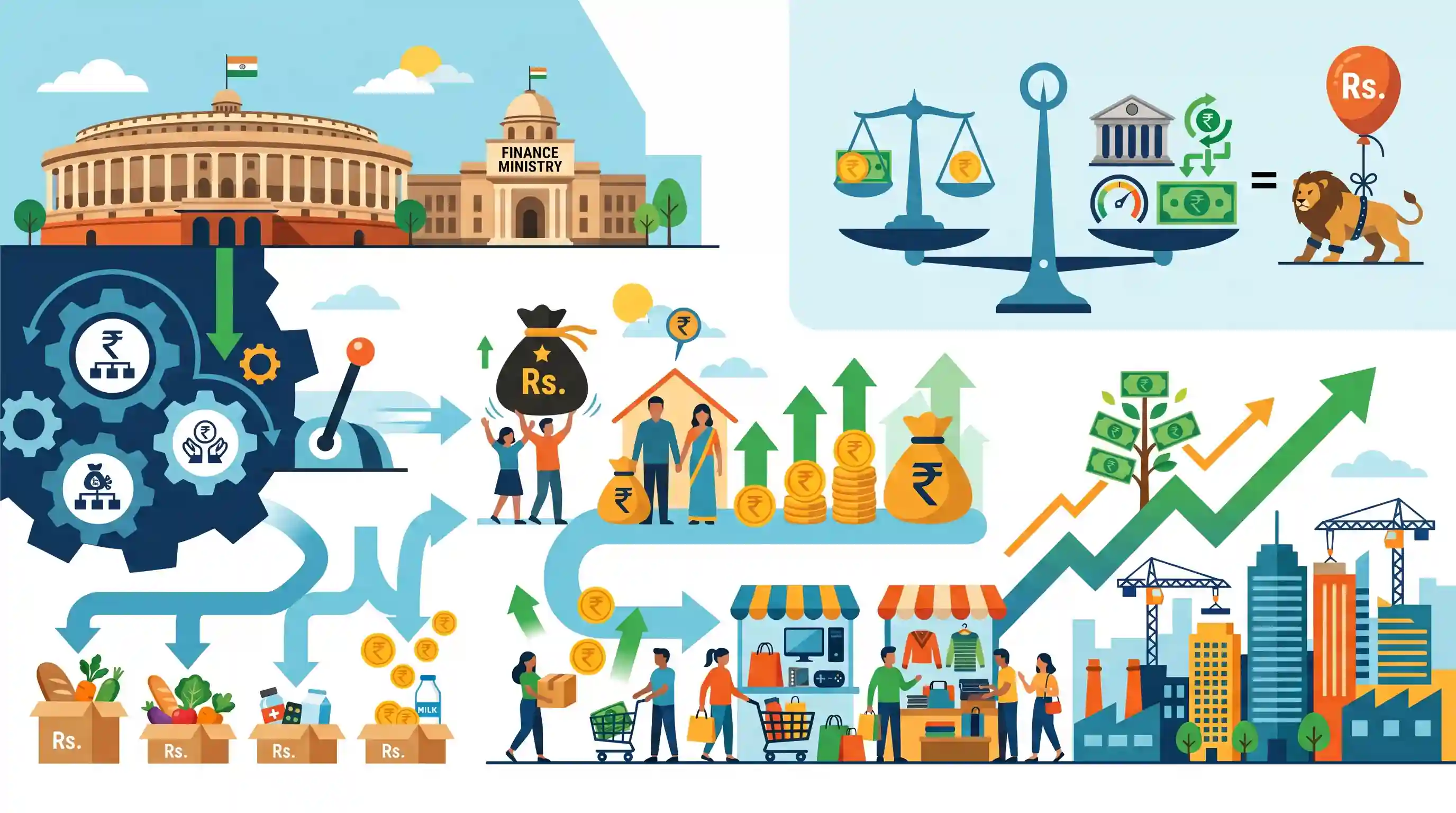
According to an RBI bulletin article, structural reforms within the Goods and Services Tax (GST) framework—specifically rationalizing tax slabs and reducing rates on essential goods—can play a pivotal role in lowering retail prices and curbing inflation. By decreasing the indirect tax burden on consumers, such reforms effectively increase households' disposable income. This enhancement in purchasing power is projected to stimulate private consumption, which is a major driver of India's economic growth. The article highlights that alongside monetary policy, supply-side interventions and indirect tax reforms are essential tools for maintaining macroeconomic stability and managing inflation.
Key Points
- An RBI article suggests that rationalizing Goods and Services Tax (GST) slabs and reducing rates on essential items can significantly lower retail prices.
- By reducing the indirect tax burden on consumers, GST reforms can help alleviate domestic inflationary pressures.
- Lower retail prices lead to enhanced household disposable incomes, which in turn acts as a catalyst for boosting private consumption.
- Increased private consumption driven by tax rationalization is expected to support and accelerate broader macroeconomic growth.
- The analysis underscores the critical role of fiscal policy and structural tax reforms in complementing the RBI's monetary policy efforts to manage inflation.
Important Terms
Goods and Services Tax (GST)

A unified, destination-based indirect tax levied on the supply of goods and services, subsuming multiple central and state taxes since 2017.
UPSC context
GS-3: Indian Economy and mobilization of resources; crucial for understanding fiscal reforms and 'One Nation, One Tax'.
GST Council
A constitutional body (Article 279A) chaired by the Union Finance Minister, responsible for making recommendations to the Union and States on GST rates and policies.
UPSC context
GS-2: Federalism and constitutional bodies; tests the dynamics of center-state fiscal relations and cooperative federalism.
Rate Rationalization
The process of simplifying the multi-tiered GST tax structure by merging or adjusting slabs to reduce complexity, boost compliance, and lower prices.
UPSC context
GS-3: Taxation and inclusive growth; frequently discussed in the context of GST 2.0 and ease of doing business.
Inverted Duty Structure
A tax regime where the tax rate on raw materials or inputs is higher than the tax rate on finished products, hurting domestic manufacturing.
UPSC context
GS-3: Industrial growth and 'Make in India'; relevant for trade policy and manufacturing sector competitiveness.
Reserve Bank of India (RBI)
India's central bank and regulatory body responsible for monetary policy, maintaining price stability, and supervising the banking sector.
UPSC context
GS-3: Monetary policy and inflation; central to questions on macroeconomic stability and central banking functions.
Indirect Tax
A tax collected by an intermediary from the consumer and paid to the government, typically levied on goods and services.
UPSC context
GS-3: Government Budgeting; core concept for understanding tax incidence and the shift towards GST.
Retail Inflation (CPI)
A measure of the average change over time in the prices paid by urban and rural consumers for a market basket of consumer goods.
UPSC context
GS-3: Inflation and economic growth; critical for understanding monetary policy targets and household purchasing power.
Prelims Trap
"The RBI uses GST slab rationalisation as a structural tool to curb retail inflation."
GST is an indirect tax and a fiscal policy tool governed by the GST Council. The RBI only suggests it; its actual tools are strictly monetary.
Static Concepts Connected
How do indirect taxes impact inflation and disposable income?
- Retail Prices: Taxes like GST are included in the final price of goods. Reducing them directly lowers retail inflation (CPI).
- Disposable Income: Lowering indirect taxes decreases retail prices, thereby increasing the real purchasing power and disposable income of households.
- PFCE Impact: Higher disposable income boosts Private Final Consumption Expenditure (PFCE), which accounts for roughly 60% of India's GDP.
What is the mandate of the GST Council regarding tax rates?
- Article 279A: Under Article 279A, it is a constitutional body headed by the Union Finance Minister, responsible for recommending GST rates, exemptions, and tax slabs.
- Voting Power: The Centre holds 1/3rd voting weightage, while all States combined hold 2/3rds. Any decision (like altering slabs) requires a 3/4th majority.
Cross-Topic Patterns
Inflation targeting & Fiscal coordination
The RBI's Flexible Inflation Targeting (4% +/- 2%) often relies on government supply-side measures and tax cuts when repo rate hikes alone cannot cool sticky cost-push inflation.
Fixing the Inverted Duty Structure
Reducing GST slabs often aims to resolve the inverted duty structure—where taxes on inputs exceed those on finished goods—which blocks manufacturers' working capital and stifles manufacturing growth.

Expect a 2026 question linking RBI's monetary policy limits with the GST Council's fiscal mandate to control sticky cost-push inflation.
Linked PYQs · 4
Linked PYQs · 4
- 2019MainsGS3
Enumerate the indirect taxes which have been subsumed in the Goods and Services Tax (GST) in India. Also, comment on the revenue implications of the GST introduced in India since July 2017.
- 2024MainsGS3
What are the causes of persistent high food inflation in India? Comment on the effectiveness of the monetary policy of the RBI to control this type of inflation.
- 2019MainsGS3
Do you agree with the view that steady GDP growth and low inflation have left the Indian economy in good shape? Give reasons in support of your arguments.
- 2017PrelimsGS1
What is/are the most likely advantages of implementing 'Goods and Services Tax (GST)'? 1. It will replace multiple taxes collected by multiple authorities and will thus create a single market in India. 2. It will drastically reduce the 'Current Account Deficit' of India and will enable it to increase its foreign exchange reserves. 3. It will enormously increase the growth and size of economy of India and will enable it to overtake China in the near future. Select the correct answer using the code given below:
