RBI Assessment on GST Reform Impact on Retail Prices and Growth
Source:Indian Express ↗
Why It Matters
The rationalisation of GST is a critical ongoing reform in India's fiscal federalism. The RBI's analysis explicitly links structural tax reforms (fiscal policy) with retail inflation and domestic consumption (macroeconomic stability), offering a valuable perspective for GS-3 answers regarding the achievements and unfinished agenda of the GST regime.
Summary
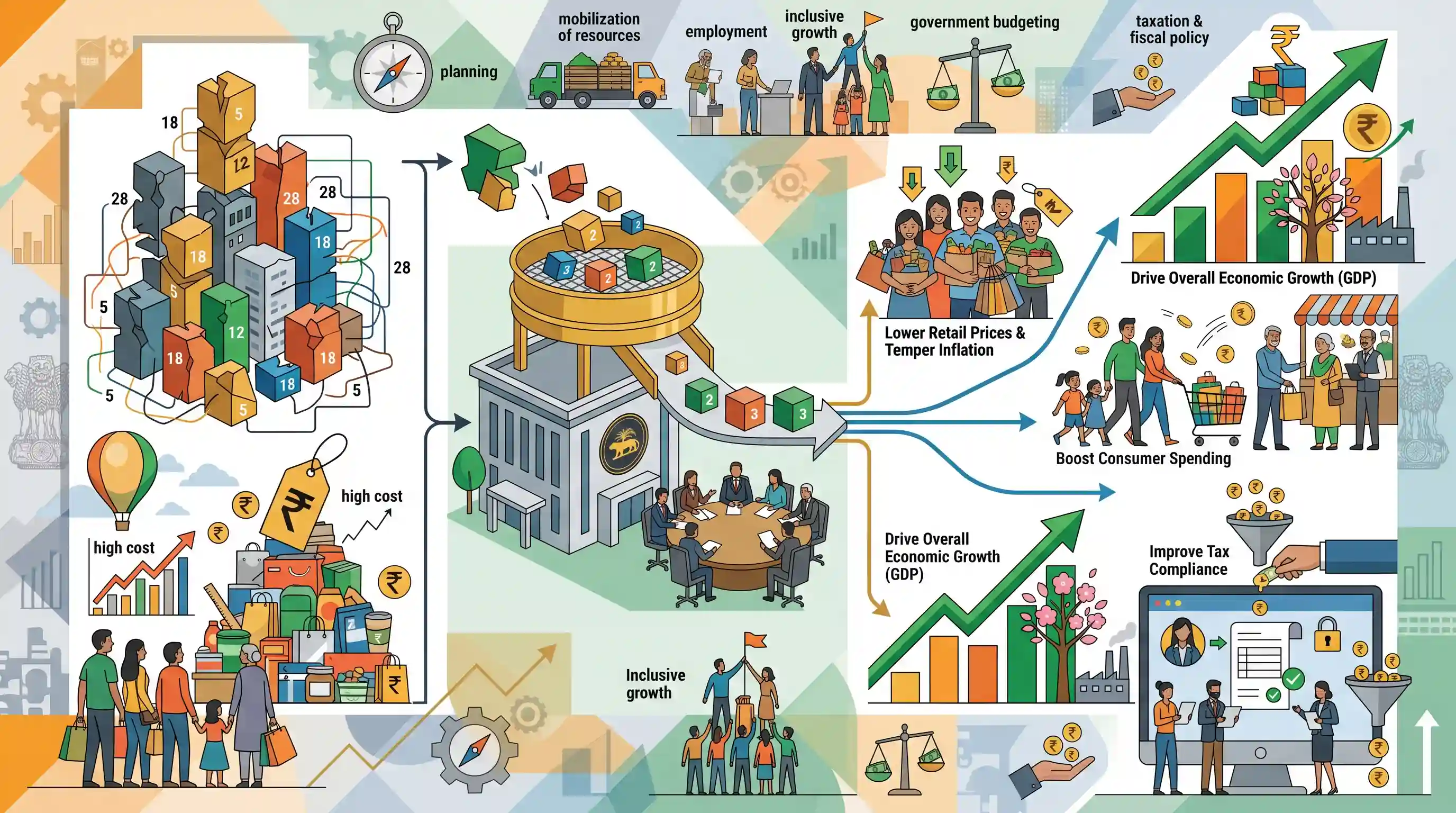
An article published by the Reserve Bank of India (RBI) highlights the macroeconomic benefits of rationalising India's Goods and Services Tax (GST) structure. The central bank posits that simplifying the indirect tax system—such as reducing the number of tax slabs—will lead to lower retail prices. This reduction in the tax burden on final goods and services is expected to temper inflation and significantly boost consumer spending, thereby driving overall economic growth and improving tax compliance.
Key Points
- The RBI argues that rationalising the GST structure (e.g., reducing the number of tax slabs) will lower retail prices for consumers.
- Lower retail prices due to an optimized indirect tax regime are expected to stimulate domestic consumption, a primary driver of India's GDP growth.
- Streamlining GST helps moderate inflationary pressures, acting as a fiscal complement to the RBI's monetary policy efforts.
- A simpler GST framework reduces compliance burdens, minimizes cascading tax effects, and can improve long-term revenue buoyancy for both the Centre and States.
Important Terms
Goods and Services Tax (GST)

A comprehensive, destination-based indirect tax on the supply of goods and services, replacing multiple central and state taxes under the 'One Nation, One Tax' principle.
UPSC context
GS Paper 3 (Economy); critical for understanding taxation reforms, fiscal federalism, and ease of doing business.
GST Council
A constitutional body (Article 279A) chaired by the Union Finance Minister that makes recommendations on GST rates, exemptions, and laws using a consensus-driven federal model.
UPSC context
GS Paper 2 (Polity) and Paper 3 (Economy); tests knowledge of cooperative federalism and fiscal decision-making.
Tax Rationalisation
The process of simplifying the GST structure by reducing or merging tax slabs to minimize complexity, lower consumer prices, and improve tax compliance.
UPSC context
GS Paper 3 (Economy); relevant for questions on taxation efficiency, resource mobilization, and addressing inverted duty structures.
Reserve Bank of India (RBI)
India’s central bank, a statutory body established in 1935, responsible for formulating monetary policy, issuing currency, and ensuring financial stability.
UPSC context
GS Paper 3 (Economy); core topic for monetary policy, banking regulation, and the central bank’s role in growth.
Indirect Tax
A tax levied on the consumption of goods and services where the economic burden is shifted from the supplier to the final consumer.
UPSC context
GS Paper 3 (Economy); fundamental concept for government budgeting and the shift to the GST regime.
Inflation
The sustained increase in the general price level of goods and services, which RBI aims to control through price stability mandates.
UPSC context
GS Paper 3 (Economy); tested under macroeconomics, focusing on price stability and purchasing power.
Prelims Trap
"The RBI can mandate changes to GST slabs to complement its monetary policy and control inflation."
The RBI only suggests fiscal measures in its research. Altering GST slabs is exclusively the constitutional domain of the GST Council (Article 279A).
Static Concepts Connected
What is 'Tax Buoyancy' and why does it matter?
- Tax Buoyancy: The responsiveness of tax revenue growth to nominal GDP growth. A buoyancy > 1 means tax revenues are growing faster than the overall economy.
- Significance: High buoyancy indicates efficient tax administration, widening formalisation, and high compliance without the government needing to hike tax rates.
How does GST eliminate the 'Cascading Effect' of taxes?
- Cascading Effect: It occurs when tax is levied on a product at every step of the supply chain without credits for taxes paid earlier, creating a 'tax on tax'.
- The ITC Solution: GST utilizes an Input Tax Credit (ITC) mechanism, ensuring tax is only collected on the net value added at each specific stage of production/distribution.
Cross-Topic Patterns
Monetary-Fiscal Synergy for Inflation
RBI's monetary policy is often complemented by fiscal measures like GST rate cuts to holistically manage supply-side inflation without overly suppressing growth via high interest rates.
Article 279A & Cooperative Federalism
Consolidating GST slabs requires consensus in the GST Council, testing the balance of cooperative federalism (Article 279A) and the states' post-compensation revenue autonomy.

Expect a 2026 question linking Tax Buoyancy, Input Tax Credit, and the macroeconomic effects of GST slab rationalisation on inflation.
Linked PYQs · 4
Linked PYQs · 4
- 2019MainsGS3
Enumerate the indirect taxes which have been subsumed in the Goods and Services Tax (GST) in India. Also, comment on the revenue implications of the GST introduced in India since July 2017.
- 2013MainsGS3
Discuss the rationale for introducing Goods and Services Tax (GST) in India. Bring out critically the reasons for the delay in roll out for its regime.
- 2017PrelimsGS1
What is/are the most likely advantages of implementing 'Goods and Services Tax (GST)'? 1. It will replace multiple taxes collected by multiple authorities and will thus create a single market in India. 2. It will drastically reduce the 'Current Account Deficit' of India and will enable it to increase its foreign exchange reserves. 3. It will enormously increase the growth and size of economy of India and will enable it to overtake China in the near future. Select the correct answer using the code given below:
- 2020MainsGS3
Explain the rationale behind the Goods and Services Tax (Compensation to States) Act of 2017. How has COVID-19 impacted the GST compensation fund and created new federal tensions?
