GST compensation demands and fiscal federalism challenges for states
Source:Indian Express ↗
Why It Matters
The ongoing debates around GST compensation and rate rationalisation are crucial for understanding India's fiscal federalism. The topic sheds light on the structural revenue losses faced by states post-GST and the mechanisms required to balance Centre-State financial relations.
Summary
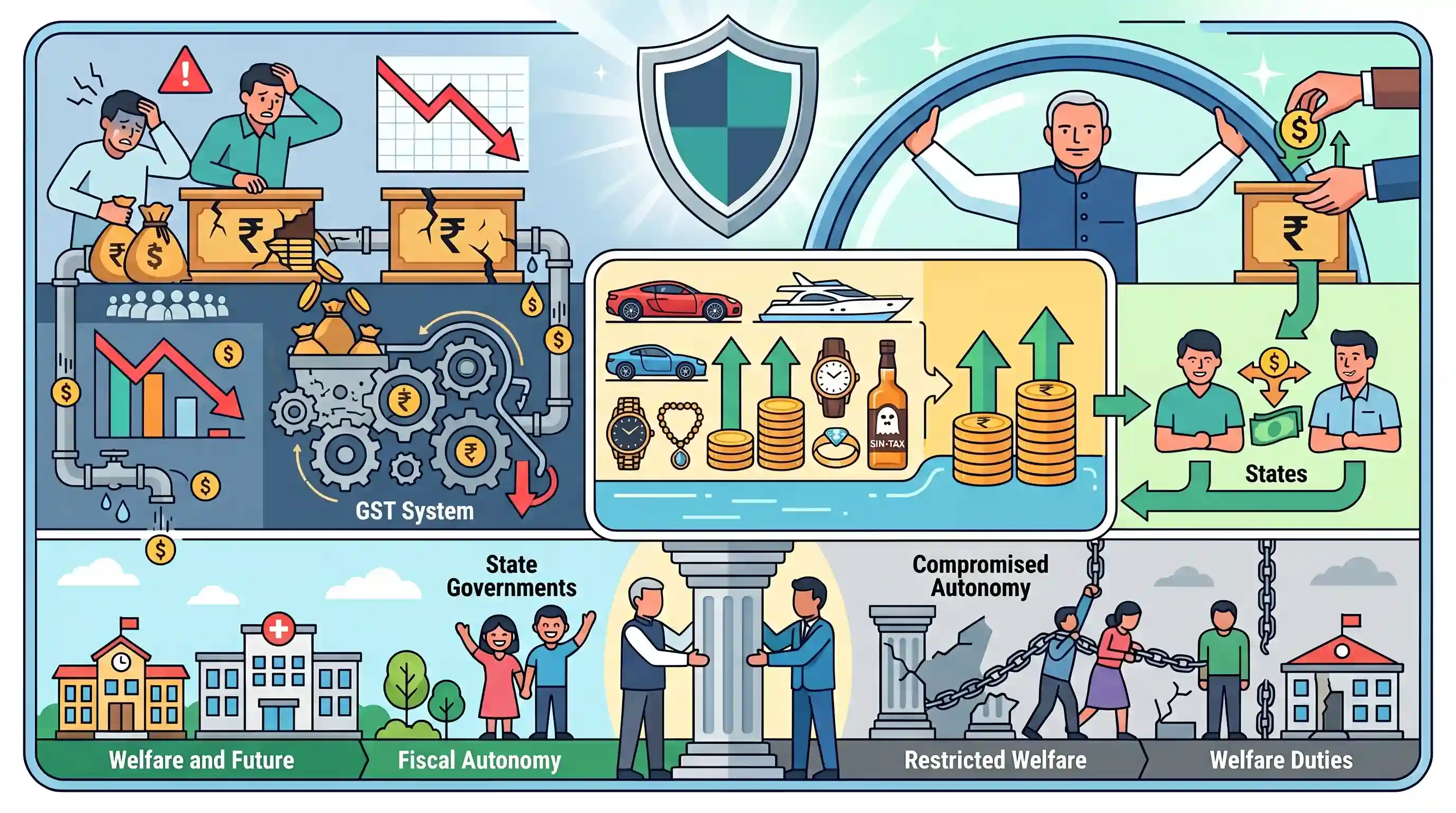
Punjab Finance Minister Harpal Singh Cheema has strongly advocated for a robust revenue protection framework to compensate states amidst the Centre's ongoing Goods and Services Tax (GST) rate rationalisation. Highlighting a pending revenue loss compensation of Rs 50,000 crore for Punjab alone, Cheema argued that states are facing significant fiscal stress post-GST implementation. Several states have jointly proposed introducing an additional levy on sin and luxury goods to maintain effective taxation levels. Stressing the principles of cooperative federalism, the states warned that without adequate revenue stabilization, their fiscal autonomy and ability to perform constitutional welfare duties would be severely compromised.
Key Points
- Punjab Finance Minister Harpal Singh Cheema demanded adequate compensation for states amid proposed GST rate rationalization to ensure their financial stability.
- He pointed out that Punjab has faced a revenue loss of Rs 1.11 lakh crore since GST implementation, with Rs 50,000 crore still uncompensated by the Centre.
- Finance ministers from several states proposed imposing an additional levy on sin and luxury goods to offset fiscal stress and protect the states' fiscal autonomy.
- The states emphasized that a robust revenue protection framework is essential for fulfilling their constitutional social welfare duties and upholding cooperative federalism.
Important Terms
GST Council

A constitutional body established under Article 279A, chaired by the Union Finance Minister, responsible for making recommendations to the Union and States on GST rates, exemptions, and administrative rules.
UPSC context
GS-II (Constitutional Bodies) and GS-III (Economy); tests understanding of joint decision-making and federal architecture.
GST Compensation Cess
A levy on luxury and demerit (sin) goods used to compensate states for revenue shortfalls post-GST implementation; currently extended until March 2026 to repay pandemic-era borrowings.
UPSC context
GS-III (Economy/Fiscal Policy); tests knowledge of state revenue protection and transitional financial mechanisms.
Goods and Services Tax (GST)
A comprehensive, destination-based indirect tax that replaced multiple central and state taxes, aimed at creating a unified national market through the 101st Constitutional Amendment.
UPSC context
GS-III (Economy); fundamental topic for tax reforms, cascading effects, and formalization of the economy.
Fiscal Federalism
The division of financial powers and responsibilities—including taxation, resource allocation, and expenditure—between the central and state governments in a federal structure.
UPSC context
GS-III (Indian Economy) and GS-II (Polity); essential for understanding resource distribution and the Finance Commission's role.
Cooperative Federalism
A model of governance where national and state governments interact collaboratively to solve common problems, exemplified by the consensus-based decision-making in the GST Council.
UPSC context
GS-II (Polity); core theme for essays and questions on Centre-State relationships and collaborative governance.
Rate Rationalisation
The policy process of simplifying the GST tax structure by merging slabs (e.g., 12% and 18%) to reduce classification disputes and improve revenue efficiency.
UPSC context
GS-III (Economy); relates to tax administration reforms and the balancing of inflation with revenue stability.
Prelims Trap
The GST Compensation Cess has been extended till 2026 to continue compensating states for post-2022 revenue shortfalls.
The cess extension to March 2026 is strictly to repay the principal and interest of pandemic-era loans taken to bridge earlier shortfalls, not for fresh compensation.
Static Concepts Connected
How is voting weight distributed in the GST Council?
- Union Weight: The Centre's vote has a weight of one-third (1/3) of the total votes cast in the meeting.
- State Weight: All state governments combined have a weight of two-thirds (2/3) of the total votes cast.
- Decision Majority: Resolutions require a 3/4th (75%) majority to pass, effectively giving the Centre a veto over rate changes.
What is the difference between Vertical and Horizontal Fiscal Imbalance?
- Vertical Imbalance: Asymmetry between the revenue-raising capacity and expenditure responsibilities of the Centre versus the States. GST worsened this by subsuming state taxes.
- Horizontal Imbalance: Disparities in fiscal capacities across different states (e.g., heavily industrialized states versus agrarian or consumption-heavy states).
Cross-Topic Patterns
Finance Commission devolution vs GST
State demands for GST compensation often spill into Finance Commission memorandums, where states argue for higher devolution formulas to offset the loss of their independent indirect tax autonomy.
Destination-based tax vs Manufacturing states
Because GST is a destination-based consumption tax, traditionally industrialized states faced steeper initial revenue dips compared to high-population consumption states, altering horizontal federal dynamics.

A GS2/GS3 question linking the end of GST compensation, state fiscal stress, and Article 279A voting mechanics is highly likely in 2026.
Linked PYQs · 5
Linked PYQs · 5
- 2019MainsGS3
Enumerate the indirect taxes which have been subsumed in the Goods and Services Tax (GST) in India. Also, comment on the revenue implications of the GST introduced in India since July 2017.
- 2020MainsGS3
Explain the rationale behind the Goods and Services Tax (Compensation to States) Act of 2017. How has COVID-19 impacted the GST compensation fund and created new federal tensions?
- 2013MainsGS3
Discuss the rationale for introducing Goods and Services Tax (GST) in India. Bring out critically the reasons for the delay in roll out for its regime.
- 2025MainsGS2
Examine the evolving pattern of Centre-State financial relations in the context of planned development in India. How far have the recent reforms impacted the fiscal federalism in India?
- 2015MainsGS2
The concept of cooperative federalism has been increasingly emphasized in recent years. Highlight the drawbacks in the existing structure and the extent to which cooperative federalism would answer the shortcomings.
