Public Expenditure on GST Rate Cut Advertisement Campaigns
Source:Indian Express ↗
Why It Matters
Provides a practical case study on the intersection of taxation policies (GST) and public expenditure on government advertising, useful for understanding issues in fiscal management, government accountability, and budgetary prioritization.
Summary
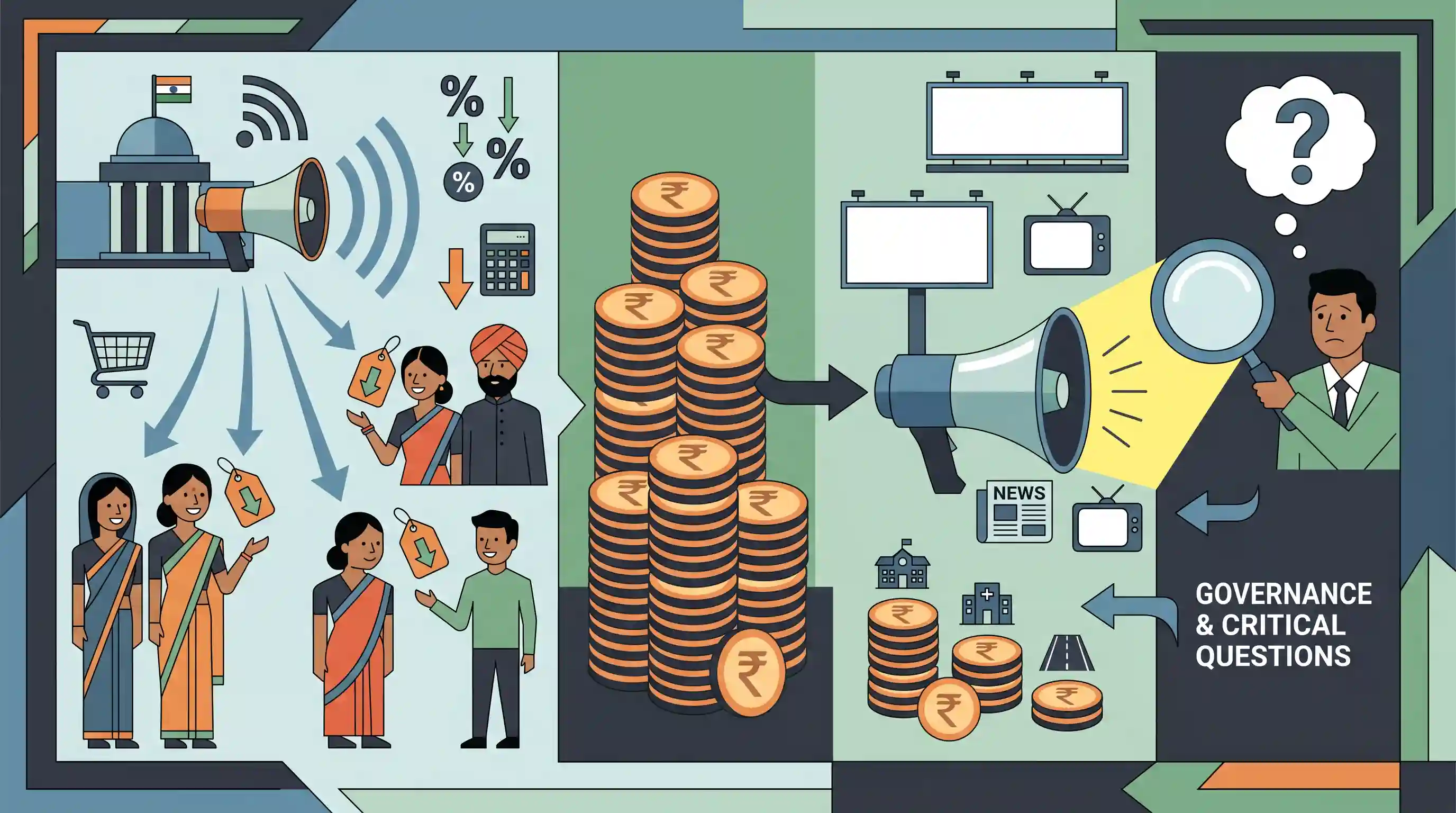
The article reports that the government incurred an expenditure of ₹89 crore in September 2025 specifically for advertising cuts in Goods and Services Tax (GST) rates. While the official objective of the campaign is to disseminate public information regarding tax relief and consumer benefits, the scale of the expenditure raises critical questions surrounding budgetary prudence, government publicity strategies, and transparency. The development touches upon both the economic impact of the GST regime and the governance ethics of utilizing public funds for extensive promotional blitzes.
Key Points
- The central government spent ₹89 crore in the month of September 2025 to advertise recent cuts in Goods and Services Tax (GST) rates.
- The massive promotional expenditure was aimed at creating widespread public awareness about the tax relief measures.
- The event brings into focus the fiscal implications and ethical dimensions of deploying significant taxpayer funds for state publicity and political signaling.
- Such expenditures invite debate over government budgeting efficiency and the necessity of high-cost advertising for policy dissemination.
Important Terms
Goods and Services Tax (GST)

A comprehensive, destination-based indirect tax levied on the supply of goods and services, subsuming multiple central and state taxes like VAT and excise.
UPSC context
GS Paper 3: Indian Economy and issues relating to planning, mobilization of resources, and taxation.
GST Council
A constitutional body established under Article 279A that makes recommendations to the Union and States on GST rates, exemptions, and thresholds.
UPSC context
GS Paper 2: Constitutional Bodies and Cooperative Federalism; GS Paper 3: Indirect tax governance.
Public Expenditure Management
The strategic and efficient allocation and use of public funds to ensure transparency, accountability, and the achievement of socio-economic objectives.
UPSC context
GS Paper 3: Government Budgeting and Economy; GS Paper 2: Governance and Transparency.
Fiscal Prudence
The policy of managing government finances to maintain a sustainable fiscal deficit and public debt level, ensuring long-term macroeconomic stability.
UPSC context
GS Paper 3: Fiscal Policy, FRBM Act, and Government Budgeting.
GST Rationalisation
The process of simplifying and restructuring tax slabs (e.g., reducing the 4-slab structure to 2) to improve compliance and revenue efficiency.
UPSC context
GS Paper 3: Resource mobilization and reforms in the indirect taxation regime.
Indirect Tax
A tax collected by an intermediary (like a retailer) from the consumer, where the tax burden is ultimately borne by the end-user.
UPSC context
GS Paper 3: Mobilization of resources and impact of taxation on consumer behavior.
Prelims Trap
"The funds spent by the government to advertise GST rate cuts are categorized as Tax Expenditure."
'Tax expenditure' refers to revenue foregone due to tax exemptions or cuts (an implicit subsidy). Actual monetary spending on advertising is standard 'Revenue Expenditure'.
Static Concepts Connected
What distinguishes 'Tax Expenditure' from standard Revenue Expenditure?
- Revenue Foregone: Tax expenditure measures the revenue lost by the government due to tax exemptions, deductions, or reduced rates.
- Implicit Subsidy: It acts as an indirect subsidy to taxpayers rather than an explicit budgetary transfer or cash outflow.
- Revenue Expenditure: Standard revenue expenditure (like advertising costs) involves actual cash outflow that doesn't create physical assets.
What are the SC guidelines on government advertising (Common Cause v. UoI 2015)?
- Objective Communication: Advertising must purely disseminate public information and not be used to build political mileage or personality cults.
- Restricted Photographs: The Court restricted the use of photographs in ads to specific constitutional and political functionaries to prevent vanity spending.
- Cost Effectiveness: Campaigns must be justified, cost-effective, and avoid wasteful expenditure of taxpayer money for partisan signaling.
Cross-Topic Patterns
Fiscal Policy + Governance Ethics
The tension between legitimate policy dissemination and politically motivated state publicity frequently invokes Supreme Court guidelines against the misuse of public funds.
Cooperative Federalism + GST Credit
While GST rate cuts are recommended jointly by the GST Council, Union-funded ad blitzes can spark federal disputes over claiming political credit for tax relief.

Concepts like 'Tax Expenditure' and 'Revenue Expenditure' are prime targets for 2026 Prelims, often tested by swapping their definitions.
Linked PYQs · 4
Linked PYQs · 4
- 2019MainsGS3
Enumerate the indirect taxes which have been subsumed in the Goods and Services Tax (GST) in India. Also, comment on the revenue implications of the GST introduced in India since July 2017.
- 2013MainsGS3
Discuss the rationale for introducing Goods and Services Tax (GST) in India. Bring out critically the reasons for the delay in roll out for its regime.
- 2013MainsGS3
What is the meaning of the term 'tax expenditure'? Taking housing sector as an example, discuss how it influences the budgetary policies of the government.
- 2024MainsGS2
The Doctrine of Democratic Governance makes it necessary that the public perception of the integrity and commitment of civil servants becomes absolutely positive. Discuss.
